The Table for Strangers: The Night My $5,000 Family Dinner Went Cold
The steak was Wagyu, the wine was a 1998 vintage, and the laughter at the long, candlelit table was deafening. Mark sat at the far end, barely touching his water. He had spent the last decade as the “Reliable One”—the cousin who paid for the funerals, the uncle who covered the tuition, the son who bought the house his parents now lived in.
He was the ATM with a pulse.
“Mark, move down, would you?” his cousin, Julian, said, waving a hand dismissively. “We’re trying to get a photo of the actual family. You’re blocking the lighting.”
Mark shifted his chair. He had paid for the flight that brought Julian here from London.
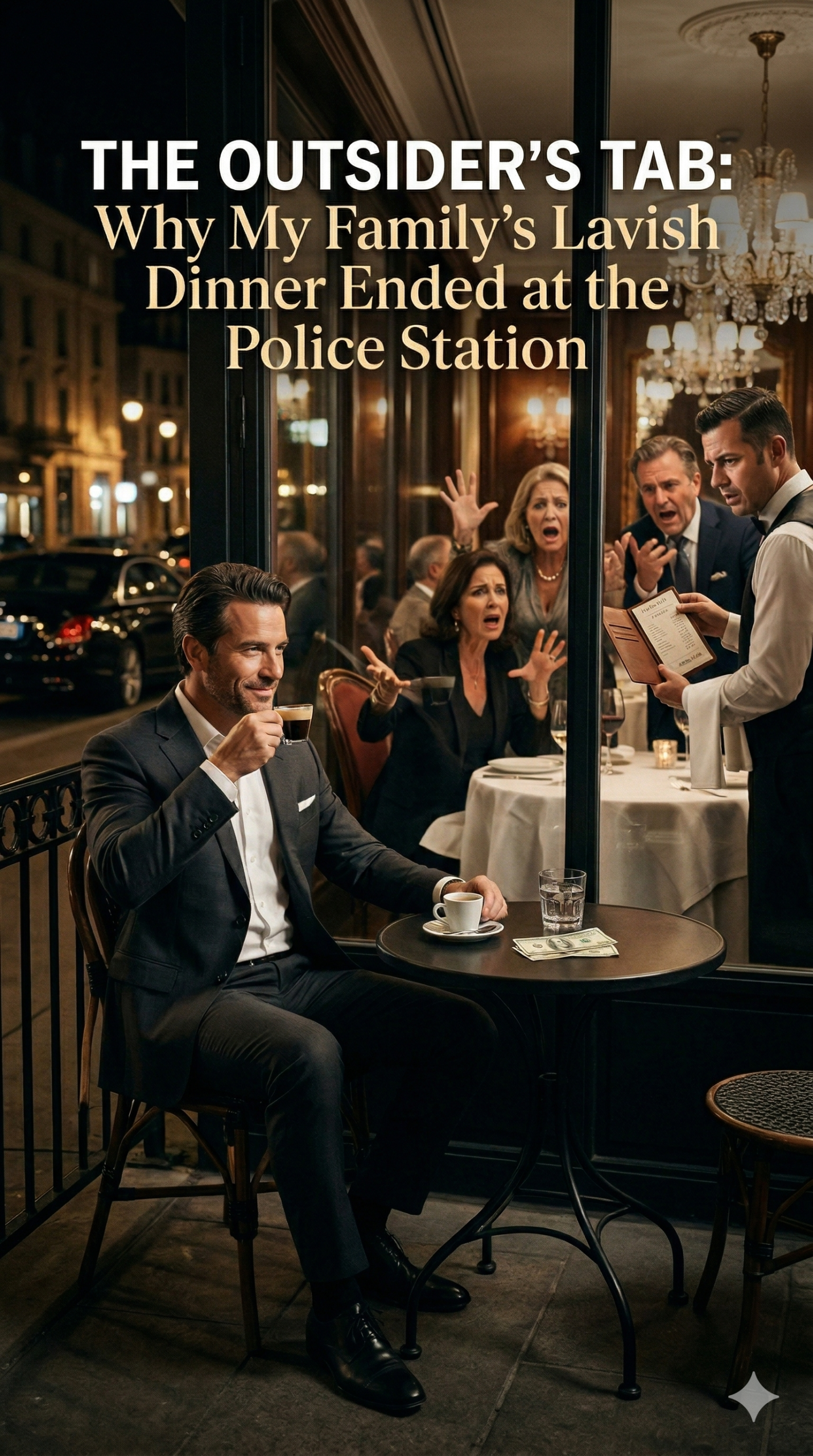
“Actually,” Julian’s wife chimed in, leaning over with a smirk, “this inner table is really just for the immediate family and the kids. Mark, there’s a lovely little bistro table outside on the terrace. You can find a spot there. We’ll send some appetizers out.”
The table went quiet for a heartbeat. Mark looked at his mother. She was busy admiring her new diamond earrings—a birthday gift from Mark. She didn’t look up. He looked at his brother, whose mortgage Mark had quietly caught up last month. His brother just adjusted his silk tie and ordered another round of cognac.
“You’re right,” Mark said, his voice as smooth as the marble floor. “I wouldn’t want to ruin the aesthetic.”
He stood up, took his coffee, and walked to the terrace.
The Two-Hour Wait
Outside, the air was crisp. Mark sat at the small iron table and watched them through the glass. He watched them order the seafood towers. He watched them toast to “family legacy.” He watched the waiter bring out the final, dreaded leather folder.
Mark didn’t leave. He waited.
He had already called the restaurant manager—a man whose daughter Mark had mentored in business school—ten minutes before they sat down.
Inside, the mood shifted. Julian opened the bill. His face went from a flushed, drunken red to a sickly, pale grey. $5,422.18.
The family looked toward the terrace. They waved Mark over, their faces now wearing frantic, sugary-sweet smiles. Julian beckoned him with a “come here” gesture, pointing at the check and laughing nervously.
Mark didn’t move. He just raised his coffee cup in a silent toast.
The Reality Check
Finally, Julian stumbled out to the terrace, the bill trembling in his hand.
“Hey, big guy! We’re all wrapped up. The waiter is being a bit pushy about the card. You want to come take care of this so we can get to the after-party?”
Mark took a slow sip of his coffee. “I thought this table was for family, Julian.”
“What? Oh, come on, that was just a joke—”
“I’m not family,” Mark interrupted, his voice dropping an octave. “I’m the ‘spot outside.’ And since I’m outside, I’m only responsible for what’s on this table.”
Mark reached into his pocket, pulled out a twenty-dollar bill, and tucked it under his coffee cup. “That covers my espresso and a very generous tip for the waiter who had to deal with you all night.”
“Mark, don’t be a child,” his mother said, appearing in the doorway, her voice sharp. “None of us brought our cards. We assumed—”
“You assumed wrong,” Mark said, standing up. “For ten years, you’ve mistaken my bank balance for my personality. Tonight, I decided to be exactly who you treated me as: a stranger.”
The Aftermath
The manager stepped onto the terrace. “Is there a problem, Mr. Vance?”
“No problem, David,” Mark said. “My bill is paid. These people, however, seem to have ordered quite a bit more than they can afford. I’ll leave you to handle the… technicalities.”
As Mark walked toward the valet, he heard the shouting start. He heard Julian trying to explain to the manager that “his cousin would pay.” He heard his mother crying about the embarrassment.
But as the valet pulled up in Mark’s car, he didn’t feel guilty. He felt light.
The $5,000 lesson was expensive, but for the first time in his life, Mark realized that the most valuable thing he owned wasn’t his money—it was his absence.