The attic smelled of cedar and stagnation. It was the smell of a life packed away in cardboard, waiting to be sorted by the survivors.
Julian sat on the floorboards, surrounded by the detritus of his mother’s eighty years. He had spent the last week organizing the funeral, writing the obituary, and smiling at strangers who told him how wonderful she was. He had played the part of the grieving son perfectly—just as he had played the part of the devoted son for forty years.
He picked up a box labeled “1980s.” Inside, nestled between tax returns and old greeting cards, was a stack of leather-bound journals.
Julian’s heart skipped a beat. His mother was a woman of few words. She was cold, efficient, and distant. He had spent his entire life trying to crack the code of her affection, trying to figure out what he was doing wrong. Maybe the answers were in here. Maybe, underneath the ice, there had been a current of warmth he just hadn’t felt.
He found the volume labeled 1985. The year he was born.
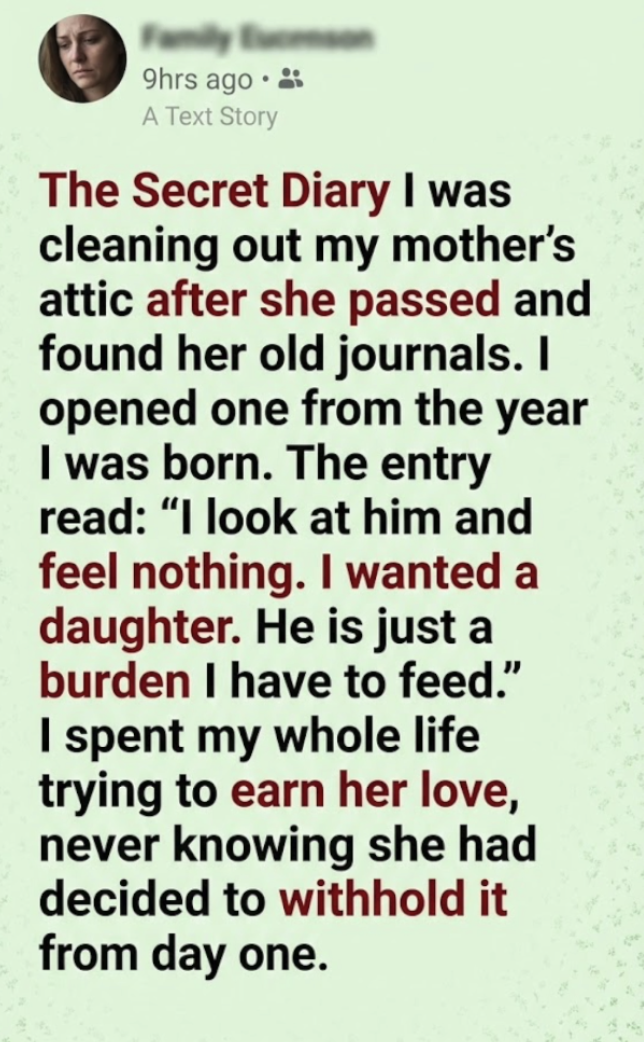
He opened it with trembling hands, flipping to October. I was cleaning out my mother’s attic after she passed and found her old journals, hoping for a legacy of love.
He found the entry dated October 14th, two days after his birth.
The handwriting was sharp and jagged. There was no joy in the loops of the letters.
“I look at him and feel nothing,” the entry began.
Julian stopped. The air in the attic seemed to drop ten degrees. He forced himself to read on.
“I wanted a daughter,” she had written. “He is just a burden I have to feed.”.
The book fell from his hands, landing with a dull thud on the floor.
Suddenly, his entire life flashed before his eyes, recontextualized by those three sentences.
He remembered being seven, bringing her a drawing he had worked on for hours, only to have her glance at it and say, “Put it in the bin, Julian, the table is for eating.” He remembered being sixteen, graduating Valedictorian, searching the crowd for her face, only to find her checking her watch. He remembered being thirty, buying her this house, hoping that finally, finally, she would look at him with pride. She had just complained about the stairs.
I spent my whole life trying to earn her love. He had thought the defect was in him. He thought if he was just smarter, richer, quieter, better, he could ignite the spark of motherly love.
But there was no spark to ignite. The wood had been wet from the start.
He sat there, weeping not for the mother he lost, but for the little boy who had spent forty years dancing for an audience that had walked out of the theater before the curtain even rose.
He realized he had been never knowing she had decided to withhold it from day one. It wasn’t his behavior. It wasn’t his failures. It was his existence. He was a “burden” simply because he wasn’t the daughter she had fantasized about.
Julian picked up the journal. He walked over to the trash bag he had filled with old newspapers and broken ornaments. He looked at the book one last time—the manifesto of his own unworthiness.
He dropped it into the bag.
He stood up and walked to the attic window, looking out at the world. For the first time in his life, the crushing weight of expectation was gone. He didn’t have to try anymore. He didn’t have to be “good enough.” He realized that he hadn’t failed her; she had failed him. And with that truth, he finally let her go.