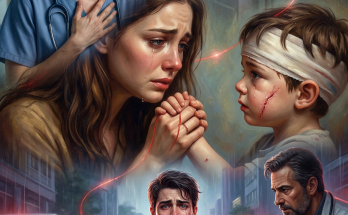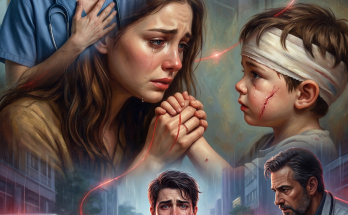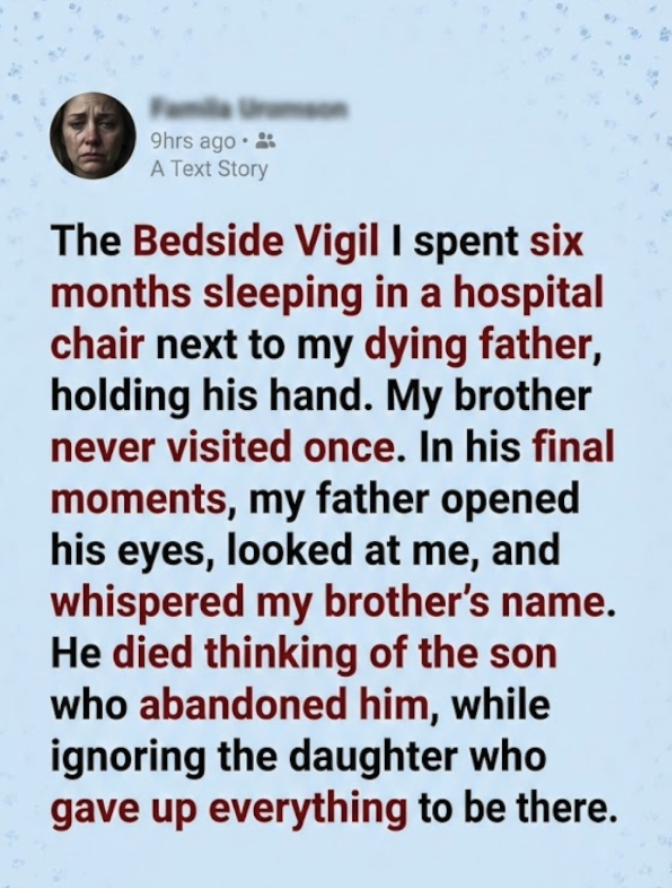
The chair in Room 304 was not designed for human sleep. It was a vinyl torture device that squeaked every time Clara shifted her weight. But for six months, I spent sleeping in a hospital chair next to my dying father.
I had become part of the room’s furniture. I knew which nurse came on shift at 7 PM. I knew exactly how many beeps the heart monitor made per minute. I had put my graphic design career on hold, let my apartment lease expire, and moved my entire existence into a tote bag so I could be the anchor my father needed.
“You’re a saint, Clara,” the nurses would whisper as I wiped his brow with a cool cloth or read him the morning paper, pretending he could still understand the headlines.
But saints are supposed to feel holy. I just felt tired. And angry.
My anger had a name: David.
David was my older brother. He was currently in Bali, or maybe it was Thailand—I couldn’t keep track of his Instagram stories. My brother never visited once. He sent a text once a week: “How’s the old man?” followed by a sun emoji. He treated our father’s slow, agonizing death like a minor inconvenience, a traffic jam he was lucky to avoid.
“He should be here,” I told my father one night, even though he was comatose. “It’s not fair that I’m doing this alone.”
My father didn’t answer. He just squeezed my hand. I took that squeeze as gratitude. I thought we were forging a bond in this twilight that David would never understand. I thought, finally, I was the favorite. I was the one who stayed.
The end came on a rainy Tuesday. The machines started to wail a different, more urgent tune. The doctor told me it was time.
I leaned over the bed, my tears falling onto his papery skin. “I’m here, Dad,” I sobbed, holding his hand. “I’m right here. I love you so much. You’re not alone.”
I waited for him to look at me. I waited for him to say, “Thank you, Clara.” I waited for the validation that would make the last six months of hell worth it.
Suddenly, his breathing hitched. In his final moments, my father opened his eyes. They were clear, focused, and filled with a desperate, searching longing.
He looked right at me. Through me.
“David?” he rasped.
My heart shattered louder than any machine in the room. He looked at me, and whispered my brother’s name.
He wasn’t looking for the daughter who had fed him ice chips and cleaned his bedpan. He was scanning the room for the golden boy who couldn’t be bothered to book a flight.
“David…” he sighed again, a look of profound disappointment settling over his face as he realized the prodigal son hadn’t returned.
And then, he was gone.
I stood there, frozen, my hand still gripping his cooling fingers. He died thinking of the son who abandoned him. His last thought wasn’t of the love present in the room; it was of the love absent from it.
I realized then, with a bitterness that tasted like bile, that presence doesn’t buy affection. Scarcity does. David was precious because he was rare. I was worthless because I was always there.
He died ignoring the daughter who gave up everything to be there.
I let go of his hand. I walked over to the window and looked out at the rain. I took out my phone and saw a notification: David had just posted a picture of a sunset.
I didn’t call him to tell him Dad was gone. Not yet. For a few more minutes, I just wanted to be alone in the room where I had been invisible for half a year.