I grew up in a house where love was distributed like rations during a war—and I was always the one left starving.
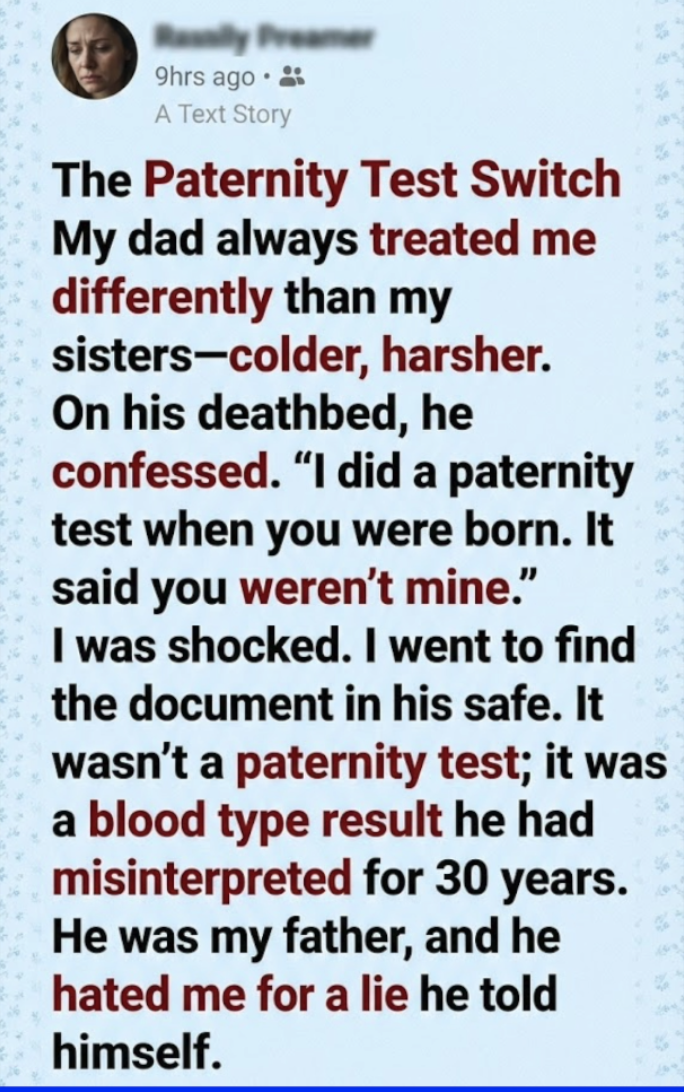
My sisters, Sarah and Emily, got the hugs. They got the bedtime stories. They got the pride in his eyes when they brought home a B-minus. I got the handshake. I got the lectures on “toughening up.” My dad always treated me differently than my sisters—colder, harsher.
“Why does he hate me?” I asked my mother once when I was twelve, after he had grounded me for laughing too loud at dinner.
“He doesn’t hate you, Leo,” she sighed, avoiding my eyes. “He’s just… hard on the boys. He wants you to be a man.”
But I knew it was a lie. It wasn’t discipline; it was disdain. I spent thirty years trying to bridge the gap. I became a lawyer because he respected the law. I learned to fix cars because he loved mechanics. I did everything to earn a nod, a smile, a scrap of validation. I got nothing but a cold, suspicious stare, as if he were waiting for me to steal the silverware.
Then came the cancer. It was swift and brutal.
I stood by his bedside in the hospice wing, the smell of antiseptic choking me. My sisters were weeping, holding his hands. He looked at them with adoration. Then, he turned his gaze to me. The warmth evaporated.
“Leave us,” he croaked to the girls. “I need to speak to Leo.”
My heart hammered. Was this it? The moment of redemption? The “I love you” I had waited three decades to hear?
He waited until the door clicked shut. He beckoned me closer.
“I have to say this before I go,” he whispered, his breath rattling. “I know.”
“Know what, Dad?”
“I know you aren’t my son.”
The room spun. “What?”
“On his deathbed, he confessed,” his voice gaining a sudden, cruel strength. “‘I did a paternity test when you were born. It said you weren’t mine.’“.
He looked at me with a mixture of vindication and pity. “I raised you anyway. I put a roof over your head. But I couldn’t… I couldn’t love another man’s mistake. It’s in the safe. The proof.”
He died an hour later.
I didn’t cry. I couldn’t. I was too busy reeling from the realization that my entire life had been a charity case. I wasn’t his son. My mother had lied. I was a stranger he had tolerated.
After the funeral, while my sisters were sorting through photos, I went to find the document in his safe. My hands shook as I dialed the combination. Inside, tucked into a velvet pouch, was a folded piece of yellowed paper from 1994.
I unfolded it, expecting to see a DNA analysis, a lab report, something definitive.
Instead, I saw a handwritten note from a family clinic and a standard blood type card.
Patient: Leo Miller. Blood Type: B Positive. Father: Arthur Miller. Blood Type: A Positive. Mother: Janice Miller. Blood Type: AB Positive.
I stared at it. I read it again.
I had taken basic biology in high school. I pulled out my phone just to be sure, typing the combinations into a medical calculator. Parent A (Type A) + Parent B (Type AB).
The results popped up: Possible Child Blood Types: A, B, or AB.
I fell to my knees on the study floor, a guttural sound ripping from my throat.
It wasn’t a paternity test; it was a blood type result he had misinterpreted for 30 years.
He had seen “Type B” and assumed that because he was “Type A,” it was impossible. He hadn’t asked a doctor. He hadn’t asked my mother. He had let his insecurity and his ignorance curdle into a secret hatred that lasted a lifetime.
He was my father, and he hated me for a lie he told himself.
I looked at the empty chair where he used to sit, ignoring me. I wasn’t the bastard he thought I was. I was his son, his flesh and blood, rejected not because of sin, but because he didn’t understand how a Punnett square worked. He had thrown away thirty years of love over a typo in his own understanding.
I crumpled the paper in my fist. I was his son, alright. And now, I was the only one left to carry the burden of his stupidity.