Twenty Years Later
The world outside St. Jude’s was in chaos. A massive pile-up on the interstate had flooded the ER, and the air was thick with the scent of rain and ozone. I was standing near the ambulance bay, directing the triage teams, when I saw him.
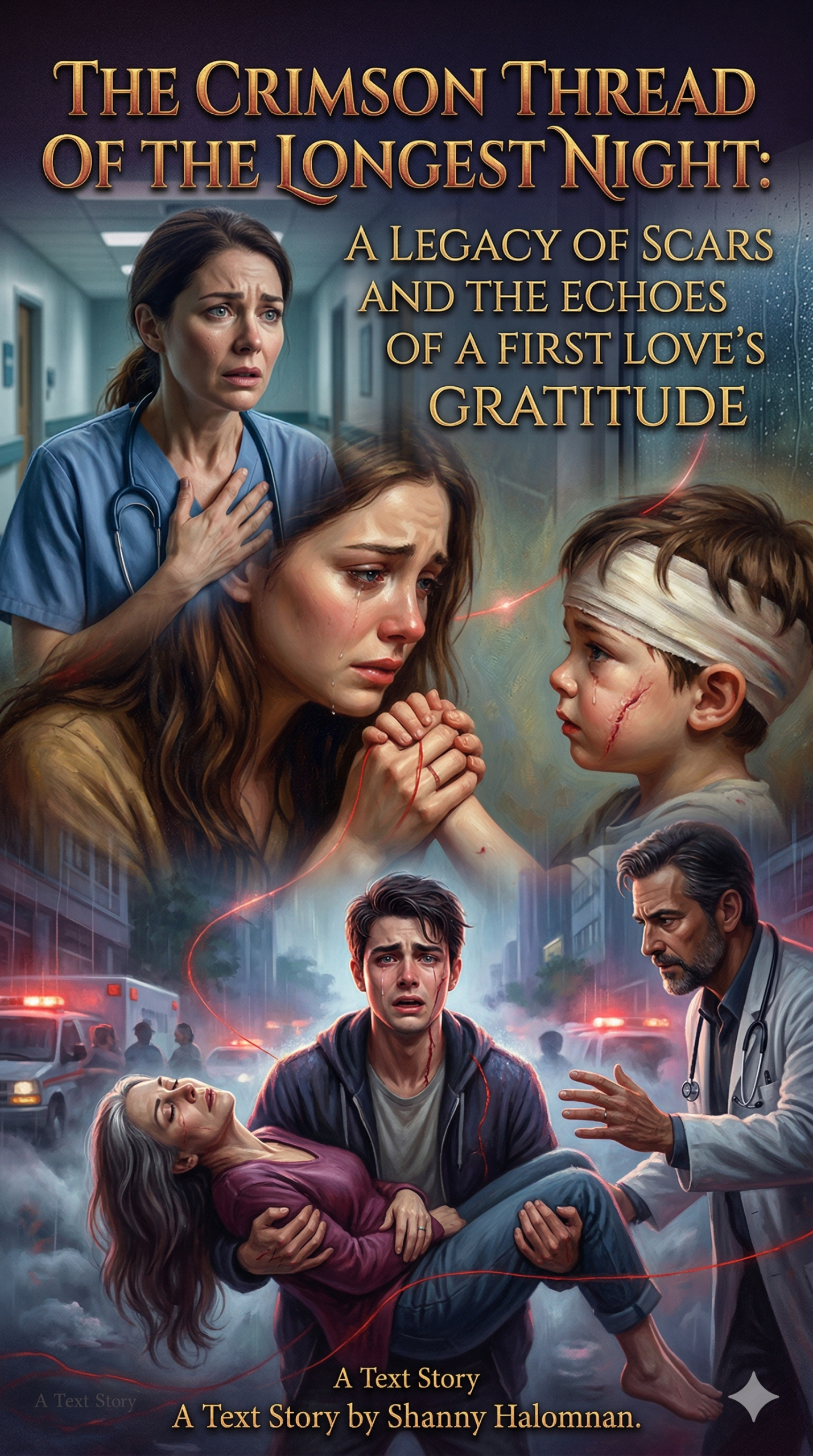
A young man, mid-twenties, was sprinting toward the entrance. He wasn’t a patient; he was a force of nature, weaving through the gurneys with desperate speed. As he skidded to a halt in front of me, the emergency lights caught his face.
A thin, jagged scar ran from his temple down to his jawline. The scarlet line I had stitched two decades ago.
“Help her!” he gasped, his voice cracking. “Please, you have to help her!”
He wasn’t alone. In his arms, he carried a woman. Her head was lolling back, her breathing shallow and ragged. As I reached out to check her pulse, the woman’s eyes fluttered open for a fleeting second.
It was Emily.
The Full Circle
The boy I had saved was now the man trying to save the woman who had given him life. The irony wasn’t lost on me as we rushed her into Trauma Room 4.
“I remember you,” the young man whispered as the doors began to swing shut. “My mother always told me… if I was ever lost, to find the man who gave me my scar. She said you were the only one who could fix anything.”
For the next four hours, the years stripped away. I wasn’t the Chief of Surgery; I was that terrified resident again, fighting against the clock. But this time, I wasn’t just saving a patient—I was protecting the legacy of that “lucky coin” of gratitude I’d carried for twenty years.
When the sun began to peek over the city skyline, I stepped out into the waiting room. The young man stood up instantly, his eyes searching mine. I walked over and placed a hand on his shoulder, feeling the sturdy muscle of the man he had become.
“She’s stable,” I said, the words tasting like a miracle. “She’s going to live.”
He collapsed into the plastic chair, burying his face in his hands, his shoulders shaking with relief. I looked down at my own hands—older now, lined with the history of a thousand surgeries—and realized that some debts aren’t paid in money. They are paid in the quiet, thrumming rhythm of a heart that refuses to stop beating.