The Long Story: Not Wedding Material
Daniel was the family’s “Quiet Provider.” When his sister, Chloe, wanted a destination bachelorette party, Daniel was the one who “lent” her the money she never intended to repay. When his parents wanted to upgrade their kitchen to keep up with the neighbors, they called Daniel. But when it came to the actual celebrations—the photos, the toasts, the front-row seats—Daniel was always tucked away in the back, if he was invited at all.
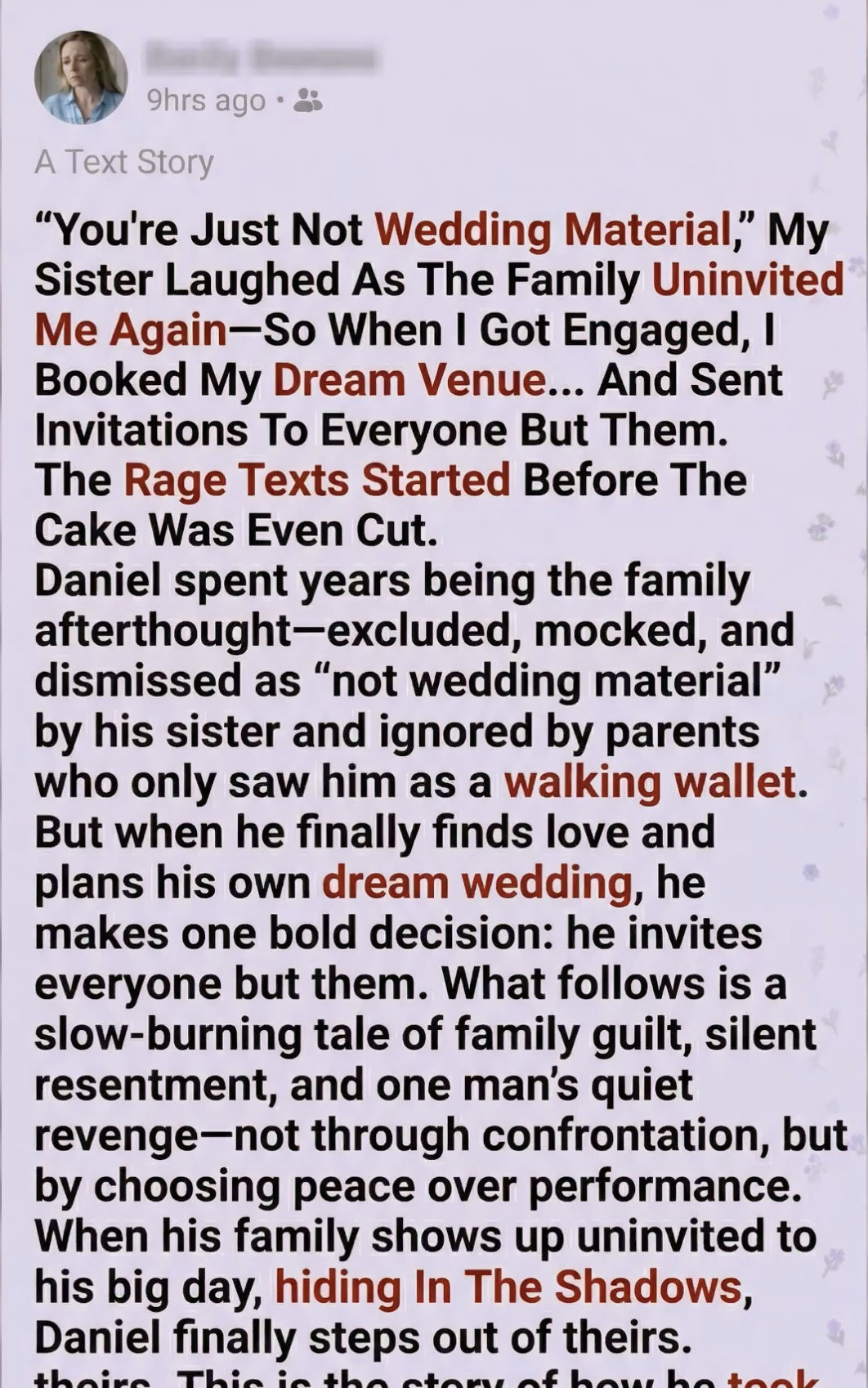
The breaking point came at Chloe’s second wedding. During a family dinner, she’d smirked over her wine glass and said, “We’re keeping the guest list tight, Dan. You’re just… not wedding material. You’re a bit of a buzzkill for the ‘aesthetic’ we’re going for. You don’t mind, right?”
His parents hadn’t defended him. They’d just asked if his check for the floral arrangements had cleared.
The Invitation List
Two years later, Daniel met Sarah. She didn’t want his money; she wanted his time. When they got engaged, Daniel decided the “Quiet Provider” was dead.
He booked an estate in the mountains—the kind of place Chloe had always dreamed of but could never afford. He sent out three hundred invitations. He invited his old high school teachers, his neighbors, and every aunt and uncle who had ever shown him a shred of kindness.
He did not send a single invitation to his parents or Chloe.
The “Rage Texts” started three weeks before the wedding. Chloe had seen a cousin’s post of the gold-embossed invitation.
-
Chloe: “A wedding at The Crest? How dare you! I’m your sister! Where is my invite?”
-
Mom: “Daniel, stop this childishness. People are asking why we aren’t in the wedding party. You’re embarrassing us.”
-
Dad: “I expect an apology and a seat at the head table. We raised you.”
Daniel didn’t reply. He blocked their numbers and hired a private security team for the venue.
Hiding in the Shadows
The wedding day was perfect. There were no “aesthetic” requirements, no demands for money, and no one calling him a buzzkill. But as Daniel stood at the altar, he saw movement near the tree line of the estate.
Through the late afternoon mist, he saw them. His mother in a frantic floral dress, Chloe in a white gown that looked suspiciously like a wedding dress itself, and his father, all lurking near the gate, arguing with the security guards. They were literally hiding in the shadows of the trees, trying to catch a glimpse of the life Daniel had built without them.
In previous years, Daniel would have felt guilty. He would have run down, apologized, and paid for their dinner just to stop the scene.
Instead, Daniel looked at Sarah, smiled, and kissed his bride. He didn’t look toward the gate again. He didn’t need to. He had spent his whole life trying to get into their pictures, only to realize he was the one holding the camera and the checkbook the whole time.
As the reception began and the music swelled, the “walking wallet” finally closed for good. Daniel wasn’t wedding material—he was the main event.