The silence in the family group chat was the loudest thing Elias had ever heard. For days, it had been humming with dress fittings and catering menus for his sister Sarah’s engagement party. Then, on Saturday night, it went dead.
Elias spent that evening at home, scrolling through Instagram until the first photo popped up. There was Sarah, radiant in champagne silk, surrounded by their mother, their cousins, and even the “black sheep” Uncle Marc. Everyone was there. Except him.
When he called his mother the next morning, he didn’t even get a “hello.”
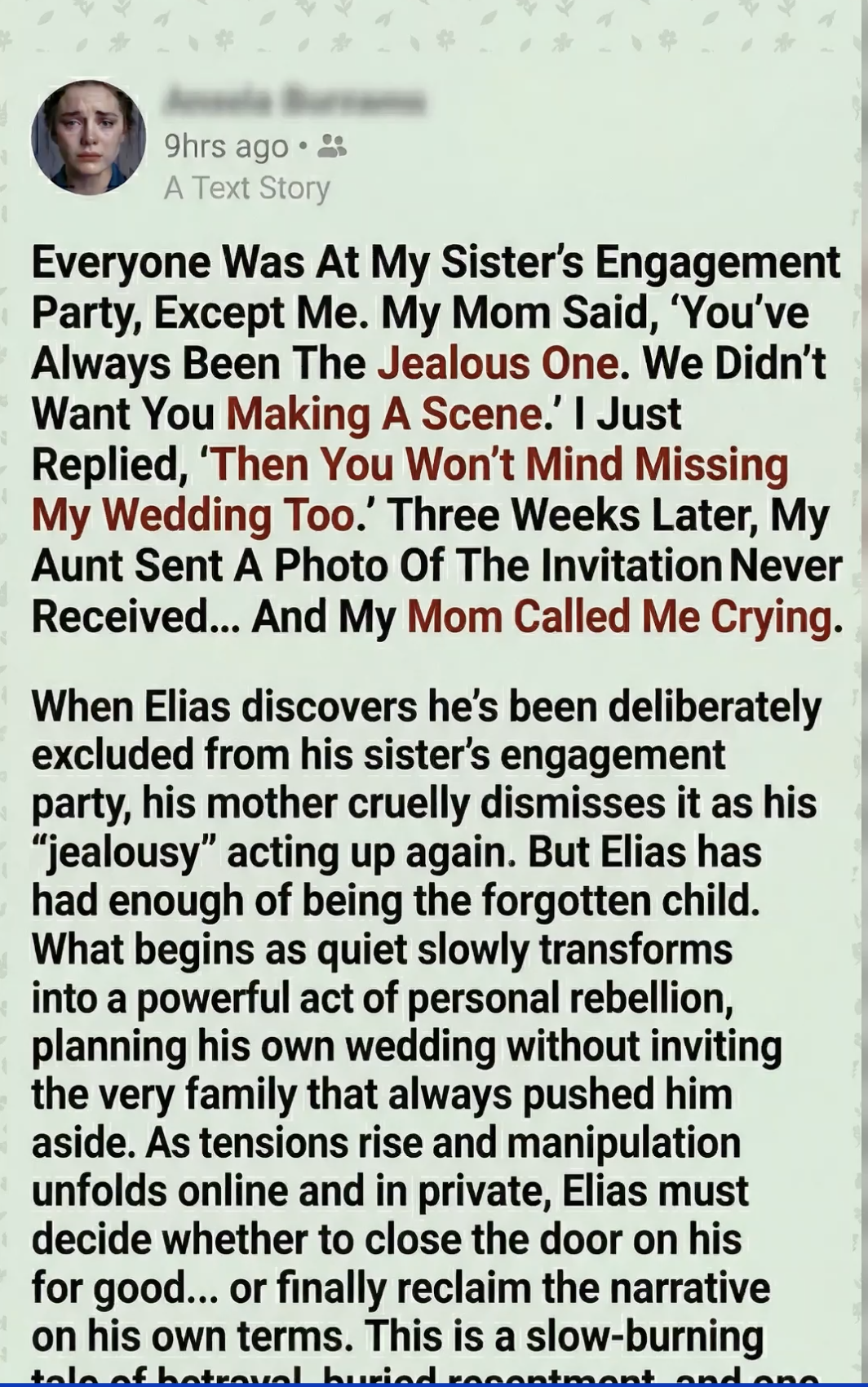
“Elias, don’t start,” she sighed. “It was a high-stress event. You’ve always been the jealous one, and we just didn’t want you making a scene and ruining your sister’s night.”
The word jealous hit him like a physical blow. He wasn’t jealous; he was invisible. He was the son who stayed behind to help her move while Sarah traveled; the one who paid for the car repairs she couldn’t afford.
“I see,” Elias said, his voice terrifyingly calm. “Then I suppose you won’t mind missing my wedding, too.”
“Don’t be dramatic,” she scoffed. “You aren’t even engaged.”
“I am now,” he lied.
The Cold War
For the next three weeks, Elias went “ghost.” He blocked his mother and sister on all social media. He didn’t answer texts. Instead, he channeled his resentment into a singular, meticulously crafted project.
He reached out to his Aunt June—the only person in the family who saw the dynamic for what it was. Together, they began “planning.” Elias didn’t just want a wedding; he wanted a statement.
The turning point came when Aunt June sent him a grainy photo. It was a stack of ivory envelopes sitting on his mother’s sideboard. She zoomed in on the top one. It was an invitation to Sarah’s engagement party, addressed to Elias.
His mother hadn’t just forgotten to invite him. She had intercepted his mail to ensure he stayed away.
The Invitation
Elias didn’t scream. He didn’t call. Instead, he launched his counter-strike. He created a beautiful, password-protected wedding website and sent physical “Save the Dates” to everyone—the cousins, the family friends, and his mother’s social circle.
The catch? His mother and Sarah were the only ones who didn’t receive one.
When the calls finally started coming in to his mother—friends asking about “Elias’s gorgeous destination wedding”—the facade crumbled. She realized he wasn’t just sulking; he was erasing her from his life.
She called him, sobbing into the receiver. “Elias, how could you? Your own mother? People are asking why I’m not on the guest list! You’re making me look like a monster!”
“I’m not making you look like anything,” Elias replied. “I’m just following your lead. You didn’t want a ‘scene’ at your party, and I don’t want a ‘jealous’ person at mine. I’m reclaiming the narrative, Mom. For the first time, the story isn’t about how I failed the family. It’s about how the family failed me.”
Reclaiming the Reality
Elias didn’t actually rush a marriage. He used the “wedding fund” he’d been building to take a solo trip across Europe, posting updates that Aunt June shared with the family.
The “Anthology of Reclaimed Reality” wasn’t just a title he gave his photo albums; it was his new life. He realized that the only way to win a game where the rules are rigged against you is to stop playing.
He didn’t need an apology that would never come. He just needed the door to be closed, and for the first time, he was the one holding the key.