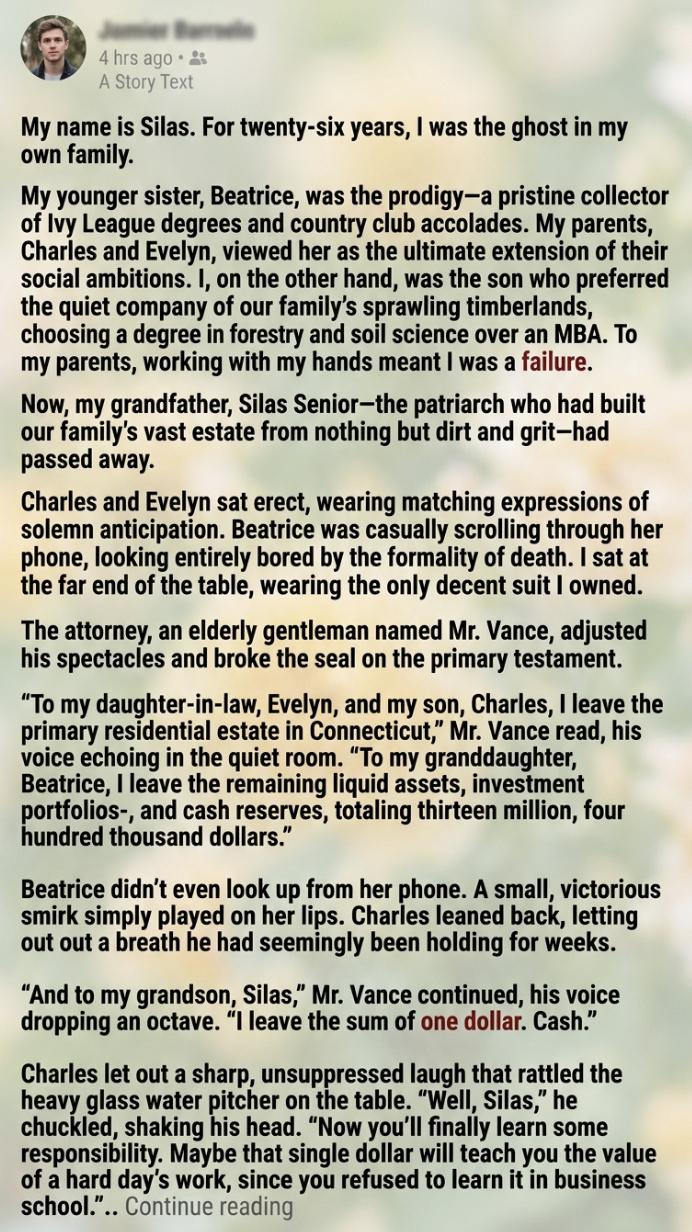
My name is Silas. For twenty-six years, I was the ghost in my own family.
My younger sister, Beatrice, was the family prodigy. She collected Ivy League degrees, country club invitations, and professional awards like trophies. My parents, Charles and Evelyn, treated her as the greatest achievement of their lives.
I was different.
While Beatrice studied business and finance, I spent my childhood exploring our family’s enormous timberlands with my grandfather. I loved the smell of wet soil, the sound of wind moving through pine trees, and the quiet satisfaction of watching something grow.
I eventually earned a degree in forestry and soil science.
To my parents, that was a disappointment.
“Your sister is building a future,” my father once told me. “You’re playing in the dirt.”
I stopped trying to convince them otherwise.
My grandfather, Silas Senior, was the only person who never made me feel small. He had built the family estate from almost nothing, starting with a few acres of timberland and expanding through decades of hard work.
He understood something my parents never did.
Land wasn’t just property. It was something you had to understand, protect, and care for.
When he died, our family gathered in the attorney’s office for the reading of his will.
My parents sat upright, dressed in black, wearing matching expressions of solemn anticipation.
Beatrice scrolled through her phone, looking bored.
I sat at the far end of the table in the only decent suit I owned.
The attorney, an elderly gentleman named Mr. Vance, adjusted his spectacles and opened the document.
“To my daughter-in-law, Evelyn, and my son, Charles, I leave the primary residential estate in Connecticut.”
My mother nodded.
“To my granddaughter, Beatrice, I leave the remaining liquid assets, investment portfolios, and cash reserves, totaling thirteen million, four hundred thousand dollars.”
Beatrice finally looked up. A small smile appeared on her face.
My father leaned back in his chair, visibly relieved.
“And to my grandson, Silas,” Mr. Vance continued, lowering his voice, “I leave the sum of one dollar. Cash.”
My father burst out laughing.
“Well, Silas,” he said, shaking his head, “maybe that dollar will finally teach you the value of a hard day’s work. You should have listened to us instead of wasting your life studying trees.”
Beatrice smirked.
I looked down at the table.
I wasn’t surprised. My grandfather had always told me that appearances could be deceiving, and I had learned not to judge the value of something by its first impression.
Mr. Vance, however, wasn’t finished.
He carefully turned another page.
“There is one additional provision,” he said. “The distribution of the remaining assets does not conclude the administration of this estate.”
My father frowned.
“What does that mean?”
Mr. Vance removed a second document from his briefcase.
“Your father established a separate land-management trust several years ago. Its terms are contained in this document, which must be read alongside the primary will.”
He looked directly at me.
“Silas, your grandfather appointed you as the sole successor trustee, subject to the responsibilities and conditions outlined here.”
My father’s smile disappeared.
Beatrice put her phone down.
Mr. Vance continued.
“The trust controls approximately 18,000 acres of timberland, conservation property, and agricultural land. It also holds the operating interests in several forestry partnerships.”
My father sat forward.
“That’s impossible. Those properties belong to the family.”
“They belong to the trust,” Mr. Vance corrected. “And the trust has its own governing documents.”
Beatrice looked confused.
“How much is it worth?”
Mr. Vance glanced at his notes.
“Based on the latest independent valuation, the land and associated business interests are estimated at approximately $42 million.”
The room went completely silent.
My father turned toward me.
“Why would he give you control of all that?”
Mr. Vance answered before I could.
“Because Silas was the only family member who consistently demonstrated an understanding of the land, its long-term value, and the responsibilities involved in managing it.”
He opened another page.
For years, my grandfather had watched me work with forestry experts, study soil conditions, manage erosion, and develop sustainable harvesting plans. While my family dismissed my education, he had been quietly asking for my advice.
He had also watched me refuse to sell several valuable parcels when developers offered enormous sums.
I had believed I was simply protecting the land.
My grandfather had seen something more.
He had seen someone willing to protect what he had spent his life building.
My father stood abruptly.
“This is ridiculous. Silas doesn’t have the experience to manage a fortune like that.”
Mr. Vance remained calm.
“The trust includes professional accountants, forestry managers, and legal advisers. Silas’s responsibility is to oversee the trust according to its terms, not to manage every operation personally.”
Then he handed me a sealed letter.
It was written in my grandfather’s familiar handwriting.
I opened it carefully.
My dear Silas,
They will probably laugh when they hear you received one dollar. Let them.
I did not leave you the land because you needed to become rich. I left you the responsibility because you already understood its value.
Your father sees money in every acre. Your sister sees an investment opportunity. You see something that takes generations to grow.
Never forget that the greatest inheritance is not what you own. It is what you choose to protect.
With love, Grandpa.
I read the letter twice.
My eyes filled with tears.
For twenty-six years, I had wondered why my grandfather was the only person in the family who seemed to understand me.
Now I finally knew.
My father demanded that the meeting be postponed. Beatrice wanted another review of the trust. My mother asked whether there was a way to divide the timberland among the family.
Mr. Vance explained that the trust had to be administered according to its legal terms. No one could simply divide or sell its assets because they disliked the arrangement.
I didn’t celebrate.
I didn’t insult my father or remind Beatrice that she had laughed at me.
I simply picked up the dollar from the table.
Then I placed it inside my wallet.
That afternoon, I drove out to the timberlands.
The trees were still standing. The streams still ran through the lower valley. The old dirt road still led to the cabin where Grandpa had taught me how to recognize healthy soil.
I stood there for a long time.
My family had spent years measuring success by degrees, bank accounts, and invitations.
My grandfather had measured it differently.
He had given my sister $13.4 million in liquid assets.
He had left me one dollar and a responsibility worth far more than money.
And for the first time in my life, I didn’t feel like the forgotten son.
I felt like the person my grandfather had trusted me to become.