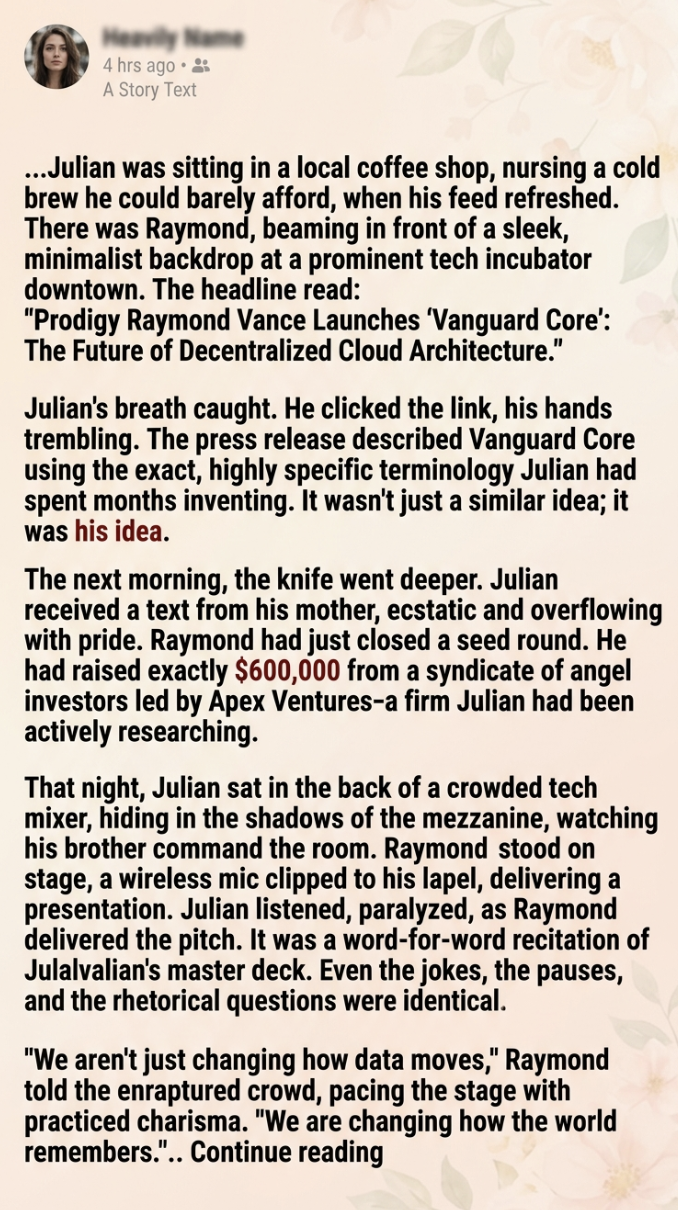
Julian was sitting in a local coffee shop, nursing a cold brew he could barely afford, when his social media feed refreshed.
There was his younger brother, Raymond, smiling confidently in front of a sleek backdrop at a prominent technology incubator downtown.
The headline read:
“Prodigy Raymond Vance Launches Vanguard Core: The Future of Decentralized Cloud Architecture.”
Julian’s breath caught.
He clicked the article.
His hands began trembling as he read the press release.
The technical descriptions were familiar. The terminology was familiar. Even the central architecture was described using the exact phrases Julian had spent months developing.
This wasn’t a similar idea.
It was his idea.
For nearly a year, Julian had worked on a decentralized cloud architecture designed to make data storage more secure, efficient, and resistant to centralized failures.
He had filled notebooks with diagrams, written technical specifications, and spent countless nights refining his master presentation.
He had shared early drafts with Raymond because he believed his younger brother genuinely wanted to help.
Apparently, Raymond had wanted something else.
The next morning, the betrayal became even more painful.
Julian received a message from his mother.
Your brother just closed his first seed round! $600,000! We’re so proud of him. You should call and congratulate him.
The investment had come from a syndicate of angel investors led by Apex Ventures, a firm Julian had been researching for months.
His mother attached a photograph of Raymond holding a ceremonial oversized check.
Julian stared at it.
His own savings account contained barely enough to cover another month’s rent.
His brother was celebrating with $600,000 raised using the work Julian had created.
That night, Julian attended a technology mixer downtown.
He didn’t tell anyone he was coming.
He stood near the back of the mezzanine, watching the crowd gather around the stage.
Raymond walked out wearing an expensive suit, a wireless microphone clipped to his lapel.
He looked completely at ease.
“Ladies and gentlemen,” he began, “we aren’t just changing how data moves. We are changing how the world remembers.”
Julian froze.
That was his sentence.
The exact sentence he had written in his master deck.
Then Raymond continued.
The jokes were identical.
The pauses were identical.
Even the rhetorical questions Julian had carefully placed throughout the presentation appeared in precisely the same order.
Julian felt sick.
But he didn’t storm the stage.
He didn’t shout accusations.
Instead, he pulled out his phone and began recording.
He captured the entire presentation.
When Raymond finished, the room erupted in applause.
Investors approached him. Photographers gathered around him. His mother posted another photograph with the caption:
Our brilliant Raymond is changing the future!
Julian went home and opened his laptop.
He had saved everything.
The original technical drafts.
The dated presentation files.
The emails in which he had sent Raymond early versions.
The development notes.
The version history.
And one message from Raymond, sent eight months earlier:
Bro, this architecture is incredible. Send me the full deck. I want to help you get it in front of the right people.
Julian read it several times.
Then he contacted an intellectual-property attorney.
The attorney listened carefully and explained that an idea alone was not automatically protected. The specific materials, software code, confidential information, contractual obligations, and evidence of unauthorized use would all need to be examined.
Julian provided every document he had.
A technical specialist reviewed the two presentations and identified extensive similarities, including unusual terminology, identical diagrams, and matching technical descriptions.
The attorney prepared a formal notice requesting preservation of relevant records and an explanation of how Raymond had obtained the materials.
Julian also contacted Apex Ventures through its official legal channel.
He didn’t demand money.
He simply provided evidence and asked the firm to investigate the origin of the materials used in its investment presentation.
Three days later, Raymond called.
“What the hell are you doing?” he shouted.
Julian remained calm.
“I’m asking people to examine the work.”
“You’re trying to destroy my company!”
“No, Raymond. I’m trying to establish who created it.”
Raymond laughed nervously.
“It’s a shared concept. We talked about this together.”
“Talking about an idea isn’t the same as copying my entire presentation.”
“You gave me the files!”
“I gave you early drafts because I trusted you.”
There was a long silence.
Then Raymond said something Julian would never forget.
“Mom and Dad think I’m the one who can actually make this happen. Why can’t you just let me have this?”
Julian closed his eyes.
“Because I made it.”
The following weeks were difficult.
Apex Ventures paused further investment discussions while its legal team reviewed the documentation. Raymond’s company was asked to provide additional records explaining its development history.
Julian didn’t receive an immediate victory or a sudden fortune.
Instead, he spent months working with his attorney to establish what had happened and protect his original work.
Eventually, the evidence led to a negotiated resolution. Raymond acknowledged that he had used Julian’s confidential development materials without permission. The parties reached a confidential settlement that addressed ownership of specific materials and required corrections to the company’s public claims.
Raymond’s public image suffered.
The investment group reassessed its involvement, and the company’s leadership was forced to reconsider its launch plans.
Julian, meanwhile, returned to his own work.
He rebuilt the project with proper legal protections, independent development records, and a team that understood the value of trust.
His parents called several times.
His mother wanted everyone to sit down and “put this unfortunate misunderstanding behind them.”
His father suggested that the brothers should share the opportunity.
Julian refused.
For years, he had believed that family meant giving people unlimited access to your dreams.
Now he understood that trust was something people had to earn.
One evening, he opened the original presentation.
The final slide still contained the sentence Raymond had delivered on stage.
We aren’t just changing how data moves. We are changing how the world remembers.
Julian smiled faintly.
His brother had borrowed his words.
But he couldn’t take away the years of knowledge, effort, and determination behind them.
And Julian was finally ready to build something that belonged entirely to him.