The reunion was supposed to be about family.
Instead, it became the day my entire family discovered how badly they had been wrong about me.
The lakeside property was already crowded when I arrived.
Aunts sat beneath the old oak trees.
Uncles stood around the grill.
Cousins laughed near the water while children ran across the lawn.
It was the kind of family gathering where everyone knew everyone else’s business.
And unfortunately, my family had always known mine.
They knew about my failures.
They knew about the business that collapsed.
They knew about the apartment I had been forced to leave.
They knew about the years when I struggled just to keep food on the table.
What they didn’t know was what happened after I disappeared.
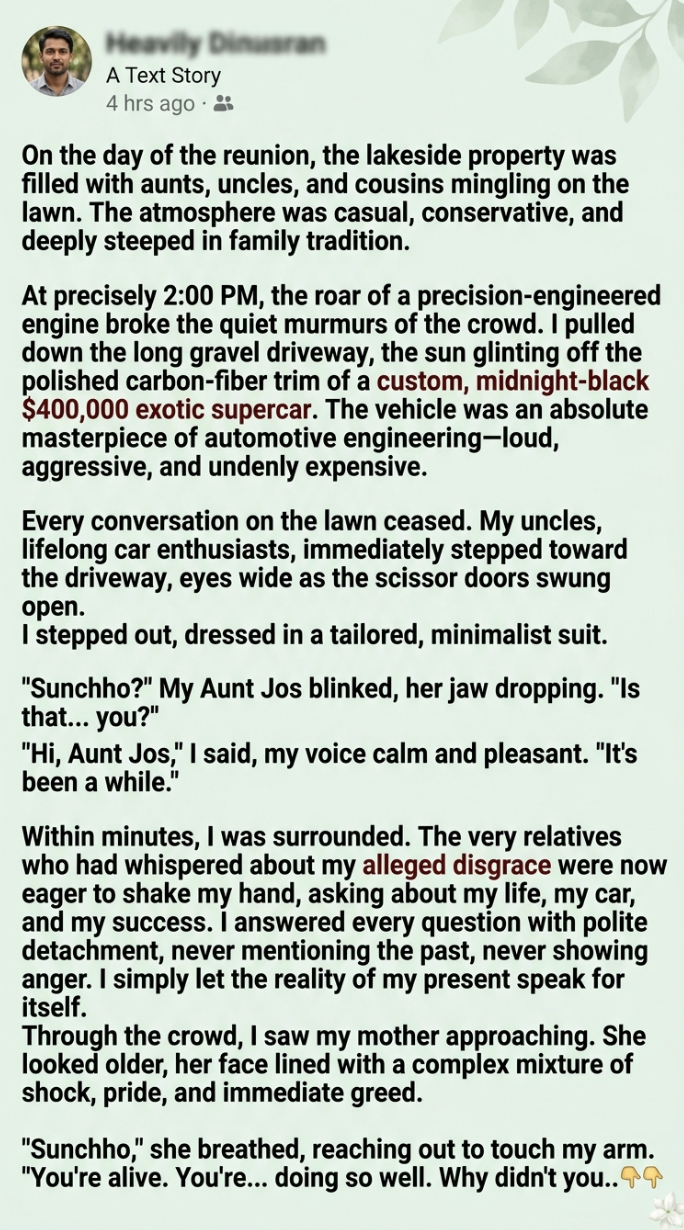
At exactly 2:00 PM, the sound of an engine rolled across the property.
It was deep enough to make conversations stop.
People turned toward the long gravel driveway.
Then a midnight-black exotic supercar came around the bend.
The sunlight flashed across its carbon-fiber body.
The car was worth nearly $400,000.
My uncle, who had spent his entire life talking about automobiles, nearly dropped his drink.
“That’s not a rental,” he whispered.
The car stopped.
The scissor doors slowly rose.
And I stepped out.
I was wearing a simple, perfectly tailored suit.
No flashy jewelry.
No designer logos.
No attempt to prove anything.
For several seconds, nobody recognized me.
Then Aunt Jos stared at me.
Her eyes widened.
“Sunchho?”
I smiled.
“Hi, Aunt Jos.”
She covered her mouth.
“Oh my goodness.”
Within seconds, people were coming toward me.
The same relatives who had once whispered that I was a failure were suddenly smiling.
Shaking my hand.
Patting my shoulder.
Asking where I lived.
Asking what I did.
Asking how much the car cost.
One uncle even laughed and said,
“We always knew you’d do something big.”
I almost laughed.
Because I remembered exactly what they had said when I was struggling.
They hadn’t always known.
They had barely believed in me at all.
But I didn’t embarrass them.
I didn’t remind them.
I didn’t tell them how many nights I’d cried alone.
I simply answered their questions politely.
Because sometimes the most powerful response isn’t an argument.
It’s the life you built after everyone stopped believing in you.
Then I saw my mother.
She was standing near the house.
For a moment, she didn’t move.
She looked older.
Much older.
Her hair had turned gray at the temples, and there were lines around her eyes that hadn’t been there the last time I’d seen her.
Then she started walking toward me.
“Sunchho…”
Her voice trembled.
“You’re alive.”
I looked at her.
“Yes, Mom.”
She reached for my arm.
“You’re doing so well.”
Her eyes moved toward the car.
Then toward the crowd.
Then back to me.
“Why didn’t you tell us?”
That question hurt more than I expected.
Not because I didn’t have an answer.
Because I had waited years for her to ask it.
I looked at her and said quietly,
“Because you never asked.”
Her face fell.
“I was worried about you.”
I swallowed.
“Were you?”
She started crying.
And suddenly, I wasn’t looking at the woman who had rejected me.
I was looking at my mother.
The woman I had once desperately wanted to make proud.
The woman whose approval I had spent half my life chasing.
For a moment, I wanted to hug her.
Then I remembered all the birthdays she had forgotten.
All the phone calls she hadn’t returned.
All the times she had believed someone else’s version of me without asking me what had really happened.
So I stood there.
Neither of us moved.
Then she whispered,
“We heard so many things.”
“I know.”
“They said you lost everything.”
“I did.”
“They said you were struggling.”
“I was.”
She looked at the car again.
“So how did you…”
I smiled sadly.
“I started over.”
That was all I said.
But the questions didn’t stop.
By sunset, relatives were asking about my business.
By dinner, they were asking whether I needed partners.
One cousin suddenly remembered that we had “always been close.”
Another asked whether I could help her son find a job.
Then my uncle pulled me aside.
“Your mother tells me the family has been having some financial problems.”
I looked across the lawn.
My mother was watching us.
And suddenly everything made sense.
They weren’t simply happy to see me.
They were interested in what I could do for them.
That realization hurt.
I had spent years imagining that one day my family would finally be proud of me.
I never imagined that their pride would arrive carrying a price tag.
That night, my mother approached me again.
“Can we talk?”
We walked toward the lake.
For several seconds, neither of us spoke.
Then she said,
“Your father wants to make things right.”
I looked at her.
“Does he?”
“He misses you.”
I smiled sadly.
“Does he miss me?”
She hesitated.
Or perhaps she simply didn’t know how to answer.
Then I asked the question I had carried for years.
“Mom, if I had arrived here tonight in an old car instead of that one, would you still have walked over to me?”
She started crying.
She didn’t answer.
And somehow, that silence answered everything.
I looked out across the lake.
The water was calm.
The sunset was beautiful.
And for the first time, I realized I didn’t need their approval anymore.
I had spent years trying to prove I wasn’t a failure.
But standing there, I finally understood something.
I wasn’t successful because I had a $400,000 car.
I wasn’t successful because I had money.
I wasn’t successful because my relatives suddenly wanted to know me.
I was successful because I had survived the years when nobody believed I would.
I turned to my mother.
“I forgive you.”
She looked at me through her tears.
“Does that mean you’ll come home?”
I shook my head gently.
“No.”
Her expression broke.
“I can forgive you without pretending nothing happened.”
She nodded slowly.
Then she reached for my hand.
This time, I let her hold it.
We stood there quietly for several minutes.
No money was discussed.
No business.
No favors.
Just a mother and son standing beside a lake, grieving the years they could never get back.
When I finally walked toward my car, my mother called after me.
“Sunchho?”
I turned.
She smiled through her tears.
“I’m proud of you.”
I stood there for a moment.
Those four words were something I’d wanted to hear since I was a child.
And strangely, they didn’t have the power over me anymore.
I smiled.
“Thank you, Mom.”
Then I got into the car and drove away.
As the gates disappeared behind me, I realized the reunion hadn’t given me what I thought I wanted.
It had given me something better.
Closure.
Because sometimes success isn’t about making the people who hurt you regret losing you.
Sometimes success is reaching the point where their regret no longer matters.