Three years ago, I learned that sometimes a family can put a price on your dreams without ever saying the words out loud.
It happened during a mandatory Sunday dinner at my parents’ suburban home outside Boston.
The dining room looked exactly as it always had.
Polished mahogany table.
Fine china.
Crystal glasses.
My mother’s favorite flowers in the center.
Everything was arranged to look like a perfect family.
But beneath the surface, there had always been a difference between my younger sister, Caroline, and me.
Caroline was the daughter my parents celebrated.
I was the son they expected to manage on his own.
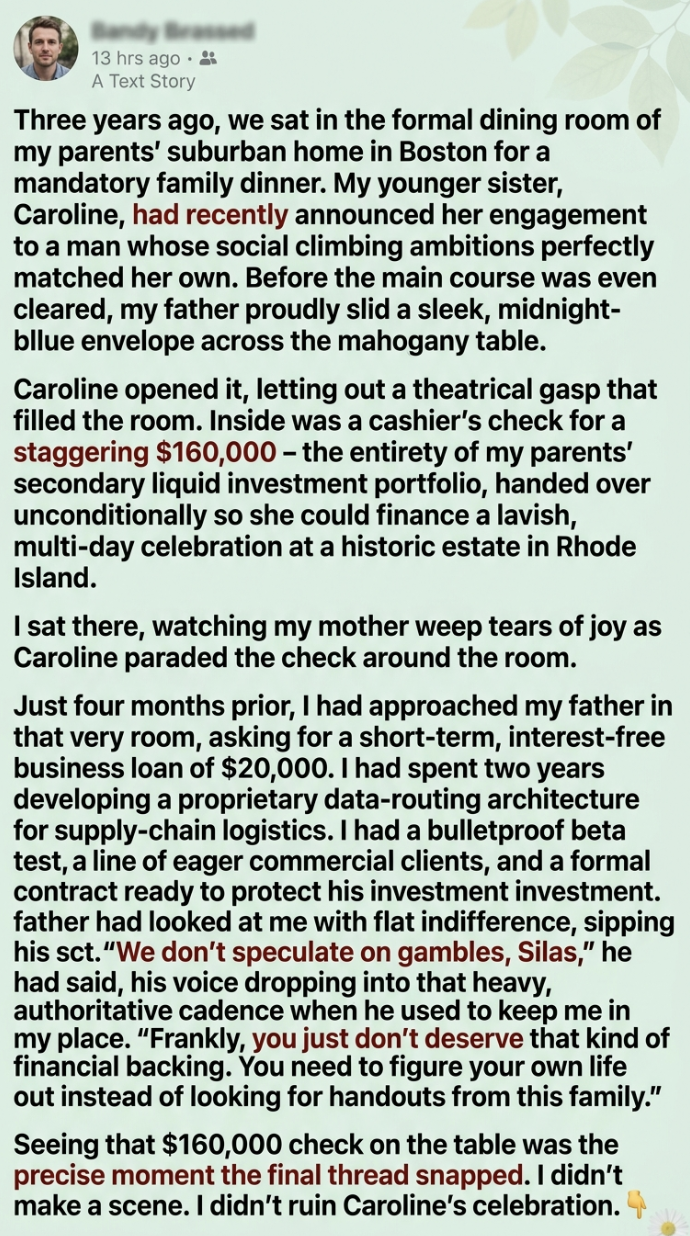
That evening, Caroline had recently announced her engagement.
She was marrying a man whose ambitions seemed to match hers perfectly.
My mother had been talking about the wedding for weeks.
The venue.
The flowers.
The guest list.
The clothes.
The photographs.
Before the main course had even been cleared, my father reached beneath his chair.
He pulled out a sleek midnight-blue envelope.
Then he slid it across the table toward Caroline.
“Open it.”
Caroline smiled.
She slowly opened the envelope.
Then she gasped.
Inside was a cashier’s check.
$160,000.
My parents had taken the money from their secondary investment portfolio and handed it to her without conditions.
It was meant to pay for a lavish, multi-day wedding at a historic estate in Rhode Island.
Caroline screamed.
My mother stood up and hugged her.
My father smiled proudly.
Everyone started talking at once.
And I sat there silently.
Because four months earlier, I had been sitting in that same chair asking my father for $20,000.
Not a gift.
Not an inheritance.
Not charity.
A loan.
I had spent two years developing proprietary data-routing software for supply-chain logistics.
I had working beta results.
Potential commercial clients waiting to sign.
A business plan.
A repayment schedule.
And a formal contract protecting his investment.
I wasn’t asking him to believe in a fantasy.
I was asking him to believe in his son.
He hadn’t even finished reading my proposal.
He had taken a sip of scotch and looked at me with the same expression he’d used throughout my childhood whenever he thought I was asking for too much.
“We don’t speculate on gambles, Silas.”
I remember those words because they were delivered so calmly.
Almost casually.
Then he added,
“Frankly, you don’t deserve that kind of financial backing.”
I stared at him.
He continued.
“You need to figure your own life out instead of looking for handouts from this family.”
I nodded.
I thanked him.
And I walked away.
I didn’t argue.
I didn’t tell him how much those words hurt.
I didn’t tell him that I’d spent countless nights working while everyone else slept.
I didn’t tell him that I had already invested nearly everything I had into the company.
I simply went home and kept working.
Four months later, I was sitting across from the same man while he handed my sister eight times the amount I’d asked for.
And suddenly, everything became clear.
It wasn’t that my parents couldn’t afford to help me.
They simply didn’t believe I was worth helping.
That realization hurt more than the money ever could.
I looked at Caroline.
She was crying happily.
My mother was wiping away tears.
My father was explaining how the check would cover everything.
I smiled.
“Congratulations.”
Caroline looked at me.
“Are you okay?”
I nodded.
“I’m happy for you.”
And strangely, I was.
Her wedding wasn’t her fault.
My parents’ favoritism wasn’t something she had created.
But I knew something that evening that nobody else at that table knew.
I was done asking.
Not just for money.
For approval.
For recognition.
For permission.
For a place at the table.
The next morning, I returned to my office before sunrise.
I opened the same business plan my father had dismissed.
Then I made myself a promise.
I would build the company without them.
No family money.
No family connections.
No favors.
No safety net.
Just me.
For the next three years, I worked harder than I had ever worked in my life.
The first client signed.
Then another.
Then another.
The little logistics platform I’d built from my apartment became a real company.
Employees joined.
Contracts grew.
Investors came knocking.
And eventually, the company became worth more money than I had ever imagined.
I never called my father.
I never told my mother.
I never sent Caroline an update.
They heard about my success the same way everyone else did.
Through other people.
Then, one afternoon, my phone rang.
It was my mother.
I almost didn’t answer.
“Silas?”
Her voice sounded strangely nervous.
“Yes?”
“We heard about your company.”
I said nothing.
“Your father is very proud of you.”
I looked out my office window.
“Is he?”
There was silence.
Then she said something I never expected.
“He wishes he had helped you.”
I closed my eyes.
Three years earlier, those words might have meant everything.
Now they were simply words.
My mother continued.
“Caroline’s having some financial problems.”
There it was.
The real reason for the call.
Her husband’s business had struggled.
Their expenses had grown.
The wedding money was long gone.
And suddenly, the son who supposedly didn’t deserve $20,000 had become the person everyone believed could solve the problem.
“How much does she need?” I asked.
My mother hesitated.
“About $200,000.”
I laughed quietly.
Not because it was funny.
Because the irony was almost unbearable.
Three years earlier, my father had refused to lend me $20,000 to build something.
Now they wanted $200,000 because I had succeeded without them.
“I can’t do that,” I said.
My mother started crying.
“You’re family.”
I looked around my office.
At the people working because I had taken a chance on myself.
At the company my father had called a gamble.
“I know,” I said softly.
“That is exactly why this hurts.”
I didn’t give Caroline the $200,000.
But I didn’t abandon her either.
I offered something different.
I helped her restructure the debts.
I connected her husband with a business adviser.
I helped them sell the assets they could no longer afford.
It took time.
It wasn’t glamorous.
But eventually, they recovered.
And Caroline eventually called me herself.
She didn’t ask for money.
She apologized.
“I used to think you were jealous of me,” she said.
I smiled.
“I wasn’t jealous of you.”
“I know that now.”
She started crying.
“I didn’t understand what Dad did to you.”
I looked down at my desk.
“You didn’t have to.”
She was quiet.
Then she said,
“I should have.”
That conversation changed something between us.
Not overnight.
Not perfectly.
But slowly.
Years later, I still remember that $160,000 check.
Not because of the amount.
Because of what it taught me.
My father’s refusal didn’t mean I wasn’t capable.
My family’s favoritism didn’t determine my worth.
And being denied a seat at their table didn’t mean I couldn’t build my own.
The greatest revenge wasn’t becoming rich.
It was becoming successful without becoming bitter.
I never needed my father to admit that he was wrong.
I never needed Caroline to feel guilty about the wedding.
And I never needed my family to regret losing me.
I simply needed to stop measuring my worth by how much they were willing to invest in me.
Because sometimes the people who refuse to believe in your future are the same people who eventually ask to share in it.
And when that day comes, you don’t have to punish them.
You simply have to remember who you became when nobody was willing to help.