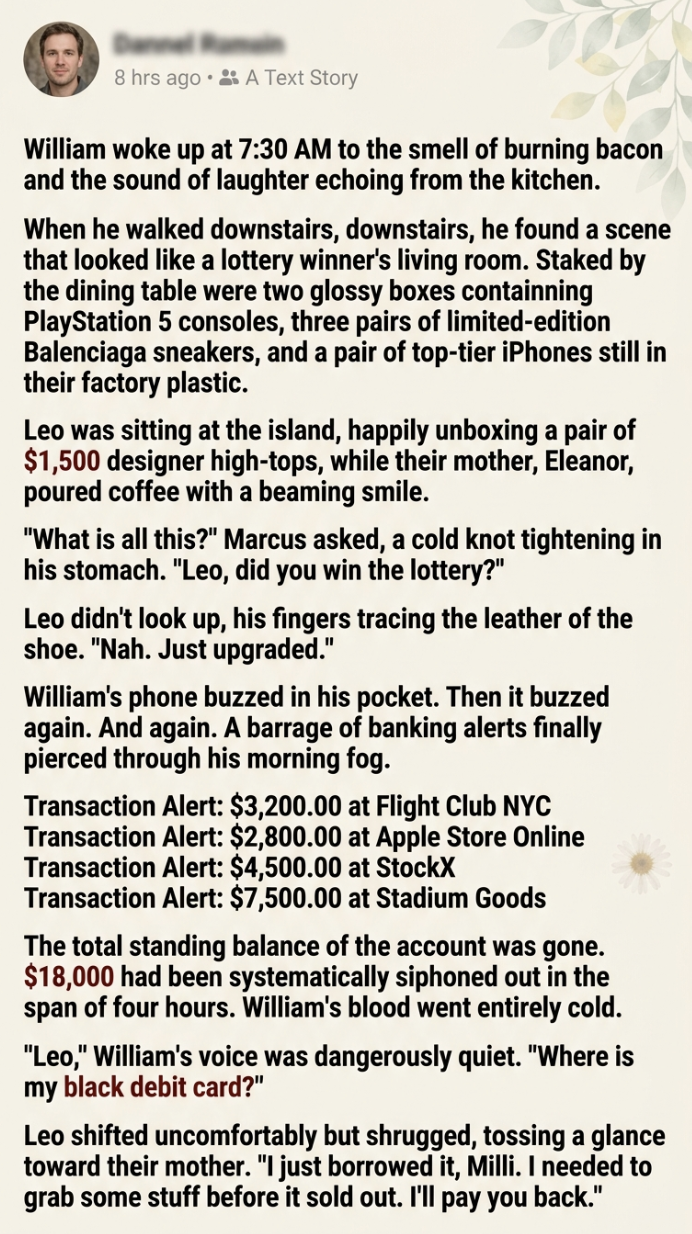
William woke at 7:30 that morning to the smell of bacon burning in the kitchen and the sound of his family laughing downstairs.
For a moment, he felt something he hadn’t felt in a long time.
Peace.
He had spent years being the responsible one in his family.
The one who paid bills on time.
The one who helped when someone needed money.
The one who never complained when his parents needed a favor.
He had learned a long time ago that being the dependable child came with an unspoken price:
Everyone expected you to keep forgiving them.
William walked downstairs.
Then he stopped.
The kitchen looked like a showroom.
Two brand-new PlayStation 5 consoles sat beside the dining table.
Three pairs of limited-edition designer sneakers were still in their boxes.
Two expensive smartphones lay on the counter, their factory plastic untouched.
And sitting at the kitchen island was his younger brother, Leo, smiling as he pulled a pair of $1,500 designer sneakers from their box.
Their mother, Eleanor, stood beside him pouring coffee.
She was smiling.
Not surprised.
Not concerned.
Proud.
William stared at the scene.
“What is all this?”
Leo didn’t even look up.
“Just some stuff.”
William glanced at his mother.
“Mom?”
Eleanor shrugged.
“Your brother wanted a few things.”
William felt a strange knot forming in his stomach.
“A few things?”
Leo finally looked at him.
“Relax. It’s not a big deal.”
Then William’s phone buzzed.
He reached into his pocket.
A banking notification appeared.
Transaction Alert: $3,200 — Flight Club NYC
His eyebrows tightened.
Before he could process it, another alert arrived.
$2,800 — Apple Store Online
Then another.
$4,500 — StockX
And another.
$7,500 — Stadium Goods
William stopped breathing.
He opened his banking app.
The account he’d spent years building was nearly empty.
$18,000 had disappeared in less than four hours.
His hands began to shake.
That money wasn’t spare cash.
It was money he’d been saving for months.
Money he’d planned to use for the roof repair his house desperately needed.
Money he’d set aside because he had learned, through years of experience, that when something went wrong, nobody was coming to rescue him.
William slowly looked up.
“Leo.”
His voice was quiet.
Too quiet.
“Where is my black debit card?”
Leo stopped smiling.
For a second, nobody spoke.
Then he glanced at Eleanor.
That tiny movement told William everything.
“You took my card?”
Leo sighed.
“I borrowed it.”
“You borrowed it?”
“I was going to pay you back.”
William stared at him.
“You spent eighteen thousand dollars.”
“It wasn’t all me.”
William looked at his mother.
Eleanor immediately stepped in.
“William, calm down.”
“Mom, he took my debit card.”
“He’s your brother.”
“That doesn’t answer my question.”
Eleanor’s expression hardened.
“He needed some things.”
William almost laughed.
“Things?”
He pointed toward the table.
“You call two PlayStations, designer shoes, and expensive phones things?”
Leo rolled his eyes.
“You’re acting like I robbed a bank.”
William’s chest tightened.
“No.”
He looked directly at him.
“You robbed your brother.”
The room went silent.
Then Eleanor said something that hurt more than the stolen money ever could.
“You always have to make everything about yourself.”
William stared at her.
His own mother.
The woman he’d helped with medical bills.
The woman whose mortgage payment he’d covered when she fell behind.
The woman who had called him countless times over the years whenever Leo got himself into trouble.
And now she was defending him.
William swallowed hard.
“Mom, I didn’t say you couldn’t help Leo.”
“Then what’s the problem?”
“The problem is that you helped him with my money.”
Leo stood up.
“I said I’d pay you back.”
“When?”
“Soon.”
“You don’t even have a job.”
Leo’s face reddened.
“You think you’re better than me because you have money?”
William shook his head.
“No, Leo. I think I’m tired of being treated like your emergency fund.”
Eleanor slammed her coffee cup onto the counter.
“Enough!”
Her voice echoed through the kitchen.
“Family helps family.”
William looked at her for several seconds.
Then he quietly asked,
“Does family also steal from family?”
Nobody answered.
That afternoon, William went to the bank.
He canceled the card.
Changed every password.
Froze the account.
And, for the first time in his life, he refused to cover Leo’s mistake.
He expected his family to apologize.
Instead, they stopped speaking to him.
For three weeks.
Then came the messages.
First from Eleanor.
“Your brother is struggling. You could at least be understanding.”
Then his father.
“Don’t let money destroy this family.”
Then Leo.
“Seriously? You’re still mad over some shoes?”
William didn’t respond.
He had finally learned that silence wasn’t cruelty.
Sometimes silence was the only boundary a family that ignored your words could understand.
But the story didn’t end there.
Two months later, William received a letter from his bank.
The investigation into the transactions was complete.
There was something the family hadn’t told him.
Leo hadn’t simply taken the card once.
He had been using it for months.
The $18,000 was only the amount William had noticed.
There were dozens of smaller purchases hidden among his normal expenses.
Food deliveries.
Hotels.
Online shopping.
Concert tickets.
Gaming equipment.
Gas.
Cash withdrawals.
The total was $31,740.62.
William sat at his kitchen table staring at the number.
Thirty-one thousand dollars.
Money he had earned one paycheck at a time.
Money his family had treated as though it belonged to everyone except him.
But then he noticed something else.
One of the largest transactions hadn’t been made by Leo.
It had been made by Eleanor.
A $6,000 transfer.
Straight into Leo’s personal account.
William’s heart sank.
His mother hadn’t merely failed to stop it.
She had participated.
He confronted her that evening.
“Why?”
Eleanor started crying.
“He was in trouble.”
“So you used my money to save him?”
“He’s your brother.”
William nodded slowly.
“I know.”
His voice cracked.
“And that’s exactly why this hurts so much.”
He wasn’t angry anymore.
He was heartbroken.
Because money could be earned again.
Trust couldn’t.
A week later, William filed the documentation with the bank and authorities.
He didn’t do it to punish Leo.
He did it because he finally understood something his family had spent years teaching him without realizing it:
Being the responsible child doesn’t mean allowing everyone else to destroy what you worked for.
Leo eventually admitted what he’d done.
The bank recovered part of the money.
The rest became a repayment agreement.
For the first time, Leo had to face the consequences of his own choices.
Eleanor stopped speaking to William for nearly a year.
William didn’t chase her.
He didn’t beg.
He simply continued living his life.
Then, on a rainy Sunday afternoon, someone knocked on his door.
It was Eleanor.
She looked older.
Tired.
She stood on the porch holding a small envelope.
“I came to apologize,” she said.
William didn’t say anything.
She handed him the envelope.
Inside was a check.
Every dollar Leo had repaid so far.
Then she whispered,
“I spent years thinking you were strong enough to handle anything.”
William looked down at the check.
“That wasn’t strength, Mom.”
She looked up.
“What was it?”
He took a breath.
“It was loneliness.”
His mother’s eyes filled with tears.
For the first time, she understood.
The child she had always called “the responsible one” hadn’t been asking to be praised.
He had simply wanted someone to protect him once.
Just once.
William eventually forgave her.
But forgiveness didn’t mean handing over his debit card again.
It meant letting go of the anger without forgetting the lesson.
From that day forward, he helped his family when he genuinely wanted to.
Not because they expected it.
Not because they guilted him.
And not because being the “good child” meant sacrificing himself.
Years later, William still kept the original bank statement from that morning.
Not as a reminder of the $18,000.
But as a reminder of the moment he finally understood his worth.
Because sometimes the hardest lesson in a family isn’t learning how to say no.
It’s realizing that the people who become angry when you finally set a boundary may have been benefiting from you never having one.