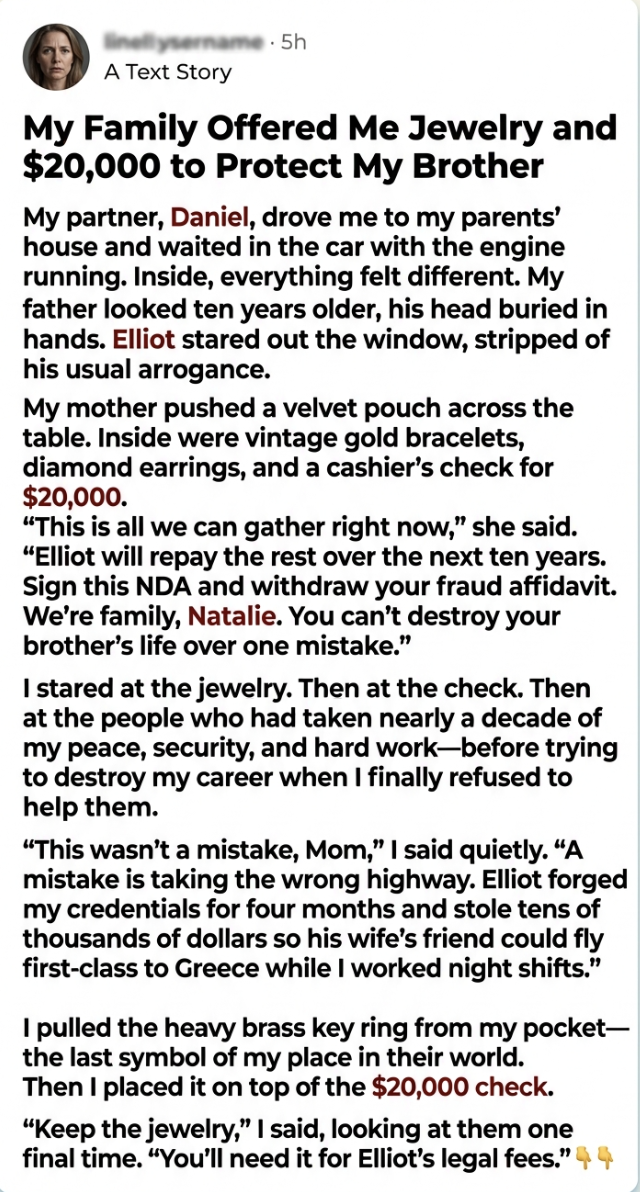
My partner, Daniel, drove me to my parents’ house and waited in the car with the engine running.
He didn’t ask me to stay.
He didn’t tell me what to say.
He only looked at me before I opened the door and said, “You don’t owe them another explanation.”
I nodded.
But part of me still hoped they had called me home because they were finally ready to tell the truth.
Inside, everything felt different.
My father looked ten years older, his head buried in his hands.
My mother stood beside the dining table, gripping the back of a chair.
And Elliot, my younger brother, stared out the window with none of his usual arrogance.
For years, Elliot had been the golden child.
He was forgiven for missed deadlines, unpaid loans, broken promises, and careless decisions.
When he failed, my parents called him unlucky.
When I struggled, they called me irresponsible.
When he needed money, they gave it.
When I needed support, they reminded me to be independent.
I had spent nearly a decade building a career in financial compliance and corporate investigations.
I worked night shifts when necessary.
I reviewed suspicious transactions.
I protected client accounts.
I built a reputation for being careful, honest, and dependable.
Then Elliot destroyed it in four months.
He forged my professional credentials.
He used my employee access to approve transfers.
He altered internal records so payments appeared to come from authorized accounts.
And he stole tens of thousands of dollars to pay for luxury travel, expensive dinners, and a first-class trip to Greece for his wife’s friend.
When I discovered what he had done, I reported it.
Not because I hated him.
Because the truth was bigger than our family.
The investigation had already begun.
My employer had suspended my access while the records were reviewed.
People who had trusted me began asking questions.
My professional license was placed under review.
My career, which I had spent years building, was suddenly hanging by a thread.
And Elliot had disappeared behind my parents’ excuses.
“He was under pressure,” my mother had said.
“He didn’t understand the consequences,” my father insisted.
“He only borrowed your credentials,” Elliot’s wife claimed.
But forged credentials were not borrowing.
Unauthorized transfers were not borrowing.
A false signature was not borrowing.
And stealing money from clients was not a family misunderstanding.
Now, weeks later, my parents had summoned me to their house.
My mother pushed a velvet pouch across the table.
Inside were vintage gold bracelets, diamond earrings, and a cashier’s check for $20,000.
“This is all we can gather right now,” she said. “Elliot will repay the rest over the next ten years.”
I didn’t touch the pouch.
She continued.
“Sign this NDA and withdraw your fraud affidavit.”
My father lifted his head.
“Your brother’s attorney says this can still be contained.”
Contained.
That was the word they were using now.
Not corrected.
Not confessed.
Contained.
My mother’s voice softened.
“We’re family, Natalie. You can’t destroy your brother’s life over one mistake.”
I stared at the jewelry.
Then at the check.
Then at the people who had taken nearly a decade of my peace, security, and hard work—before trying to destroy my career when I finally refused to help them.
“This wasn’t a mistake, Mom,” I said quietly.
Elliot finally turned from the window.
“You’re acting like I planned all of this.”
“You did.”
“I was desperate.”
“You forged my credentials for four months.”
“I thought I could fix it.”
“You used my identity to authorize transfers.”
“I was going to pay it back.”
“You stole tens of thousands of dollars so your wife’s friend could fly first-class to Greece.”
Elliot’s face reddened.
“That wasn’t all for me.”
I looked at him.
“That’s supposed to make it better?”
My mother reached for the check.
“Natalie, please. If you withdraw the affidavit, the company may reconsider.”
“The company already has the evidence.”
“Then tell them you misunderstood.”
“I didn’t misunderstand anything.”
My father stood slowly.
“You know what happens if this goes to court?”
“Yes.”
“Elliot could lose everything.”
“He should have considered that before using my name.”
“He’s your brother.”
“And I was his sister when he decided my career was disposable.”
The room fell quiet.
I remembered the first warning sign.
It had happened on a Tuesday morning.
I was reviewing a transaction report when I noticed an approval under my credentials that I had never submitted.
The transfer was small enough to avoid immediate attention.
But the account number was unfamiliar.
The vendor name looked legitimate.
The supporting invoice looked perfect.
Too perfect.
I checked the metadata.
The document had been created from a device registered to Elliot.
At first, I thought it was an error.
Then I found another transaction.
And another.
Four months of records.
Four months of forged approvals.
Four months of my name being used to hide his decisions.
I confronted him privately.
He didn’t deny it.
He simply said, “You work in finance. You know how to make things disappear.”
That sentence had changed everything.
I told him to stop.
He laughed.
“You always act like you’re better than us.”
“I’m trying to keep you from committing a crime.”
“You’re trying to control me.”
Then he threatened me.
“If you report this, Mom and Dad will never forgive you.”
He had been right about one thing.
They never forgave me.
But not for the reason he expected.
They didn’t forgive me for refusing to protect him.
My mother took the velvet pouch and opened it.
“These bracelets belonged to your grandmother.”
I looked at the gold.
“They’re beautiful.”
“Take them.”
“No.”
“They’re worth more than you think.”
“That doesn’t change what they’re being offered for.”
My father’s voice became firmer.
“This is not a bribe.”
I looked at the check.
“Then what is it?”
He didn’t answer.
My mother did.
“It’s a family solution.”
“No,” I said. “It’s a family cover-up.”
Elliot slammed his hand against the table.
“You think you’re innocent?”
I turned toward him.
“I didn’t forge anything.”
“You knew about the transfers.”
“I discovered them.”
“You could have handled it privately.”
“I tried.”
“You went straight to the investigators.”
“I went to the people responsible for protecting the accounts.”
He shook his head.
“You wanted to punish me.”
“No. I wanted to protect my name.”
My mother’s eyes filled with tears.
“Your brother is going to prison.”
“That is not my decision.”
“But your affidavit could determine what happens.”
“That is why you want me to withdraw it.”
My father looked away.
For the first time, I saw the truth clearly.
They weren’t asking me to forgive Elliot.
They were asking me to become evidence that disappeared.
They wanted my signature on a confidentiality agreement.
They wanted my sworn statement withdrawn.
They wanted the investigation to look uncertain.
They wanted everyone to believe that the fraud had been a misunderstanding between siblings.
And they wanted me to accept jewelry and $20,000 in exchange for sacrificing my future.
I reached into my pocket and pulled out the heavy brass key ring.
It had belonged to Grandfather.
The keys opened the old office, the storage room, and the back entrance of the family business.
My father had given them to me years earlier.
“Your grandfather trusted you,” he had said.
For a long time, those keys had represented my place in the family.
Now they felt like a reminder of everything I had lost.
I placed the key ring on top of the $20,000 check.
“Keep the jewelry,” I said.
My mother stared at me.
“What?”
“You’ll need it for Elliot’s legal fees.”
Elliot’s face turned pale.
“You’re really doing this?”
“No,” I said. “You did this.”
My father stepped toward me.
“Natalie, think carefully.”
“I have thought carefully.”
“You’re choosing strangers over your family.”
“I’m choosing the truth over a lie.”
“You’ll regret destroying your brother.”
“I didn’t destroy him. I refused to help him destroy me.”
My mother began crying.
“You’re so cold.”
I looked at her.
“I learned it from being treated like a resource instead of a daughter.”
She flinched.
For years, I had been the one who stayed calm.
The one who paid bills.
The one who solved problems.
The one who absorbed blame so everyone else could keep their peace.
But I had finally understood something.
Keeping the peace was not the same as keeping the truth.
I picked up my coat.
My father’s voice followed me.
“If you walk out, this family may never recover.”
I turned around.
“This family didn’t break when I walked out.”
I looked at Elliot.
“It broke when he used my identity.”
Then I looked at my mother.
“It broke when you asked me to lie.”
Finally, I looked at my father.
“And it broke when you offered me money instead of accountability.”
I walked to the door.
My mother called after me.
“Natalie, please!”
I stopped but didn’t turn.
“Do you know what your grandfather always said?” she asked.
I closed my eyes.
Of course I knew.
He had said it many times.
“A family name is only valuable if the people carrying it behave honorably.”
My mother’s voice trembled.
“He would never want this.”
I turned back.
“You’re right.”
She looked relieved for half a second.
Then I continued.
“He would never want me to sign a lie.”
I left the house.
Daniel was still waiting in the car.
When I opened the door, he looked at my face.
“Did they offer you something?”
“Jewelry and $20,000.”
“Did you take it?”
I shook my head.
He nodded once.
“Good.”
I looked back at my parents’ house.
“I thought I would feel guilty.”
“You might,” Daniel said. “That doesn’t mean you made the wrong decision.”
I placed the brass key ring in my lap.
For the first time, it no longer felt like a symbol of belonging.
It felt like proof that I had finally returned something that was never truly mine.
The next morning, I met with my attorney.
I showed her the check, the jewelry list, and the proposed NDA.
She reviewed everything carefully.
“This agreement is designed to limit your statements and create the appearance that you are withdrawing your allegations voluntarily,” she said.
“Can they force me to sign?”
“No.”
“Can they make me withdraw the affidavit?”
“No.”
“Can they accuse me of ruining the family?”
“They can say whatever they want.”
She closed the folder.
“But they cannot legally require you to lie.”
I exhaled.
For months, I had felt as though the truth was something I had to defend.
Now I understood that the truth didn’t need to be made beautiful.
It only needed to be preserved.
The investigation continued.
The forensic team confirmed that the credentials had been forged.
They traced the transfers to accounts connected to Elliot.
They found messages discussing how to disguise the payments.
They found a file where he had copied my signature.
They found the travel bookings.
They found the first-class tickets.
They found the invoices for luxury hotels and private transportation.
The evidence was not emotional.
It was not revenge.
It was dates, amounts, signatures, and records.
The company cleared my name.
My suspension was lifted.
My professional license was restored.
But the damage to my reputation did not disappear overnight.
Some people still whispered.
Some clients asked questions.
Some colleagues avoided discussing what had happened.
I had to rebuild trust one conversation at a time.
Meanwhile, Elliot’s situation became worse.
The court rejected the claim that the money had been a family loan.
The company confirmed that I had never authorized the transfers.
The NDA was never signed.
My affidavit remained active.
And the $20,000 check was returned to my parents through my attorney.
Elliot eventually admitted to several of the transactions.
He claimed he had acted under pressure.
He said he intended to repay everything.
But intent did not erase the damage.
He had used my credentials.
He had risked my career.
He had stolen money.
And he had expected our parents to pressure me into protecting him.
Months later, my father asked to meet.
I agreed, but only in my attorney’s office.
He arrived alone.
No folders.
No check.
No jewelry.
Just a tired man sitting across from me.
“I owe you an apology,” he said.
I waited.
He looked down at his hands.
“I knew Elliot was asking for money. I didn’t know about the credentials.”
“But you knew something was wrong.”
“Yes.”
“Why didn’t you tell me?”
He swallowed.
“Because I thought I could fix it before you found out.”
I nodded slowly.
“You wanted to protect him.”
“I wanted to protect the family.”
“No,” I said. “You wanted to protect the family’s appearance.”
He didn’t argue.
That was the first honest conversation we had shared in years.
“Your mother says you hate us,” he said.
“I don’t hate you.”
“Then why won’t you forgive Elliot?”
“Forgiveness is not the same as pretending nothing happened.”
“He’s still your brother.”
“And I’m still a person whose life he endangered.”
My father’s eyes filled with regret.
“I should have believed you.”
“Yes,” I said. “You should have.”
He sat quietly.
Then he asked, “What do you want from us?”
I thought about it.
Not money.
Not jewelry.
Not a dramatic apology.
“I want you to stop asking me to sacrifice my future for someone else’s choices.”
He nodded.
“And I want you to understand that protecting someone from consequences is not love.”
My father looked at me for a long time.
“I understand now.”
I didn’t know if he truly did.
But for the first time, I no longer needed his understanding to move forward.
I rebuilt my career.
I accepted a position with a firm that valued compliance and transparency.
I began mentoring young professionals who were afraid to report misconduct.
I told them something I had learned the hard way:
A person who asks you to hide wrongdoing is not protecting you. They are recruiting you into it.
I never returned to the family business.
I never used the brass keys again.
I kept them in a small box beside my desk—not as a reminder of my family, but as a reminder of the moment I chose myself.
One year later, I received a letter from my mother.
She wrote that Elliot had begun taking responsibility.
She wrote that my father had sold several personal assets to cover legal costs.
She wrote that the family was no longer pretending the fraud had been a mistake.
At the end, she wrote:
“I wish I had protected you when you needed it.”
I read the sentence several times.
Then I placed the letter beside the brass keys.
I was not ready to forget.
But I was no longer trapped inside the past.
My family had offered me jewelry and $20,000 to protect my brother.
They believed they were buying silence.
They believed the right price could make betrayal disappear.
They were wrong.
Because my peace was not for sale.
My career was not for sale.
My name was not for sale.
And my love for my family would never again mean helping them hide the truth.
The most expensive thing my family ever offered me was not the jewelry or the check.
It was the chance to lose myself trying to save someone who had never protected me.