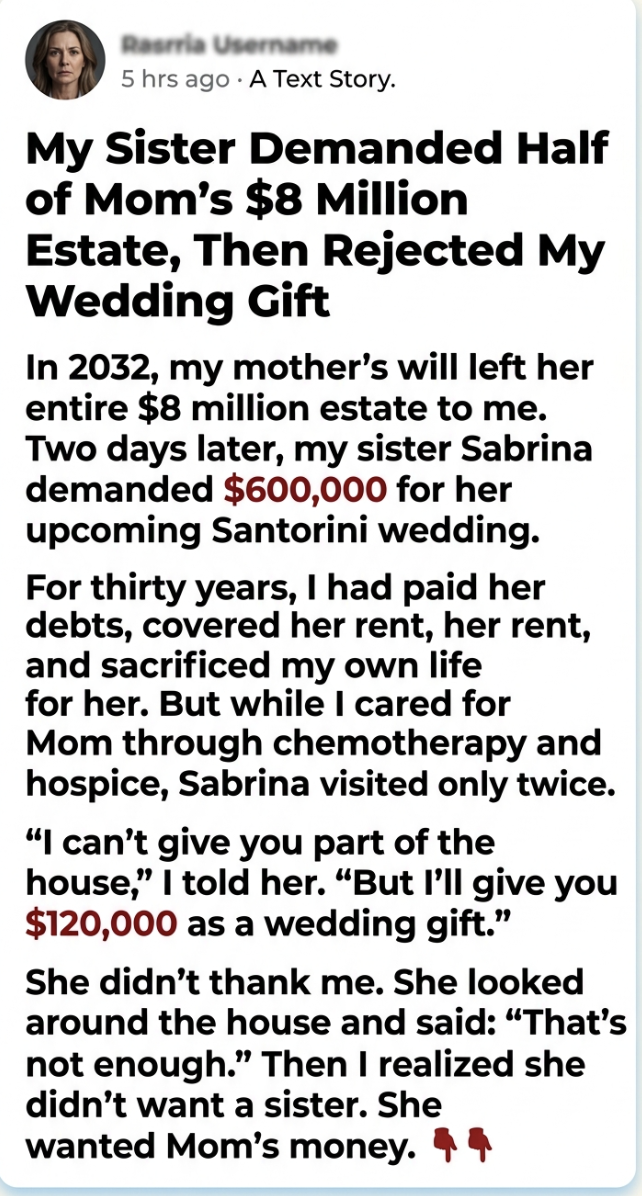
In 2032, my mother’s will left her entire $8 million estate to me.
The lawyer read the words slowly.
“My client leaves her home, investments, businesses, and savings to her daughter, Elena.”
For several seconds, nobody moved.
My father had passed away years earlier. My mother had been my entire world.
I was the one who took her to chemotherapy.
I was the one who sat beside her during sleepless nights.
I was the one who learned how to manage her medications, prepare soft meals, and hold her hand during hospice.
My sister, Sabrina, visited only twice during Mom’s final year.
The first time, she stayed for twenty minutes.
The second time, she complained that the house smelled like medicine.
Then she left.
Still, I never expected the will to divide us.
I thought grief would make us closer.
I was wrong.
Two days after the reading, Sabrina arrived at Mom’s house wearing expensive sunglasses and carrying a folder.
She didn’t ask how I was sleeping.
She didn’t ask whether I had eaten.
She walked straight into the living room and placed the folder on the coffee table.
“I need $600,000,” she announced.
I stared at her.
“For what?”
“My wedding.”
She said it as if the answer should have been obvious.
“My wedding in Santorini. The venue is already booked, but the deposits are due soon. Mom would have wanted me to have the wedding of my dreams.”
I took a slow breath.
“Sabrina, Mom just died.”
“And I’m getting married,” she replied. “Life continues.”
I looked at the folder.
Inside were photographs of a luxury resort, white flowers, a private yacht, designer dresses, and a guest list filled with people I had never met.
“You want six hundred thousand dollars?”
“Not want,” she corrected. “Need.”
I almost laughed.
For thirty years, I had paid Sabrina’s debts.
When she was twenty-two, I paid her university balance.
When she lost her first job, I covered six months of rent.
When she bought a car she couldn’t afford, I made the payments.
When she opened a boutique and failed, I paid her suppliers so she wouldn’t be sued.
I had sacrificed vacations, postponed my own plans, and worked extra hours to keep her life comfortable.
She always promised to repay me.
She never did.
And now she was standing in our mother’s living room, demanding money from the estate.
“I can’t give you half of the house,” I said quietly.
Her expression hardened.
“Why not?”
“Because Mom left it to me.”
“She was confused near the end.”
“She was clear when she signed the will.”
“She was manipulated!”
The accusation struck harder than I expected.
“By whom?”
Sabrina looked directly at me.
“By you.”
I felt something inside me go still.
“You think I manipulated Mom?”
“You were with her every day. You controlled her appointments, her medications, her lawyers. You knew she was vulnerable.”
I looked toward the hallway where Mom’s bedroom door still stood open.
I could still picture her sitting by the window, wrapped in a pale blue blanket.
I could still hear her voice saying, “Don’t let Sabrina ruin her life, sweetheart. She doesn’t know how to stop chasing things.”
Mom had known.
She had known everything.
“Sabrina,” I said, “Mom made her decision.”
“Then give me my share.”
“You don’t have a share.”
Her mouth fell open.
“Half the estate should be mine.”
“Why?”
“Because I’m her daughter!”
“So am I.”
“You got everything!”
“No,” I replied. “I got the responsibility.”
She scoffed.
“The house is worth almost three million. The investments are worth more than five. You’re keeping all of it while I’m expected to get nothing?”
“You’re getting the life you chose. I’m keeping what Mom entrusted to me.”
Sabrina stood and began walking around the room.
She examined the paintings, the antique cabinet, and the photographs on the shelves.
Then she stopped in front of Mom’s jewelry box.
“That necklace would look beautiful with my wedding dress.”
I stepped between her and the cabinet.
“That belonged to Mom.”
“She won’t be using it.”
“Sabrina.”
“What? You’re keeping eight million dollars. Surely you can give me a necklace.”
I closed my eyes for a moment.
Then I said, “I’ll give you $120,000 as a wedding gift.”
She turned toward me.
“One hundred twenty thousand?”
“Yes.”
“That’s your offer?”
“It’s more than I ever received from you.”
She stared at me as though I had insulted her.
“I’m getting married in Santorini. The wedding alone costs more than that.”
“Then choose a smaller wedding.”
Her face changed.
The sadness disappeared.
So did the pretending.
“You always thought you were better than me.”
“That’s not true.”
“You acted like the responsible daughter. The perfect daughter. The one who stayed with Mom. The one who made all the sacrifices.”
“I stayed because she needed me.”
“You stayed because you wanted everything.”
I felt my throat tighten.
“I wanted Mom to live.”
For the first time, Sabrina had no answer.
But the silence lasted only a few seconds.
Then she looked around the room again.
“Fine,” she said. “I don’t want your charity.”
“It isn’t charity. It’s a gift.”
“It’s an insult.”
“You asked for six hundred thousand. I offered one hundred twenty.”
“You should have offered more.”
I nodded slowly.
And suddenly, I understood.
She didn’t want a wedding gift.
She wanted access.
She wanted the house.
She wanted Mom’s accounts.
She wanted the life Mom had built and the inheritance I had been trusted to protect.
She didn’t want a sister.
She wanted Mom’s money.
Sabrina picked up her folder.
“You’ll regret this.”
“I already regret many things,” I said.
“Like what?”
“Like spending thirty years confusing love with obligation.”
Her face turned pale.
For a moment, I thought she might cry.
Instead, she smiled coldly.
“You’ll hear from my lawyer.”
She walked out without saying goodbye.
The next morning, I received a letter.
Sabrina was challenging the will.
Her lawyer claimed Mom had been mentally incapable of making financial decisions. They argued that I had exerted “undue influence” and that Sabrina deserved half the estate.
I was stunned.
I had spent the final year of Mom’s life keeping her comfortable.
Now I was being accused of stealing from her.
The legal battle lasted seven months.
During that time, Sabrina told relatives that I had tricked Mom.
She posted vague messages online about “greedy family members.”
She told people I had hidden money.
She even contacted Mom’s former doctor, hoping to find evidence that Mom had been confused.
But the truth was stronger than her accusations.
The hospice records showed Mom had been mentally alert when she signed the will.
The attorney who prepared it confirmed that Mom had met with him privately.
The witnesses testified that Mom understood exactly what she was leaving behind.
Then the lawyer presented something I had never seen before.
A handwritten letter from Mom.
It had been sealed in an envelope and stored with the original will.
The judge allowed it to be read aloud.
“My dear Elena,
I know Sabrina may be angry when she learns about my decision. Please do not allow her anger to make you doubt yourself.
You gave me your time when you had very little. You gave me your strength when you were exhausted. You gave me your peace when life was difficult.
Sabrina has always believed that love means receiving. You have always understood that love means showing up.
I am leaving the estate to you because I trust your heart, not because I love her less.
Please use what I leave you wisely. Protect the home. Help people who need help. And never again allow anyone to make you feel guilty for having limits.
Love, Mom.”
The courtroom was silent.
Sabrina stared at the floor.
The judge ruled in my favor.
The will remained valid.
The estate was mine.
But winning the case did not feel like winning.
I had lost my mother.
And I had lost the sister I thought I had.
A month later, Sabrina called me.
Her voice was softer than usual.
“I’m canceling the wedding.”
I said nothing.
“The venue won’t refund everything. I’m losing almost sixty thousand dollars.”
“I’m sorry.”
“You could still help me.”
I looked out the window at Mom’s garden.
“I already offered you one hundred twenty thousand.”
“That was before.”
“Before what?”
“Before you embarrassed me.”
“I didn’t embarrass you. I offered you a gift.”
“You made me feel poor.”
“Sabrina, I never wanted you to feel poor. I wanted you to understand that I’m not responsible for funding your lifestyle.”
She began crying.
For years, her tears had made me surrender.
This time, I listened without fixing anything.
“I’m your sister,” she whispered.
“Yes,” I said. “And I wanted you to love me as your sister, not as the person who could pay your bills.”
There was a long silence.
Then she asked, “Do you hate me?”
“No.”
“Then why won’t you give me the money?”
“Because forgiveness doesn’t mean removing every boundary.”
She hung up.
I never sent the six hundred thousand dollars.
I also never sent the one hundred twenty thousand.
Not because I wanted revenge.
But because a gift should come from love, not pressure.
Instead, I used part of Mom’s estate to restore the house, establish a medical-support fund in her name, and help families who were caring for loved ones through cancer.
I kept Mom’s jewelry exactly where it had always been.
I kept her favorite chair by the window.
And I kept the handwritten letter in a safe place.
Months later, Sabrina came to the house without a lawyer, without a folder, and without a demand.
She stood at the front door holding a small box.
“I found this in Mom’s storage room,” she said.
Inside was an old photograph of the two of us as children.
We were sitting on Mom’s lap, smiling with missing teeth and messy hair.
Sabrina looked at the picture.
“I don’t remember being that happy.”
“We were.”
“Did Mom really love me?”
I looked at her.
“Yes. She loved you very much.”
“Then why did she leave everything to you?”
I answered honestly.
“Because she trusted me to protect it.”
Sabrina nodded, tears filling her eyes.
For the first time, she didn’t ask for money.
She didn’t ask for the house.
She didn’t ask what was in the accounts.
She simply said, “I’m sorry I wasn’t there.”
I wanted to forgive her immediately.
But forgiveness, I had learned, did not require pretending nothing happened.
So I said, “I’m glad you came.”
It was not a perfect reconciliation.
It was not a magical ending.
But it was the first honest conversation we had shared in years.
And sometimes, that is where healing begins.
Mom left me $8 million.
But her greatest gift was not the money.
It was the truth.
Love should never be measured by what someone can take from you.
And family should never mean that one person gives everything while another person keeps demanding more.
I had spent thirty years paying for Sabrina’s comfort.
It took losing Mom to realize that I was allowed to protect my own peace.
Because the moment someone stops seeing you as family and starts seeing you as a wallet, the most loving thing you can do is close the account.