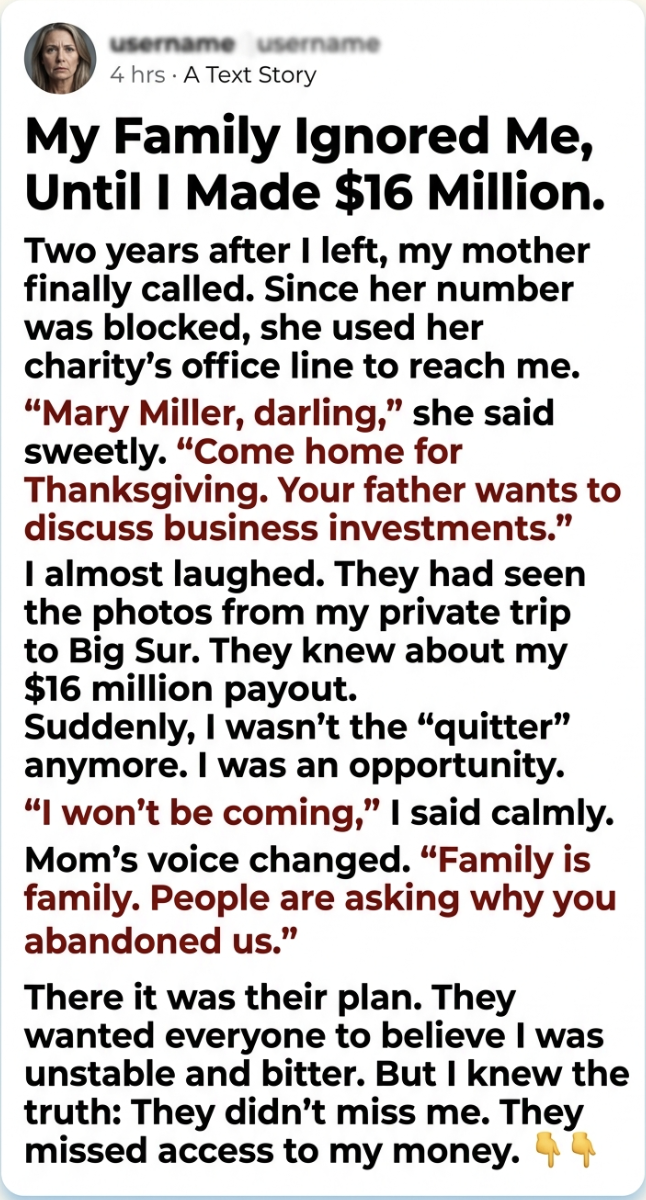
Two years after I left, my mother finally called.
Since her number was blocked, she used her charity’s office line to reach me.
“Mary Miller, darling,” she said sweetly. “Come home for Thanksgiving. Your father wants to discuss business investments.”
I almost laughed.
They had seen the photos from my private trip to Big Sur.
They knew about my $16 million payout.
Suddenly, I wasn’t the “quitter” anymore.
I was an opportunity.
“I won’t be coming,” I said calmly.
Mom’s voice changed.
“Family is family. People are asking why you abandoned us.”
There it was—their plan.
They wanted everyone to believe I was unstable and bitter.
But I knew the truth:
They didn’t miss me. They missed access to my money.
For years, I had been the invisible daughter.
My parents, Richard and Helen, had built their entire identity around being admired. They hosted expensive dinners, donated money publicly, and made sure everyone knew their names were attached to important buildings.
But inside our home, everything was different.
My brother Jason could do no wrong.
When he failed a business, Dad called it “a learning experience.”
When he missed payments, Mom quietly covered them.
When he moved into a luxury apartment, they celebrated his “independence.”
But when I worked late, paid bills, or helped keep the family’s finances stable, they called it my responsibility.
“You’re good with numbers,” Dad would say.
“You don’t need praise for doing what you’re supposed to do.”
I believed him for too long.
After college, I joined a corporate restructuring firm. I worked brutal hours, learned how companies survived financial disasters, and eventually became one of the youngest executives in my division.
My parents barely noticed.
They only called when something needed fixing.
A mortgage payment.
A tax issue.
A business loan.
A medical bill.
A country-club membership renewal.
Every time, I helped.
Not because I was weak.
Because I thought that was what family meant.
Then came the investment opportunity that changed everything.
My firm was hired to restructure a technology company that had nearly collapsed. I spent eighteen months rebuilding its operations, negotiating with investors, and creating a recovery strategy that turned the company around.
When the company was acquired, the executive team received performance payouts.
Mine was worth $16 million.
The money arrived quietly.
No announcement.
No celebration.
No champagne.
Just a message from my financial adviser:
“The funds have cleared.”
I stared at the screen for a long time.
For the first time in my life, I had enough money to make every decision without asking whether my family would approve.
So I did something they never expected.
I moved.
I rented a quiet house near the coast, changed my number, blocked my parents, and stopped explaining myself.
I didn’t post pictures of the money.
I didn’t buy a mansion.
I didn’t show off.
I simply disappeared from the role they had assigned me.
For two years, nobody from my family tried to find out whether I was happy.
They didn’t ask if I was safe.
They didn’t ask if I missed them.
They didn’t ask what I was building.
Then a photo from Big Sur appeared online.
It showed me standing near the cliffs, wearing a simple jacket, with the ocean behind me.
The caption said:
“A quiet life is still a successful life.”
My mother saw it.
Someone must have told her about the payout.
And suddenly, she remembered that I was her daughter.
After I refused Thanksgiving, Mom called again.
This time, she sounded wounded.
“Mary, your father is very upset.”
“I’m sure he is.”
“He says you’re being selfish.”
“That’s interesting.”
“He wants to help you invest your money properly.”
I looked out at the ocean beyond my window.
“Mom, I’ve worked in corporate finance for twelve years.”
“That doesn’t mean you understand family investments.”
“No,” I replied. “It means I understand risk.”
She went silent.
Then she lowered her voice.
“Your father has an opportunity. A very important one. He needs $4 million to purchase a controlling interest in a private company.”
I almost smiled.
There it was.
Not an apology.
Not affection.
A request.
A very large request.
“You want me to give Dad $4 million?”
“He would pay you back.”
“When?”
“He has a plan.”
“Does the plan include a written agreement?”
“Mary, you’re making this uncomfortable.”
“You made it financial.”
Her voice sharpened.
“You have more money than you could ever spend. Your father gave you everything.”
I remembered the years of unpaid help.
The nights I covered their bills.
The time I saved their house from foreclosure.
The medical expenses I paid without telling anyone.
The money I transferred every month while Jason received praise for simply showing up.
“You’re right,” I said quietly. “I have more money than I need. That’s why I’m not giving it to people who only call when they want more.”
Mom hung up.
The next morning, my aunt called.
Then my cousin.
Then a family friend I hadn’t spoken to in years.
Every message followed the same pattern.
“Your parents are heartbroken.”
“You should forgive them.”
“Money changes people.”
“Family should come before pride.”
Nobody asked why I had left.
Nobody asked what had happened.
They had already received the version my parents wanted them to believe.
According to them, I had become arrogant.
I had abandoned my family.
I had become obsessed with money.
So I decided to stop defending myself privately.
Not with anger.
Not with insults.
With facts.
I created one document.
It contained every major payment I had made for my parents over the previous ten years.
Mortgage assistance.
Medical expenses.
Insurance premiums.
Business debts.
Property taxes.
Luxury travel.
Emergency transfers.
The total was $3,842,611.47.
I also included the messages where my parents had asked for money.
Some were polite.
Most were not.
One message from Dad read:
“Transfer the money before Friday. Don’t make this difficult.”
Another from Mom said:
“Jason needs help again. You can afford it.”
Then there was the message from the week I left.
I had asked my father why he never acknowledged anything I had done.
His reply had been:
“You were always too sensitive. If you wanted attention, you should have done something meaningful.”
That sentence had stayed with me.
Now I understood why.
They didn’t see my work as love.
They saw it as a service.
I sent the document to the family group chat with one sentence:
“Since everyone is discussing why I left, I thought the facts should be included.”
For several minutes, nobody replied.
Then Jason wrote:
“This is pathetic. You’re keeping score with your own family.”
I answered:
“No. I’m showing the score because you accused me of never contributing.”
Mom wrote:
“How dare you embarrass us?”
I replied:
“I didn’t embarrass you. I documented what happened.”
Dad called immediately.
I let it ring.
He called again.
Then again.
Finally, he sent a message.
“You are destroying this family.”
I stared at those words.
The family had survived my silence.
It had survived my absence.
It had survived two years without asking about me.
But now that I had stopped paying, apparently it was falling apart.
I typed one final reply:
“If a family collapses because one person stops funding it, the money was holding it together—not love.”
Then I left the group chat.
Three days later, my parents arrived at my house.
I hadn’t given them my address.
They must have found it through someone who worked at the property office.
When I opened the door, Mom was holding a basket of expensive food.
Dad stood behind her with the expression he used when he expected obedience.
“Let’s talk,” he said.
“I don’t think there’s anything left to discuss.”
“You humiliated us.”
“I shared records.”
“You made us look like we depended on you.”
“You did depend on me.”
Dad’s face tightened.
“We are your parents.”
“And I was your daughter,” I said. “Not your bank.”
Mom began to cry.
For a moment, the old instinct returned.
I wanted to comfort her.
I wanted to apologize.
I wanted to make everything peaceful again.
Then I remembered how often I had swallowed my feelings to protect theirs.
“I gave you money because I loved you,” I continued. “But you treated that love like an obligation. You praised Jason for doing nothing while criticizing me for doing everything. You called me cold when I asked for respect. You called me selfish when I asked for boundaries.”
Dad looked away.
Mom whispered, “We never meant to hurt you.”
“Intent doesn’t erase impact.”
Dad stepped forward.
“Your mother and I have decided to revise the family trust.”
I almost laughed.
“Does that mean I’ll finally be included?”
He hesitated.
That hesitation answered everything.
“Actually,” he said, “we thought you might contribute $5 million to the trust. It would show that you’re still committed to the family.”
I looked at both of them.
Even now, they couldn’t imagine a conversation without a number.
“No,” I said.
Mom’s tears stopped.
“What?”
“No more money.”
Dad’s voice became cold.
“You’ll regret turning your back on us.”
“I already regret how long I allowed you to use me.”
For the first time, neither of them had an answer.
They left without the basket.
I donated it to a local shelter.
Over the next few months, I rebuilt my life around something I had never had before: choice.
I funded scholarships for young professionals from low-income families.
I invested in small businesses with transparent leadership.
I bought a modest home near the water.
I traveled when I wanted to travel.
I worked when I wanted to work.
And I stopped feeling guilty for enjoying my own life.
Then, one afternoon, I received an email from Jason.
He said he wanted to apologize.
I almost deleted it.
But I opened it.
He admitted that Dad had promised him money from the family trust. He admitted that he had known about my contributions. He admitted that the family had discussed my payout before Mom ever called.
The final sentence read:
“They weren’t planning Thanksgiving. They were planning how to get your money.”
I already knew.
Still, seeing it in writing gave the truth a different weight.
Jason asked if we could meet.
I agreed to one meeting in a public café.
He arrived looking exhausted.
For once, he didn’t look like the favorite son.
He looked like someone who had finally realized the cost of being protected from consequences.
“I’m sorry,” he said.
I nodded.
“Are you sorry because they used me, or because you’re no longer receiving money?”
He looked down.
“Both.”
It wasn’t a perfect apology.
But it was honest.
And honesty was more than my parents had offered.
“I don’t hate you,” I told him. “But I won’t rescue you.”
He nodded slowly.
“That’s fair.”
Before we left, he asked, “Do you think Mom and Dad will ever understand?”
I looked toward the window.
“Maybe. But understanding is their responsibility now.”
Months later, my mother sent one final letter.
It contained no request.
No investment proposal.
No mention of the payout.
She wrote that she had gone through the records I sent. She said she had finally understood how much I had carried while everyone praised Jason.
She admitted that they had confused dependence with love.
At the end, she wrote:
“I miss my daughter. Not your money. I hope someday you believe that.”
I read the letter twice.
Then I placed it in a drawer.
I wasn’t ready to forgive everything.
But I was no longer waiting for her apology to begin living.
That Thanksgiving, I cooked dinner for a few friends and several families from the scholarship program.
There were no expensive decorations.
No speeches about success.
No one asked how much money I had.
They asked what I was grateful for.
I looked around the table and answered honestly.
“I’m grateful I finally learned that being loved should never require me to disappear.”
Outside, the evening wind moved softly through the trees.
My phone remained silent.
And for the first time, silence didn’t feel like rejection.
It felt like freedom.
Because my family had ignored me until I made $16 million.
But I had finally learned something more valuable than money:
The people who love you should recognize your worth before your bank account proves it.