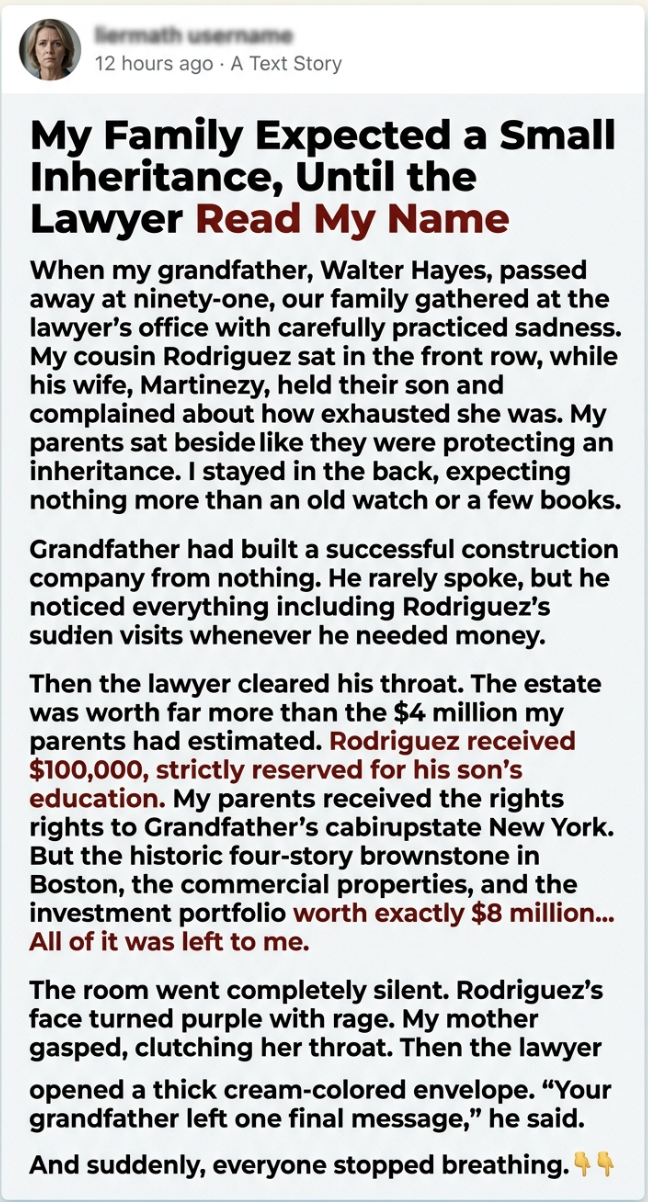
When my grandfather, Walter Hayes, passed away at ninety-one, our family gathered at the lawyer’s office with carefully practiced sadness.
My cousin Rodriguez sat in the front row, while his wife, Martinezy, held their son and complained about how exhausted she was.
My parents sat beside them, whispering about property taxes, maintenance costs, and whether the cabin could be sold.
I stayed in the back.
I expected nothing more than an old watch, a few books, or perhaps one of Grandfather’s worn leather jackets.
That was all I had ever wanted from him.
A memory.
A small piece of the man who had taught me that hard work mattered more than applause.
Grandfather had built a successful construction company from nothing. He had started with one borrowed truck, a toolbox, and a contract repairing a damaged bridge outside Boston.
Over the decades, he turned that tiny operation into a respected company with commercial buildings, warehouses, rental properties, and historic homes.
He never flaunted his wealth.
He drove the same dark-green sedan for nearly twenty years.
He wore simple shirts.
He repaired broken furniture instead of replacing it.
And he never trusted people who became generous only when they smelled money.
That was why he rarely spoke during family gatherings.
He watched.
He remembered.
He noticed everything.
Especially Rodriguez’s sudden visits.
Rodriguez could disappear for months, but the moment he needed money, he would appear at Grandfather’s house with expensive wine and a dramatic story.
A business opportunity.
A medical emergency.
A temporary cash-flow problem.
A debt he promised to repay.
Grandfather always listened.
But he never gave Rodriguez as much as he expected.
Afterward, Grandfather would call me into his study and ask, “What do you think?”
I used to believe he was asking about the money.
I later understood he was asking whether I had noticed the pattern.
Rodriguez didn’t visit because he missed him.
He visited because he wanted something.
My parents weren’t much different.
They spoke about Grandfather with respect in public, but privately they complained that he was too stubborn, too secretive, and too slow to make decisions.
They had already estimated his estate at around $4 million.
My father said it confidently, as if he had personally inspected every account.
“Most of it is tied up in old properties,” he told my mother during the funeral reception. “There won’t be much cash.”
My mother sighed.
“At least the cabin should be worth something.”
Rodriguez overheard them and smiled.
“Whatever happens, I’m sure Grandpa wanted the family taken care of.”
He said it while checking his phone.
I said nothing.
Grandfather had taught me that silence was often the best way to discover what people truly believed.
Two weeks later, the family gathered at the office of Martin Collins, Grandfather’s longtime attorney.
The room smelled like polished wood, old paper, and rain coming through the windows.
A large folder rested on the table.
Everyone stared at it.
My father sat forward.
My mother kept adjusting her bracelet.
Rodriguez sat in the front row with Martinezy and their son.
I stayed near the back wall.
Martin looked around the room.
“Thank you all for coming. Before we begin, I want to remind everyone that this is the final, legally executed estate plan of Walter Hayes.”
Rodriguez leaned toward his wife.
“Let’s get this over with,” he whispered.
Martin opened the first page.
“There are several personal gifts.”
He read the names.
A longtime employee received $25,000.
Grandfather’s housekeeper received $40,000.
His mechanic received $15,000.
A local children’s library received $75,000.
A scholarship fund received $250,000.
My mother frowned.
“That seems like a lot of money to give away.”
Martin continued.
“To Rodriguez Hayes, the amount of $100,000, to be placed in an education account for his son.”
Rodriguez’s expression changed.
“An education account?”
Martin nodded.
“The funds may be used only for tuition, books, approved educational expenses, and related costs. They cannot be withdrawn for personal spending.”
Rodriguez’s smile disappeared.
“But I’m his father.”
“That is why the account is structured to protect the child’s future.”
Martinezy shifted uncomfortably.
Rodriguez opened his mouth, but Martin continued before he could speak.
“To Richard and Helen Hayes, Walter leaves the rights to his cabin in upstate New York, including its furnishings and surrounding land.”
My parents exchanged a relieved glance.
The cabin was beautiful.
It sat beside a quiet lake and had belonged to Grandfather for decades.
My mother whispered, “At least we have that.”
Then Martin turned the page.
“The historic four-story brownstone in Boston…”
My father leaned forward.
“…the commercial properties held under Hayes Development…”
Rodriguez stopped moving.
“…and the investment portfolio currently valued at approximately $8 million…”
Martin paused.
I could hear the rain tapping against the office windows.
“All of these assets are left to Mary Miller.”
For a moment, I thought I had misunderstood.
My name sounded unfamiliar in the room.
Mary Miller.
Mine.
Martin looked directly at me.
“Mary, you are the sole beneficiary of these assets, subject to the conditions outlined in the trust.”
The room went completely silent.
My mother gasped.
Rodriguez’s face turned purple.
My father stared at me as if I had walked into the room carrying a weapon.
Martinezy’s mouth fell open.
“No,” Rodriguez said.
Martin lowered his eyes to the document.
“Yes.”
“No. That can’t be right.”
“Your grandfather’s instructions are clear.”
Rodriguez stood.
“He barely spoke to her!”
My mother turned toward me.
“Mary, what did you do?”
I looked at her.
“Nothing.”
“That’s impossible,” she snapped. “You were always the one he favored.”
“I wasn’t favored.”
I swallowed.
“I was present.”
That sentence seemed to anger Rodriguez more than the inheritance itself.
“You manipulated him!”
Martin raised one hand.
“Rodriguez, sit down.”
“He was old! She must have convinced him to change the will.”
“Your grandfather signed this trust three years ago,” Martin said. “It was reviewed and amended twice afterward. Each amendment was witnessed and legally documented.”
My father’s voice became tense.
“Why didn’t any of us know about this?”
“Because Walter did not want the contents disclosed before his death.”
My mother pressed her fingers against her throat.
“But the estate was supposed to be divided equally.”
Martin looked at her calmly.
“Your father-in-law was not legally required to divide his estate equally.”
Rodriguez laughed bitterly.
“So she gets everything?”
“Not everything,” Martin replied. “There are charitable gifts, employee gifts, and educational provisions. But Mary receives the primary assets.”
My father looked at me.
“Mary, you need to understand the responsibility involved.”
I almost smiled.
That was the first thing he had said to me all morning.
Not congratulations.
Not grief.
Responsibility.
As if I had suddenly become a child who needed instruction.
Martin reached beneath the folder and removed a thick, cream-colored envelope.
“Before we discuss the trust conditions, Walter left one final message.”
Everyone became still.
The envelope had my name written across the front in Grandfather’s handwriting.
Mary Miller.
My hands felt cold.
Martin opened it carefully.
“Walter requested that this letter be read aloud in the presence of the family.”
Rodriguez sat back down.
My mother leaned forward.
Martin began.
“To my family,
If you are hearing this letter, then I am no longer able to explain my decision myself.
I know some of you will be angry.
I know some of you will say Mary received too much.
I know some of you will claim that she influenced me.
But I want you to understand something before you judge her.
Mary did not ask for my money.
She never once asked what I planned to leave her.
She never visited me with a request.
She never called only when she needed help.
She came when I was lonely.
She brought groceries when my hands became weak.
She repaired the loose railing on my porch.
She sat with me during the nights when I could not sleep.
She listened to the same stories I had told her a hundred times.
And when I asked her what she wanted from me, she always answered the same way:
‘Nothing, Grandpa. I just wanted to see you.’
That answer told me everything.”
My mother lowered her gaze.
Rodriguez looked toward the window.
Martin continued.
“I have watched this family confuse inheritance with love.
Some of you measured my worth by the size of my estate.
Some of you visited when you needed money.
Some of you assumed that being related to me entitled you to what I built.
But Mary understood that a person is not a bank account.
She treated me like a human being when everyone else treated me like an opportunity.
That is why I trust her.”
My father shifted in his chair.
Martin turned the page.
“Mary, the assets I leave you are not a reward for being perfect.
They are not payment for your kindness.
They are a responsibility.
Protect the employees who helped build the company.
Keep the properties maintained.
Do not allow anyone to pressure you into selling what you do not want to sell.
And never let people convince you that generosity requires surrendering your peace.
If your family asks for money, remember that you are allowed to say no.
If they accuse you of changing, remember that sometimes people only notice your boundaries when they can no longer cross them.
You are not required to become smaller so other people can feel important.
Live well.
Love carefully.
And choose people who recognize you before they recognize your bank account.
—Walter Hayes.”
Martin folded the letter.
Nobody spoke.
For the first time in my life, Grandfather had said everything he had kept inside.
My mother was the first to break the silence.
“He was confused near the end.”
Martin’s expression hardened.
“Walter was evaluated by two independent physicians before the final amendment. Both confirmed that he understood the nature and consequences of his decisions.”
Rodriguez shook his head.
“He would never leave that much to her.”
“He did,” Martin said.
My father looked at me.
“You knew about this.”
“No.”
“You expect us to believe that?”
“I didn’t know the amount. I didn’t know the trust existed.”
“But you knew he loved you.”
I looked down at the letter.
“I knew he loved me. That was enough.”
Rodriguez stood again.
“This is not fair.”
Martin gathered the documents.
“Fairness is not determined by whoever shouts the loudest.”
Rodriguez pointed at me.
“You’re going to regret this.”
I finally turned toward him.
“Regret what?”
“Taking everything.”
“I didn’t take anything.”
“You’re sitting there acting innocent.”
“I’m grieving my grandfather.”
“You’re rich now!”
His voice echoed through the office.
There it was.
The truth he had been trying to hide.
He didn’t see a grieving granddaughter.
He saw $8 million.
My mother stood beside him.
“Mary, you have to help your family.”
“With what?”
“Your father has debts.”
My father’s face tightened.
“Your mother didn’t mean—”
“She meant exactly what she said,” I replied.
My mother’s eyes filled with tears.
“We are your parents.”
“And I’m your daughter,” I said. “But that doesn’t mean Grandfather’s estate belongs to you.”
Rodriguez scoffed.
“You’re going to keep all of it?”
I looked at Martin.
“What are the conditions?”
Martin explained that the commercial properties and company shares were placed into a protected trust. I could manage them, but selling certain core assets required independent review.
Grandfather had also created an employee protection fund.
A percentage of annual profits would go toward healthcare support, retirement assistance, and scholarships for longtime workers’ children.
He had planned everything.
Even after death, he was protecting the people who had built his life with him.
Then Martin handed me another document.
“This is the letter of instruction for the trust.”
I read the first line.
“Mary is not to be pressured into distributing personal funds to relatives.”
I almost laughed through my tears.
Grandfather had anticipated the entire room.
The next few weeks were difficult.
The family called constantly.
My mother left long messages about how disappointed she was.
My father sent spreadsheets showing his debts.
Rodriguez sent angry texts accusing me of destroying the family.
Then he sent a softer message.
“We should talk like adults. I’m willing to settle for $1 million.”
I stared at the screen.
Settle.
As if he were negotiating a business contract.
I replied:
“There is nothing to settle. Grandfather made his decision.”
He responded immediately.
“You’re selfish.”
I blocked him.
My parents were more persistent.
They came to my house one evening carrying folders.
My father placed them on the table.
“These are the family obligations.”
I opened the first folder.
It contained loans, unpaid credit cards, property repairs, and several personal expenses.
“Why are these my obligations?”
“Because you inherited the estate.”
“I inherited Grandfather’s assets. I did not inherit your debts.”
My mother looked wounded.
“You’re becoming cold.”
“No,” I said. “I’m becoming clear.”
My father’s face darkened.
“You think money makes you better than us?”
“Money doesn’t make me better than anyone.”
“Then prove it.”
“How?”
“Help your family.”
I looked at the folders.
“I have already decided to create a family assistance policy. It will be based on documented need, repayment terms, and independent review. No private demands. No emotional pressure. No money given because someone shares my last name.”
My father pushed back from the table.
“You’re treating us like strangers.”
“You treated Grandfather like an inheritance.”
That ended the conversation.
Months passed.
I moved into the Boston brownstone, but I kept Grandfather’s old apartment untouched.
His books remained on the shelves.
His worn chair stayed beside the window.
His watch sat inside the desk drawer.
I visited the construction company and met the employees.
Many of them had known Grandfather for decades.
One older foreman named Thomas shook my hand.
“Your grandfather told us you were the one he trusted.”
I felt tears rise.
“I didn’t know he said that.”
“He said it often.”
The company’s financial reports were strong, but there were problems.
Several executives had been taking unnecessary bonuses.
A contractor had been overbilling.
One property manager had been hiding maintenance failures.
I hired an independent audit team.
We corrected the problems, protected the employees, and redirected profits into the trust’s scholarship and healthcare funds.
For the first time, I understood what Grandfather meant when he said the inheritance was a responsibility.
It wasn’t about owning buildings.
It was about deciding what kind of person I would become after receiving them.
One year after the funeral, I hosted a small gathering at the brownstone.
I invited Grandfather’s employees, the scholarship recipients, his housekeeper, and a few people who had cared for him without expecting anything.
My parents were not invited.
Neither was Rodriguez.
The evening was quiet and warm.
We ate at a long wooden table.
Someone told a funny story about Grandfather accidentally driving his old sedan into a flower bed.
Everyone laughed.
For a moment, he felt close.
After dinner, I stood near the window and looked out at the city.
Martin approached me.
“Walter would be proud.”
“I hope so.”
“He knew exactly what he was doing.”
I touched the watch inside my pocket.
“I still wish he were here.”
Martin nodded.
“So do I.”
Later that night, I opened the final page of the trust documents.
There was one handwritten sentence at the bottom.
I had missed it during the first reading.
It said:
“The greatest inheritance is not what you receive. It is what you refuse to let money turn you into.”
I sat quietly for a long time.
My family had expected a small inheritance.
They had estimated the value of Grandfather’s life.
They had divided his possessions before the lawyer even opened the will.
But Grandfather had left me something they never understood.
Not just the brownstone.
Not just the commercial properties.
Not just the $8 million portfolio.
He had left me the freedom to choose who I would become.
And I finally understood why he had written my name.
Because I had never treated him like a fortune.
I had treated him like family.
And in the end, he left his fortune to the only person who had loved him before knowing what he was worth.