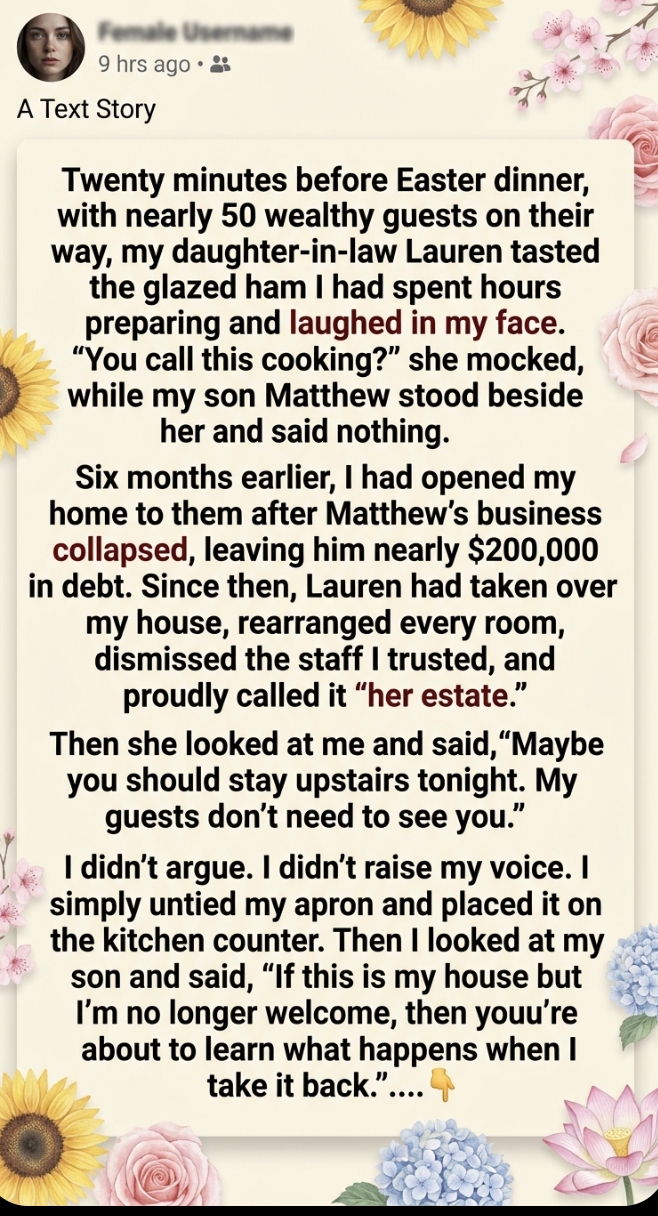
Twenty minutes before Easter dinner, my kitchen looked like a battlefield.
The glazed ham had taken nearly four hours.
The potatoes were still steaming.
Fresh bread was cooling beside the window, and the dining room had been prepared for nearly fifty guests—most of them wealthy friends and business associates my daughter-in-law, Lauren, desperately wanted to impress.
I stood at the kitchen counter, exhausted but proud.
Then Lauren walked in.
She wore an expensive cream-colored dress, carried a glass of sparkling water, and looked around my kitchen as if she owned every inch of it.
She picked up a fork.
Took a bite of the ham.
Chewed.
Then laughed.
Not a polite laugh.
A cruel one.
“You call this cooking?”
I stared at her.
Lauren shook her head.
“My guests are going to expect something better than this.”
My son Matthew was standing beside her.
He heard every word.
He looked at me.
Then looked away.
That hurt more than Lauren’s insult.
Because six months earlier, everything had been different.
Matthew had come to me with tears in his eyes.
His business had collapsed.
His investors had walked away.
His creditors were demanding answers.
He was nearly $275,000 in debt.
He told me he didn’t know where else to go.
So I opened my home.
“Stay here,” I had said.
“You’re my son.”
I never asked him for rent.
I never asked him to repay me immediately.
I gave him and Lauren the largest guest suite in the house.
I told them they could use the office.
I even let them bring their furniture in.
I thought I was helping my family get back on their feet.
I didn’t realize I was slowly being pushed out of my own home.
First, Lauren rearranged the furniture.
Then she replaced the curtains.
Then she dismissed the housekeeper I’d trusted for seventeen years.
“She doesn’t fit the new atmosphere,” Lauren explained.
Next came the gardener.
Then the cook.
Then the people who had helped maintain the house for years.
Every time I objected, Lauren smiled.
“I’m just modernizing things.”
Eventually, she started calling the property “our estate.”
Not my house.
Not the family home.
“Our estate.”
And somehow, my son never corrected her.
Tonight was supposed to be the final humiliation.
Lauren had invited nearly fifty guests for Easter dinner.
Business owners.
Investors.
Socialites.
People she wanted to impress.
And she wanted everything perfect.
Except me.
She placed her glass on the counter.
Then looked directly into my eyes.
“Maybe you should stay upstairs tonight.”
I blinked.
“What?”
She smiled.
“My guests don’t need to see you.”
For a moment, nobody spoke.
Matthew stood behind her.
Silent.
I waited for him to say something.
Anything.
He didn’t.
So I untied my apron.
Slowly.
Carefully.
I placed it on the counter.
Then I looked at my son.
“If this is my house but I’m no longer welcome…”
I paused.
“…then you’re about to learn what happens when I take it back.”
Lauren laughed.
Actually laughed.
“You’re being dramatic.”
“No,” I said quietly.
“I’ve been patient.”
Her smile remained.
Until I reached into my pocket.
I pulled out a folded document.
Lauren’s eyes dropped to it.
“What is that?”
I unfolded it.
Matthew suddenly went pale.
Because he recognized it.
It was the original property deed.
The house wasn’t theirs.
It wasn’t Matthew’s.
It wasn’t Lauren’s.
It was mine.
And according to the document, something else was mine too.
The renovation loan.
The furniture.
The vehicles.
The investment account Matthew had been using to rebuild his business.
Every major asset had been purchased through money I had provided.
Lauren stared at the papers.
“But… Matthew told me—”
“I know what Matthew told you.”
I looked at my son.
“And that’s why we’re going to have a conversation.”
Matthew finally stepped forward.
“Mom, please.”
“Please what?”
He swallowed.
“Don’t do this tonight.”
I almost smiled.
“Tonight?”
I looked toward the dining room.
“Tonight is exactly when I should do it.”
Lauren’s confidence disappeared.
But I wasn’t finished.
I pulled another envelope from my pocket.
“This is a copy of the agreement you both signed when you moved in.”
Lauren stared at it.
“What agreement?”
“The one you apparently forgot.”
Matthew closed his eyes.
I continued.
“You were allowed to stay here temporarily while Matthew rebuilt his company.”
I placed the document on the counter.
“You were never given ownership.”
Lauren’s face tightened.
“That doesn’t mean anything.”
“It means everything.”
Then I showed them the final page.
There was one condition they had both agreed to.
If either of them attempted to claim the house as their own, their permission to live there would immediately end.
Lauren looked at Matthew.
“You knew about this?”
He nodded.
Barely.
Her face changed.
“You knew?”
Matthew whispered, “I thought we’d have more time.”
Lauren turned toward me.
“You can’t throw us out.”
“I don’t have to.”
I pointed toward the front door.
“You have thirty days.”
Lauren looked stunned.
“But where are we supposed to go?”
I picked up my apron.
“Somewhere you actually belong.”
Then the doorbell rang.
One of the first guests had arrived.
Lauren froze.
For months, she had been desperate to impress these people.
Now she stood in my kitchen, realizing they were about to walk into a house she had been pretending to own.
I walked toward the dining room.
Then I stopped.
I turned back to Matthew.
“You know what hurts the most?”
He couldn’t answer.
“It isn’t the money.”
His eyes filled with tears.
“It isn’t the furniture.”
I shook my head.
“It isn’t even what Lauren said to me.”
I looked directly at him.
“It is that you watched her erase me from my own home because you were too afraid to tell her the truth.”
Matthew lowered his head.
“I was ashamed.”
“Of what?”
“That I failed.”
I stared at him.
“You didn’t fail because your business collapsed.”
He looked up.
“You failed when you forgot who stood beside you when it did.”
Silence.
Then something unexpected happened.
Matthew walked toward me.
He reached for my hand.
“I’m sorry, Mom.”
For the first time in six months, I believed him.
Lauren stood behind him, speechless.
The guests continued arriving.
But instead of hiding upstairs, I walked into the dining room.
I greeted every person personally.
And when one guest asked who owned the beautiful home, I smiled.
“I do.”
Lauren heard me.
She didn’t say a word.
That Easter dinner became something none of us had expected.
It wasn’t the elegant party Lauren had planned.
It became a lesson.
A few weeks later, Lauren moved out.
Matthew stayed.
Not because I needed him to.
Because he finally understood that rebuilding a life wasn’t about pretending to be successful.
It was about being honest when you weren’t.
He eventually started a smaller business.
This time, he built it carefully.
And every Sunday, he came home for dinner.
One year later, Easter came again.
There were no fifty wealthy guests.
No expensive decorations.
No performance.
Just family.
Matthew helped me prepare the ham.
He tasted the glaze.
Then smiled.
“Mom…”
I raised an eyebrow.
He laughed.
“This is the best ham you’ve ever made.”
I smiled.
“Careful.”
He laughed again.
“I learned my lesson.”
I looked around my dining room.
The same house.
The same table.
But everything felt different.
Because sometimes people don’t appreciate what they have until they believe they’ve lost it.
And sometimes the strongest thing you can do isn’t scream, fight, or seek revenge.
Sometimes you simply stand quietly, open the drawer, pull out the truth…
…and let the truth speak for itself.
Never confuse someone’s kindness with weakness.
A person can open their door to you out of love—and still have the strength to close it when you stop respecting them.