The first thing I noticed about the Marine base was how quiet it was.
Not peaceful.
Quiet.
The kind of quiet where every movement seemed deliberate.
I had arrived just before sunrise, wearing plain clothes and carrying only a small travel bag.
No uniform.
No escort.
No ceremony.
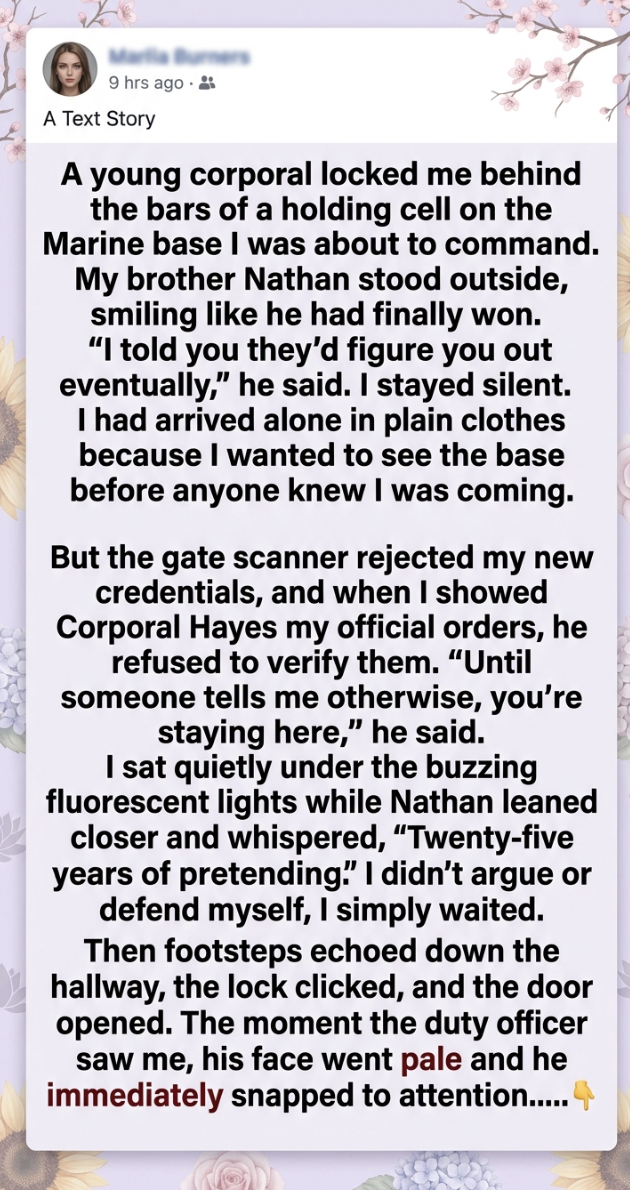
I wanted to see the base before anyone knew I was coming.
In three days, I was scheduled to officially assume command.
After twenty-five years in the military, I had learned something important:
People behave differently when they know the person in charge is watching.
I didn’t want polished answers.
I wanted the truth.
So I walked toward the main gate alone.
I handed the guard my identification.
He scanned it.
The machine beeped.
Then flashed red.
“Credential rejected.”
I frowned.
“That shouldn’t happen.”
The young corporal checking the screen looked at me.
“Try again.”
I did.
Red.
Again.
Red.
The corporal’s expression changed.
“Who are you?”
I handed him my official orders.
He unfolded the paper and read the first few lines.
Then he looked at me.
“You’re saying you’re here to take command?”
“Yes.”
He almost smiled.
“Right.”
I could tell he didn’t believe me.
“My orders are official.”
“Maybe.”
He handed the paper back.
“But I can’t verify them.”
“Call the duty officer.”
“I already called.”
“And?”
“No response.”
I looked toward the administration building.
“Then take me there.”
The corporal shook his head.
“I’m not letting an unauthorized person walk onto this installation.”
I took a breath.
“Corporal Hayes, I understand your concern. But these orders were issued through proper channels.”
He looked at the document again.
Then at me.
“Until someone tells me otherwise, you’re staying here.”
I stared at him.
“Where?”
He pointed toward a small building.
“The holding cell.”
I almost laughed.
But I didn’t.
I followed him.
The steel door opened.
I stepped inside.
The door shut behind me.
Click.
The lock engaged.
I sat on the narrow bench beneath the buzzing fluorescent light.
I wasn’t angry.
I wasn’t frightened.
I was curious.
Because something was wrong.
Not with me.
With the base.
Then I heard a familiar voice.
“Looks like you finally got caught.”
I looked up.
My brother Nathan stood outside the bars.
He was smiling.
Nathan.
My younger brother.
The man who had spent most of our lives trying to prove that I wasn’t as capable as everyone believed.
He leaned against the wall.
“I told you they’d figure you out eventually.”
I said nothing.
He laughed quietly.
“Twenty-five years of pretending.”
I looked at him.
“Pretending what?”
“That you’re something you’re not.”
I remained silent.
Nathan stepped closer.
“You really thought you could walk in here wearing regular clothes and convince everyone you’re the new commander?”
I said nothing.
He shook his head.
“You always did love attention.”
That almost made me smile.
Because Nathan had no idea what was happening.
He thought I was trapped.
He thought the gate rejection had exposed me.
He thought my career was about to collapse.
But there was something he didn’t know.
I had never been afraid of being underestimated.
In fact, I had built my career on it.
For years, I had deliberately kept my personal life private.
Even Nathan didn’t know everything about my assignments.
He knew I had served for twenty-five years.
He knew I had been promoted repeatedly.
But he didn’t know my current rank.
He didn’t know the details of my final assignment.
And he certainly didn’t know what those orders actually said.
Nathan stared at me through the bars.
“You know what’s funny?”
I waited.
“I always thought you’d eventually get exposed.”
“Exposed for what?”
He smiled.
“For pretending to be someone important.”
I leaned back against the wall.
“Interesting.”
“What?”
“I didn’t realize you were this confident.”
His smile faded slightly.
“What does that mean?”
“Nothing.”
The fluorescent light hummed above us.
Minutes passed.
Then twenty.
Then thirty.
Nathan eventually left.
Before he walked away, he turned around.
“This is over.”
I watched him disappear down the hallway.
I still didn’t move.
Because I knew something he didn’t.
My orders hadn’t been forged.
My credentials hadn’t been fake.
And I wasn’t an ordinary officer walking onto the base.
I was the person who had been assigned to inspect the installation before taking command.
That was the reason I had come alone.
I wanted to see what happened when nobody knew who I was.
And what I had seen so far told me there were serious problems.
A gate system that couldn’t recognize newly issued credentials.
A corporal who couldn’t reach the duty officer.
A command structure that apparently couldn’t verify official orders.
And, somehow, my own brother had been waiting for me.
That last part bothered me most.
How had Nathan known where I would be?
I closed my eyes.
Then I heard footsteps.
Not hurried.
Not casual.
Measured.
Several people were approaching.
Corporal Hayes appeared at the end of the hallway.
Behind him was a senior officer.
The officer was reading something on a tablet.
He stopped.
Looked at me.
Then looked at the document in his hand.
His expression changed instantly.
He walked closer.
“Sir?”
I stood.
The officer looked at my face.
Then at my orders.
Then back at me.
His face went pale.
For a second, he couldn’t speak.
Then he straightened his uniform.
His heels came together.
His right hand snapped upward.
“ATTENTION!”
The hallway changed instantly.
Every Marine nearby straightened.
The corporal froze.
Nathan, who had returned after hearing the commotion, stood completely still.
The duty officer stepped toward the cell.
“Sir, I sincerely apologize.”
I looked at him calmly.
“Open the door.”
“Yes, sir.”
The lock clicked.
The door swung open.
I stepped out.
Corporal Hayes looked like he wanted the floor to disappear beneath him.
“Sir, I—”
I raised my hand.
“Corporal.”
“Yes, sir.”
“You followed procedure based on the information available to you.”
He swallowed.
“Yes, sir.”
“That part was correct.”
Relief crossed his face.
“But the system failure wasn’t.”
His expression fell again.
“No, sir.”
I turned toward the duty officer.
“Who authorized the credential system update?”
“We’re still investigating, sir.”
“And who knew my arrival date?”
He hesitated.
“Only senior command personnel.”
I looked down the hallway.
Nathan was still standing there.
Suddenly, the smile was gone.
I turned toward him.
“You seem surprised.”
He couldn’t answer.
The duty officer looked between us.
“Sir, is this your brother?”
“Yes.”
Nathan finally spoke.
“I didn’t know.”
I raised an eyebrow.
“You didn’t know what?”
“That you were…”
He couldn’t finish the sentence.
I waited.
Finally, the duty officer spoke.
“General, we need to brief you immediately.”
Nathan’s face went white.
The word hung in the air.
General.
Twenty-five years.
That was what Nathan had called pretending.
He had spent years believing I was exaggerating my career.
Believing I had been lucky.
Believing my promotions were political.
Believing I had something to hide.
The truth was simpler.
I had never needed to prove anything to him.
The duty officer handed me my official identification.
“The system rejected your new credentials because the update was scheduled for activation at the formal change-of-command ceremony.”
I nodded.
“That explains the scanner.”
“And Corporal Hayes couldn’t verify your orders because the authorization list hadn’t been updated.”
I looked at Hayes.
He stood perfectly still.
“I understand.”
Then I turned to the duty officer.
“But there’s another problem.”
He waited.
“My brother knew I was coming.”
Nathan looked at me.
I continued.
“He knew the exact gate I would use.”
Silence.
The duty officer’s expression hardened.
“Sir…”
“Find out how.”
“Yes, sir.”
Nathan suddenly stepped forward.
“I didn’t do anything.”
I looked at him.
“I didn’t accuse you.”
He stopped.
That silence told me more than an accusation ever could.
Because people who had nothing to hide usually didn’t rush to defend themselves.
I walked past him.
At the end of the hallway, I stopped.
I turned around.
“Corporal Hayes.”
“Yes, sir?”
“You did one thing right today.”
He looked confused.
“You didn’t let someone through simply because they claimed to be important.”
I nodded toward the gate.
“Never abandon procedure just because someone looks convincing.”
“Yes, sir.”
I walked away.
That morning, I officially assumed command.
But before the ceremony, I ordered a full security review.
The investigation eventually revealed that someone had intentionally interfered with the credential transition.
Nathan hadn’t personally changed the system.
But he had been communicating with someone on the inside.
He had believed that if my credentials failed publicly, my command appointment would be delayed and my reputation damaged.
He wanted me embarrassed.
Instead, he accidentally exposed a security weakness before I officially took command.
The incident became one of the first major problems I had to solve.
And I solved it.
Not by punishing everyone involved.
Not by shouting.
Not by proving Nathan wrong.
I simply did my job.
Months later, the base was operating more securely than it had in years.
Corporal Hayes was promoted after demonstrating exceptional judgment under pressure.
And Nathan?
He eventually came to my office.
He stood in the doorway for several seconds.
“I was jealous,” he finally said.
I looked up from my desk.
“I know.”
“I spent my whole life thinking you were trying to make me feel smaller.”
I shook my head.
“I was never competing with you.”
He looked down.
“I know that now.”
There was a long silence.
Then he said something I never expected.
“I’m proud of you.”
I didn’t answer immediately.
Not because I was angry.
Because some words take years to arrive.
Finally, I smiled.
“Thank you.”
He nodded.
Then he left.
I returned to my work.
Because the lesson wasn’t that I had been underestimated.
The lesson was that I never needed to announce who I was.
My record already knew.
My orders already knew.
And when the moment came, the truth didn’t need an argument.
It only needed someone to open the door.
Sometimes the most powerful response to being underestimated isn’t proving people wrong—it’s quietly becoming undeniable.