For thirty-two years, I worked at Lincoln Elementary School.
My name is Daniel Rivera.
Most children simply called me Mr. Rivera.
I wasn’t a teacher.
I wasn’t the principal.
I wasn’t even part of the cafeteria staff.
I was the school custodian.
But after three decades in the same building, I learned that children don’t care much about job titles.
They care about who remembers their names.
Who notices when they’re having a bad day.
Who asks why they haven’t eaten.
And sometimes, they care about who leaves a small brown paper bag waiting for them on Friday afternoon.
It started nine years ago.
I noticed several children behaving differently on Fridays.
They lingered around the cafeteria.
Some quietly asked whether anyone had leftover food.
Others saved half of their lunch inside their backpacks.
At first, I didn’t understand.
Then one Friday afternoon, I watched a little boy carefully wrap half a sandwich in a napkin.
“Why are you saving that?” I asked.
He shrugged.
“My little sister likes turkey.”
That answer stayed with me.
I spoke with a few teachers.
Eventually, I learned that several children depended heavily on school meals during the week.
When Friday afternoon came, some families had very little food available until the following Monday.
I went to the administration.
I asked whether the school could create a weekend food program.
The answer was complicated.
Liability concerns.
Budget limitations.
Storage requirements.
Permission forms.
I understood.
Schools have rules for good reasons.
But knowing the rules didn’t make me forget those children’s faces.
So I started something quietly.
Every Thursday evening, I went grocery shopping.
Eight sandwiches.
Eight pieces of fruit.
Eight granola bars.
Eight juice boxes.
Nothing extravagant.
Just enough to help.
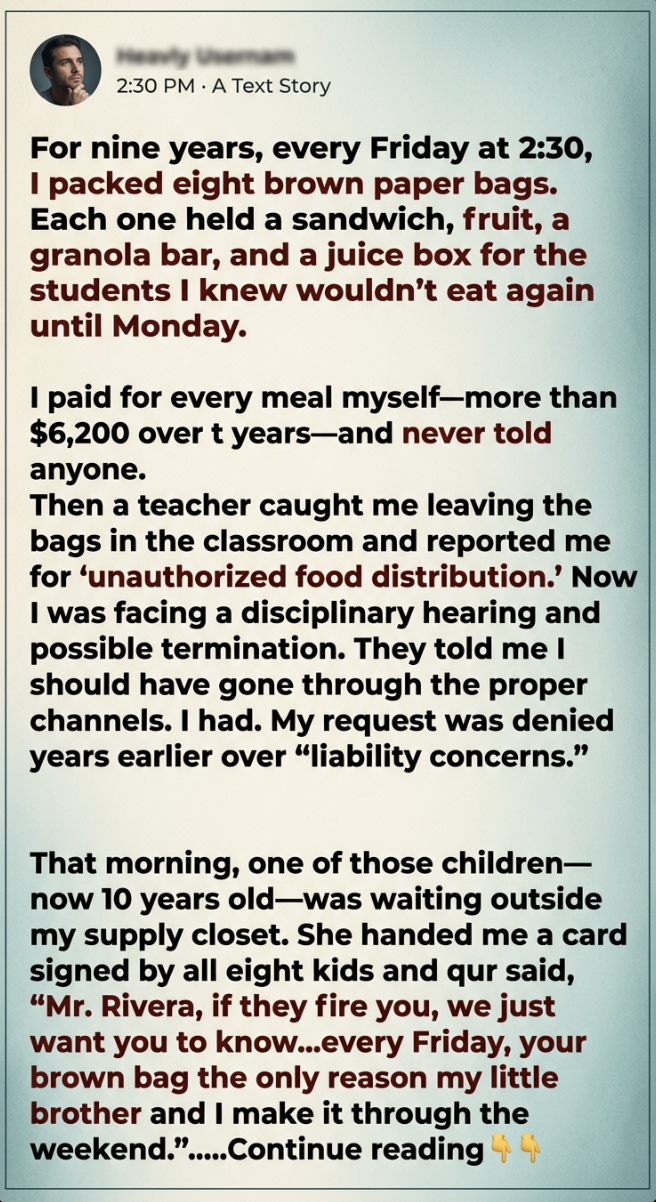
Every Friday at exactly 2:30, I packed the bags.
I placed them discreetly inside a classroom cabinet.
The children knew where to find them.
No names were written on the bags.
No photographs.
No announcements.
No social media posts.
I didn’t want anyone feeling embarrassed.
For nine years, I paid for everything myself.
More than $6,200.
Sometimes I had to cut back on my own expenses.
Sometimes I bought cheaper groceries.
But I never regretted it.
Then one Friday, everything changed.
A new teacher walked into the classroom while I was leaving the bags.
She stared at me.
“What are those?”
“Food for some students.”
“Are you authorized to distribute that?”
I explained the situation.
She didn’t argue.
She simply reported it.
The following Monday, I was called into the principal’s office.
There was a formal complaint against me.
Unauthorized food distribution.
I could face suspension.
Possibly termination.
The principal looked uncomfortable.
“Daniel, you know we have procedures.”
“I asked for permission.”
“We have the request on file.”
“And it was denied.”
He nodded.
“Yes.”
I looked at him.
“Then what was I supposed to do?”
He didn’t answer.
The disciplinary hearing was scheduled for Friday morning.
I barely slept the night before.
Not because I was ashamed.
I wasn’t.
But after thirty-two years, the thought of losing the school I loved was painful.
That morning, I arrived early.
I unlocked my supply closet.
Before I could step inside, I heard a small voice.
“Mr. Rivera?”
I turned.
Lily was standing in the hallway.
She was ten years old.
One of the original eight children.
She was holding a handmade card.
“What are you doing here so early?”
She smiled nervously.
“We wanted to give you something.”
She handed me the card.
It was covered in colorful drawings.
Eight children’s names were written across the bottom.
I opened it.
Inside were several handwritten messages.
“Thank you.”
“Thank you for remembering us.”
“Thank you for Fridays.”
Then Lily pointed to one sentence.
I read it slowly.
“Mr. Rivera, if they fire you, we just want you to know that every Friday, your brown bag is the only reason my little brother and I make it through the weekend.”
I had to sit down.
For nine years, I thought I was giving them food.
I hadn’t realized how much the simple act of remembering them mattered.
Lily wiped her eyes.
“My brother always asks if it’s Friday yet.”
I hugged her.
“Thank you for this.”
She smiled.
“We’re going to tell them.”
“Tell who?”
“The people at the hearing.”
I shook my head.
“You don’t have to.”
She looked at me seriously.
“Yes, we do.”
At 10:00 a.m., the disciplinary hearing began.
The board members sat behind a long table.
The teacher who had reported me explained her concerns.
She wasn’t cruel.
She was simply following policy.
Then the superintendent spoke.
“Mr. Rivera, do you acknowledge that you distributed food without formal authorization?”
“Yes.”
“Did you know the policy?”
“Yes.”
“Why did you continue?”
I looked down at the brown paper bag sitting beside me.
Then I answered.
“Because the policy told me what I wasn’t allowed to do.”
“But the children were telling me what they needed.”
The room became quiet.
Then the door opened.
Lily walked in with her mother.
Behind them were the other seven children and several parents.
The principal looked surprised.
Lily walked to the front.
Her hands were shaking.
But she didn’t turn around.
She looked directly at the board.
“Mr. Rivera helped us.”
One board member asked gently,
“How?”
She explained.
The other children added their own stories.
One boy said the Friday bags helped his family during a difficult period.
Another child explained that Mr. Rivera never made anyone feel ashamed for accepting food.
Then Lily held up the card.
“He never asked for anything.”
“He never told people.”
“He just helped us.”
The room became emotional.
Then something unexpected happened.
The teacher who had reported me stood up.
She looked at me.
“I want to apologize.”
Everyone turned toward her.
“I reported him because I believed he was breaking the rules.”
She paused.
“But I didn’t know the whole story.”
She looked at the board.
“Maybe we should ask why our system left these children needing a secret food program in the first place.”
The superintendent lowered his head.
He knew she was right.
The board postponed my disciplinary decision.
Instead, they launched an investigation into the school’s food-support policies.
Within three months, the district created a formal weekend meal program.
Local grocery stores donated food.
Parents volunteered.
Community organizations provided funding.
Teachers received training on identifying families who needed assistance.
And the program expanded far beyond those original eight children.
One Friday afternoon, I walked into the cafeteria and saw hundreds of brown paper bags lined up on tables.
I smiled.
A volunteer approached me.
“Where should these go?”
I pointed toward the classrooms.
“Wherever a child needs one.”
Two years later, I retired.
On my final day, I expected a small farewell.
Maybe coffee and cake.
Instead, the entire school gathered in the auditorium.
Lily walked onto the stage.
She was twelve now.
She carried something familiar.
A brown paper bag.
She placed it on the podium.
“I used to think this bag was about food.”
She looked toward me.
“Now I understand it was about knowing someone cared whether we made it through the weekend.”
The auditorium became silent.
Then she smiled.
“You taught us something nobody can put into a lunch bag.”
“Kindness.”
The applause lasted several minutes.
Afterward, Lily came over and hugged me.
“Mr. Rivera?”
“Yes?”
“I still remember the first Friday.”
“So do I.”
She smiled.
“My brother is doing great.”
“He’s in middle school now.”
“I’m proud of him.”
“Good,” I said.
“You should be.”
Before she left, she handed me another card.
This time, only one sentence was written inside.
“You thought you were feeding eight children, but you were teaching eight children that they mattered.”
I kept that card.
I still have it today.
It’s sitting in the same desk drawer where I keep my retirement papers.
Sometimes people ask me whether I regret breaking the rules.
I tell them something different now.
Rules matter.
Procedures matter.
Accountability matters.
But when a system isn’t working for the people it was created to serve, the answer shouldn’t always be punishment for the person who noticed.
Sometimes the answer is to fix the system.
I never set out to become anyone’s hero.
I was just a school custodian who noticed eight children were hungry.
I bought eight sandwiches.
Eight pieces of fruit.
Eight granola bars.
Eight juice boxes.
And for nine years, I quietly placed those bags where small hands could find them.
The food lasted a weekend.
The kindness lasted much longer.
Because sometimes the most important thing a child receives isn’t what’s inside the brown paper bag.
It’s the message written between the lines:
“Someone noticed you.”
“Someone remembered you.”
“You matter.”
And sometimes…
That is enough to change the direction of an entire life.