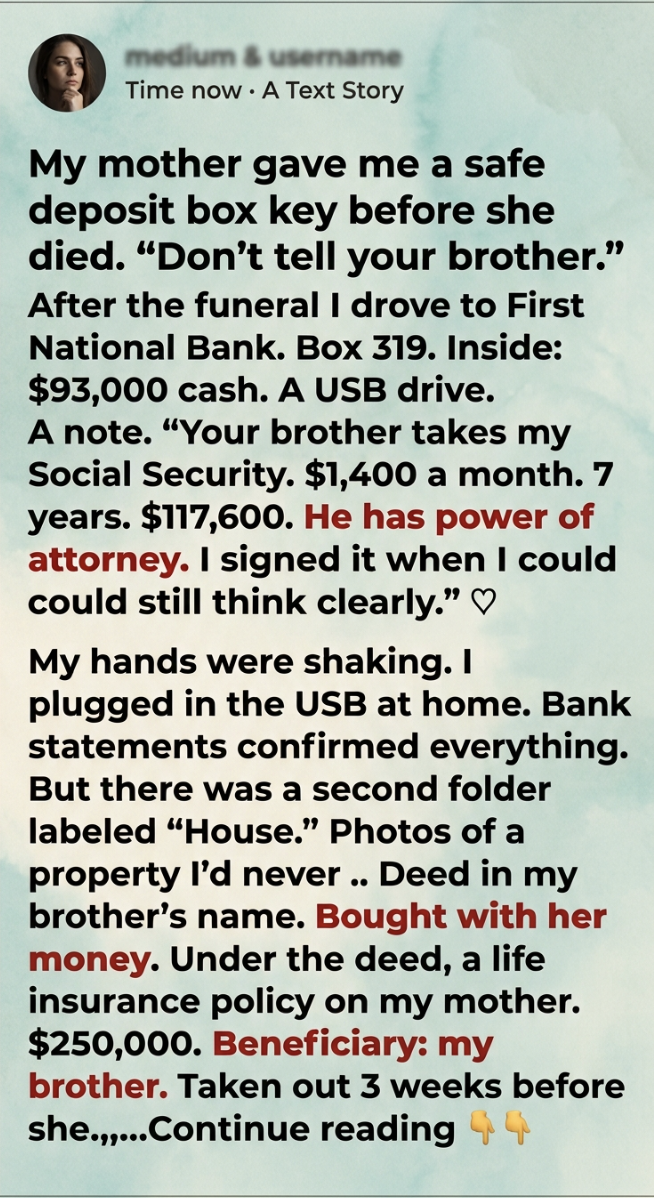
My mother gave me the key three days before she died.
We were sitting together in her bedroom.
She looked tired.
Much older than I remembered.
But her eyes were clear.
She reached beneath her pillow and pulled out a small envelope.
Inside was a brass key.
“Take this.”
I looked at it.
“What is it?”
“A safe-deposit box.”
“At First National Bank.”
I smiled.
“Mom, what’s in it?”
She looked toward the hallway.
Then lowered her voice.
“Don’t tell your brother.”
That was the first time in my entire life my mother had ever asked me to keep something from him.
I knew immediately that something was wrong.
“Why?”
She squeezed my hand.
“Because he will tell you not to look.”
“Promise me you’ll look first.”
I promised.
Three days later, she passed away peacefully.
After the funeral, I couldn’t stop thinking about the key.
The following Monday, I drove to First National Bank.
Box 319.
The bank employee verified my identification and opened the box.
Inside was a thick envelope.
A USB drive.
And a handwritten note.
I opened the envelope first.
There was cash.
Stacks of it.
$93,000.
My hands began shaking.
Then I unfolded the note.
“Your brother has been taking my Social Security.”
“Approximately $1,400 every month.”
“Seven years.”
“About $117,600.”
“He has power of attorney.”
“I signed it when I was still thinking clearly.”
I sat there completely stunned.
My brother had always told everyone he was taking care of Mom.
He said he drove her to appointments.
Paid her bills.
Managed her accounts.
I had believed him.
Then I saw the USB drive.
I took it home.
I plugged it into my computer.
There were folders.
Bank statements.
Tax records.
Payment histories.
Transfers.
Every month, money had been withdrawn from my mother’s account.
Some went to household expenses.
But large amounts went elsewhere.
My brother’s personal account.
Credit cards.
Car payments.
Vacation expenses.
Then I noticed another folder.
HOUSE.
I opened it.
My stomach tightened.
Photographs appeared on the screen.
A beautiful house.
Large backyard.
Modern kitchen.
Expensive furniture.
I had never seen it before.
Then I opened the next file.
The deed.
My brother’s name was listed as the owner.
The purchase price had been paid largely from an account belonging to my mother.
I kept scrolling.
Then I saw another document.
A life insurance policy.
$250,000.
Beneficiary:
My brother.
Policy issued three weeks before my mother’s death.
I sat back in my chair.
For several minutes, I couldn’t move.
My mother had known.
She had been preparing for something.
But why hadn’t she simply told me?
The answer was in another folder.
LETTER.
I opened it.
“I know you will be angry.”
“I am not asking you to destroy your brother.”
“I am asking you to protect yourself and make sure the truth is known.”
“I was afraid.”
“He controlled my money.”
“He told me you didn’t want to be involved.”
“I believed him for a while.”
“Then I started keeping copies.”
“If you are reading this, I finally found the courage to protect what remains.”
I cried.
Not because of the money.
Because my mother had been frightened inside her own family.
The next morning, I contacted an attorney who specialized in elder financial abuse.
I brought everything.
The USB.
The bank records.
The deed.
The insurance policy.
The handwritten note.
The attorney studied everything carefully.
Then said something I will never forget.
“Your mother was trying to leave you a trail.”
We reported the financial activity to the appropriate authorities and notified the bank and insurance company of the dispute.
My brother was furious when he learned I had discovered the records.
He called me immediately.
“You had no right to go through Mom’s things.”
I answered calmly.
“She gave me the key.”
Silence.
Then he said,
“Mom didn’t know what she was doing.”
That sentence stopped me.
Because that was exactly what my mother had feared he would say.
My attorney requested an independent review of her capacity when the power of attorney and later financial documents were signed.
The investigation found inconsistencies in several transactions.
Some withdrawals lacked supporting documentation.
Several transfers had been made without clear evidence that my mother had personally authorized them.
The house purchase became especially important.
The money used for the down payment came from my mother’s accounts.
The insurance policy was also examined.
Eventually, the court ordered that the disputed assets be preserved while everything was investigated.
My brother could no longer simply move money around.
For the first time in years, someone was asking him questions.
Hard questions.
Where did the money go?
Why was the property purchased?
Why were my mother’s funds used?
Why had certain transactions never been disclosed?
He had answers for some.
Not for others.
Months later, the property was sold.
The money that could be traced to my mother was returned to her estate.
The insurance proceeds were placed on hold until the beneficiary dispute was resolved.
My brother eventually admitted that he had used some of Mom’s money for himself.
He insisted he had been “taking care of everything.”
Maybe he believed that.
Maybe he had convinced himself that managing someone’s money gave him permission to use it.
But my mother had a different definition of family.
She had spent her entire life saving for her children.
She never wanted wealth.
She wanted security.
Before the estate was finalized, I returned to the bank.
Box 319 was empty.
Except for one final envelope.
I had never seen it before.
Inside was a photograph of my brother and me as children.
We were sitting beside Mom at a picnic.
On the back she had written:
“You were both my greatest gifts.”
Then beneath that:
“Please don’t let money turn you into enemies.”
I cried when I read it.
Because that was the hardest part.
My mother didn’t want revenge.
She wanted truth.
She wanted her children to understand what had happened without allowing her final years to become a permanent war between us.
Eventually, my brother and I sat down together.
No lawyers.
No documents.
Just two adult children sitting at the same table where our mother used to serve Sunday dinner.
He looked exhausted.
“I messed up.”
I nodded.
“Yes.”
“I thought I was helping.”
“Then you should have asked.”
He looked down.
“I was ashamed.”
I didn’t forgive him immediately.
Trust doesn’t return because someone says sorry.
But I decided not to spend the rest of my life carrying hatred for him.
We agreed to keep Mom’s photograph.
Neither of us would sell it.
Neither would claim it.
It belonged to both of us.
Years later, whenever I think about the safe-deposit box, I realize the $93,000 wasn’t the most valuable thing my mother left behind.
It was the evidence.
The records.
The courage to finally tell the truth.
And most importantly, the reminder that family isn’t defined by who controls the money.
It’s defined by what we do when someone we love becomes vulnerable.
My mother trusted my brother with her finances.
She trusted me with her secret.
In the end, she wasn’t asking me to punish him.
She was asking me to make sure nobody could ever convince her children that her final years didn’t matter.
The last note she left me remains in my desk.
I read it whenever I need reminding of what really matters.
“Protect the truth.”
“Protect yourself.”
“And if you can…”
“Protect your heart from becoming as hard as the people who hurt you.”
That was my mother’s final inheritance.
Not the money.
Not the house.
Not the insurance policy.
Wisdom.
And that was worth far more than anything hidden inside Box 319.