The hardest thing about living in a quiet neighborhood isn’t the silence.
It’s that everyone notices everything.
Every car.
Every visitor.
Every light left on after midnight.
I’d lived on Maple Street for nearly fifteen years.
My next-door neighbors, David and Rachel, had been there almost as long.
They were the kind of couple everyone admired.
Every Saturday morning, they worked in the garden together.
Every Christmas, they invited the whole street for cookies and hot chocolate.
When David broke his leg one winter, Rachel shoveled not only their driveway but mine as well.
They were good people.
At least, that’s what I believed.
One Thursday evening, after finishing dinner, I drove across town to meet an old friend.
As I passed an elegant restaurant overlooking the river, I happened to glance through its large windows.
That’s when I saw her.
Rachel.
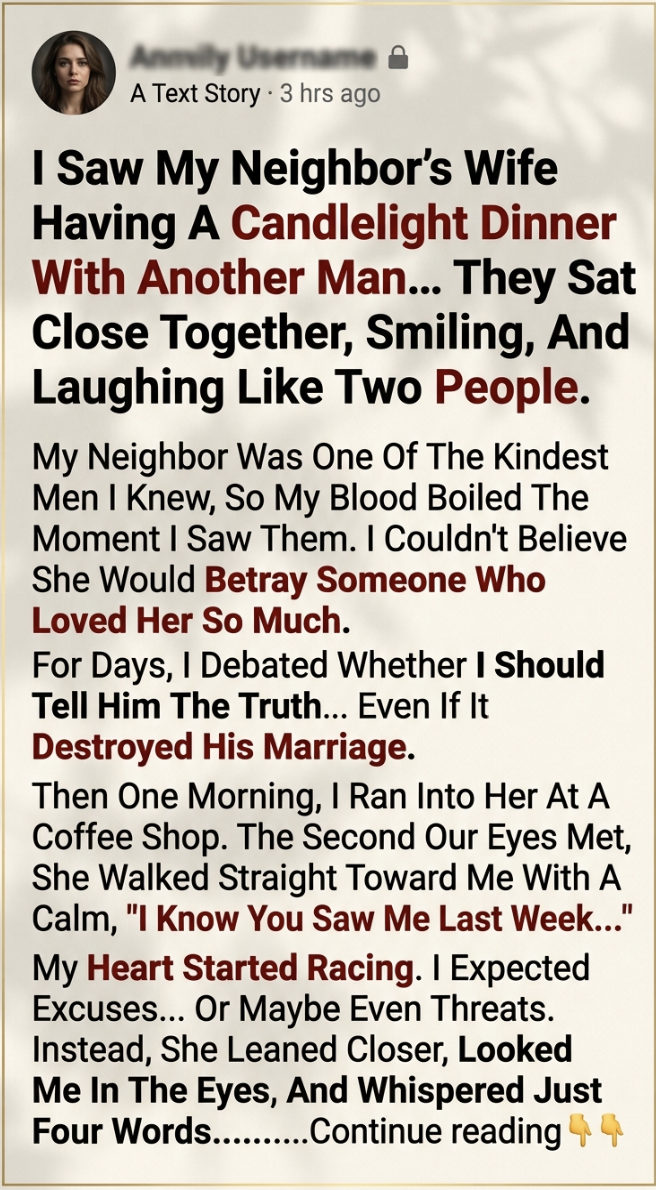
She sat at a candlelit table across from a man I’d never seen before.
They weren’t sitting like casual friends.
Their hands were intertwined.
They smiled at each other with warmth.
At one point, he gently brushed a tear from her cheek.
Then she reached across the table and squeezed his hand.
I felt sick.
David adored his wife.
How could she do this?
For the next several days, the image haunted me.
Every time David waved from his front yard, guilt washed over me.
Should I tell him?
Would I be destroying a marriage?
Or protecting an honest man from living a lie?
I barely slept.
Then, on Monday morning, fate made the decision for me.
I stopped at a small coffee shop before work.
As I turned around with my coffee, I nearly bumped into Rachel.
For a brief second, we simply stared at each other.
She looked surprised.
Then… strangely calm.
She walked toward me.
“I know you saw me last week,” she said quietly.
My heart began pounding.
I expected excuses.
Or anger.
Maybe even denial.
Instead, she leaned closer and whispered only four words.
“That was my brother.”
I blinked.
“What?”
“My younger brother, Daniel.”
She gently motioned toward an empty table.
“If you have a few minutes… I’d like to explain.”
Something in her voice made me sit down.
Rachel wrapped both hands around her coffee before speaking.
“Most people don’t know I have a brother.”
I frowned.
“I’ve lived next door for years.”
She nodded sadly.
“That’s because for almost twenty years… I didn’t.”
She explained that when she was nineteen, their parents divorced bitterly.
During the chaos, Daniel had gone to live with their father overseas while she stayed with their mother.
Distance turned into silence.
Silence became years.
Eventually, they lost contact completely.
Life moved on.
She married David.
Raised children.
Built a new life.
But the ache of losing her little brother never truly disappeared.
Then, three months earlier, she received an unexpected message through social media.
It was Daniel.
Now forty-one years old.
Recently widowed.
A father of one daughter.
He had spent years searching for her.
The dinner I had witnessed wasn’t a romantic date.
It was their first meal together after nearly two decades apart.
“The moment we saw each other,” Rachel whispered through tears, “we both cried.”
I suddenly remembered the tear he had gently wiped from her cheek.
Not romance.
Family.
“I held his hand,” she continued, “because I couldn’t believe he was really sitting across from me.”
I lowered my eyes.
“I judged you.”
She smiled kindly.
“I know.”
“But that’s not why I wanted to talk.”
She reached into her purse and handed me a folded invitation.
It was for a small family gathering the following weekend.
“We’re finally introducing Daniel to everyone.”
“I’d like you to come.”
Saturday arrived.
I almost didn’t go.
But curiosity—and embarrassment—won.
David greeted me at the door with his usual warm smile.
“You’ve finally met Daniel?”
he asked cheerfully.
“They’ve hardly stopped talking since reconnecting.”
Inside the living room stood the same man I had seen at the restaurant.
Rachel hugged him proudly.
Their laughter filled the room.
David walked over, placed one arm around his wife’s shoulders and the other around Daniel.
“I’ve always wanted a brother,” he joked.
Everyone laughed.
Except me.
I was quietly thinking about how close I had come to destroying that beautiful moment with assumptions.
Later that evening, I apologized to Rachel.
She gently squeezed my shoulder.
“You cared enough to worry about David.”
“I can’t be angry about that.”
Then she added something I’ll never forget.
“The problem isn’t caring.”
“It’s believing we know the whole story from one moment.”
Months passed.
Daniel moved to a nearby town.
He became part of every family celebration.
Watching Rachel and her brother rebuild the years they had lost reminded everyone how precious family truly is.
One afternoon, while helping David repair a fence, I finally admitted everything.
“I almost told you I thought Rachel was having an affair.”
He smiled without looking up.
“I figured.”
“You did?”
He laughed.
“Rachel told me.”
I froze.
“You weren’t upset?”
He shook his head.
“No.”
“Because if our situations had been reversed…”
“I probably would have worried too.”
He hammered another nail into the fence.
“Marriage isn’t built on never looking suspicious.”
“It’s built on trusting each other enough that the truth eventually speaks louder than appearances.”
Those words stayed with me.
Today, whenever I see people whispering, pointing, or jumping to conclusions about someone else’s life, I remember that candlelit dinner.
From a distance, it looked like betrayal.
Up close, it was the reunion of a brother and sister who had spent twenty years praying they would meet again.
That experience taught me something every neighborhood—and every family—could benefit from remembering.
Our eyes can witness a moment.
But they rarely witness the whole story.
Sometimes what looks like deception is actually healing.
Sometimes what appears to be heartbreak is really hope.
And sometimes the greatest act of kindness isn’t exposing what we think we know.
It’s having the humility to discover the truth before allowing assumptions to become someone else’s pain.
Because one misunderstanding can damage a lifetime of trust.
But one honest conversation can restore our faith in people all over again.