When I married my wife, Linda, I knew I wasn’t just marrying the woman I loved.
I was becoming a stepfather to her sixteen-year-old son, Ethan.
His father had left years earlier, and although Ethan was always polite, he kept an invisible wall between us.
He never called me “Dad.”
I never asked him to.
I simply hoped that, one day, he would see me as family.
After high school, Ethan was accepted into an excellent university.
It should have been one of the happiest days of his life.
Instead, he sat at the kitchen table staring at the financial aid papers with tears in his eyes.
“I can’t afford this,” he whispered.
Linda looked at me helplessly.
Without saying much, I reached across the table.
“We’ll figure it out.”
That decision changed the next six years of my life.
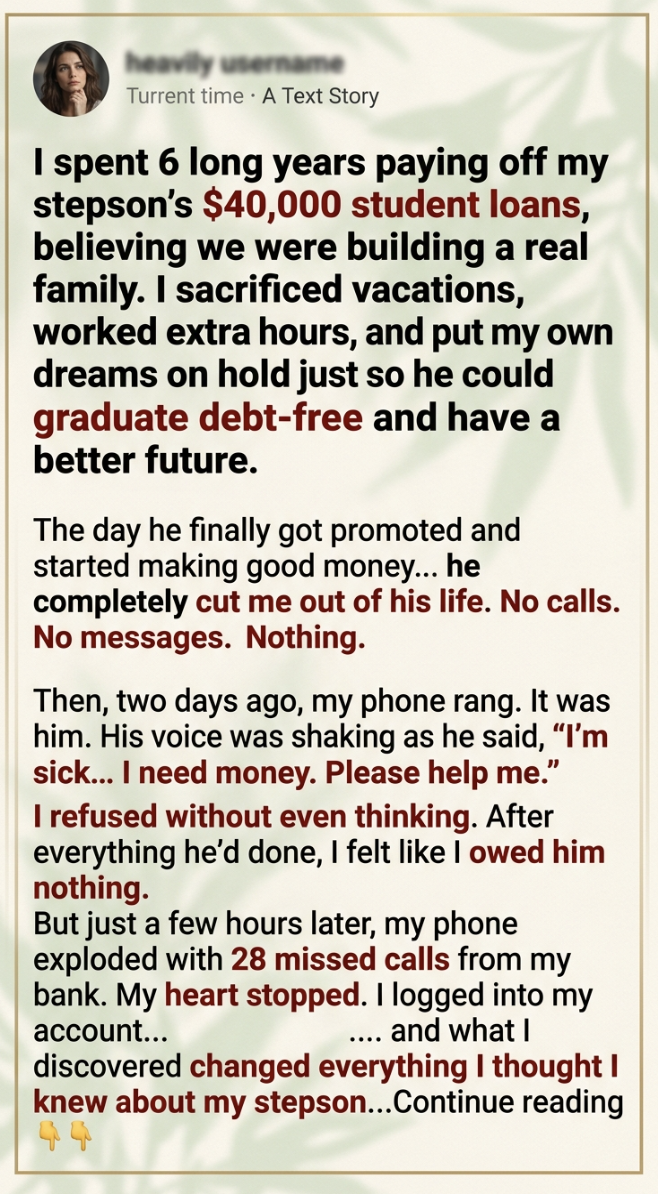
The tuition loans totaled nearly $40,000.
I took on evening tutoring after retiring from my daytime job.
I repaired neighbors’ fences on weekends.
I canceled vacations.
Sold my fishing boat.
Even postponed replacing my twenty-year-old pickup truck.
Whenever someone asked why I worked so much, I always gave the same answer.
“I’m investing in my son’s future.”
Some people reminded me that Ethan wasn’t my biological child.
But love had never asked for DNA.
It asked for commitment.
The day Ethan graduated, I stood quietly in the back row, applauding louder than anyone.
After the ceremony, he hugged his mother.
Then he turned to me.
For the first time in ten years, he said,
“Thank you… Dad.”
I thought that single word made every sacrifice worthwhile.
A few years later, Ethan landed an excellent job with a technology company.
His salary was far higher than anything I had ever earned.
I couldn’t have been prouder.
Then, slowly, everything changed.
His calls became less frequent.
Birthdays passed with only a text message.
Holiday dinners became excuses.
Then…
Nothing.
Months turned into years.
No visits.
No conversations.
No explanation.
Linda often cried quietly after pretending she wasn’t disappointed.
I told her he was probably just busy.
But deep inside, I wondered if we had simply become part of his past.
Then, one rainy Tuesday afternoon, my phone rang.
“Ethan.”
I answered immediately.
His voice sounded weak.
“Dad…”
“I need help.”
“I’ve been diagnosed with a serious illness.”
“I need money.”
Old hurt rushed back before compassion could.
I answered more sharply than I intended.
“I spent six years helping you.”
“You disappeared.”
“I don’t think I can do this again.”
There was a long silence.
Then he quietly replied,
“I understand.”
The line went dead.
I sat staring at my phone.
Part of me felt guilty.
Another part felt justified.
Only three hours later, my phone began ringing nonstop.
Unknown number.
Again.
Again.
Again.
Twenty-eight missed calls.
Finally, I answered.
“Mr. Harris?”
“This is your bank.”
“We’ve been trying to reach you.”
My heart dropped.
“Has someone stolen my account?”
“No.”
“But we noticed an unusually large incoming transfer.”
I logged into my online banking.
My balance looked wrong.
Very wrong.
An additional $200,000 had appeared.
I stared at the screen in disbelief.
The sender’s name was…
Ethan Harris.
My hands shook.
I immediately called him.
This time, he answered.
“I thought you needed money.”
He laughed softly.
“I don’t.”
“I needed to know something.”
I couldn’t understand.
“What do you mean?”
He took a deep breath.
“The illness is real.”
“But my insurance covers everything.”
“I asked for money because I wanted to see whether you’d still answer my call after everything.”
I closed my eyes.
“I failed.”
“No,” he said gently.
“You didn’t.”
“You answered.”
“You listened.”
“You were honest.”
Then he continued.
“I never disappeared because I stopped loving you.”
“I disappeared because I felt ashamed.”
I frowned.
“Ashamed?”
“I spent years believing I could never repay what you sacrificed for me.”
“Every promotion reminded me of everything you’d given up.”
“I kept thinking I’d call after I achieved something bigger.”
“Then more time passed.”
“The longer I waited…”
“The harder it became.”
His voice cracked.
“So instead of facing my guilt…”
“I avoided you.”
Tears rolled down my face.
“The money?” I asked quietly.
He laughed.
“Remember the notebook where you wrote every loan payment?”
“I found it while helping Mom clean the attic.”
“I calculated everything.”
“Every payment.”
“Every dollar.”
“Then I added interest.”
“And something extra.”
“For the dreams you postponed.”
I couldn’t speak.
“There isn’t enough money in the world to repay six years of love,” he continued.
“But it’s a start.”
The following weekend, Ethan came home.
Not for a holiday.
Not because he felt obligated.
Simply because he wanted to.
When he stepped through the front door, he hugged me longer than he ever had before.
“I’m sorry,” he whispered.
“I thought success meant paying you back.”
“But now I know…”
“It meant coming home.”
A few months later, after completing treatment, Ethan recovered fully.
He visited every Sunday.
Not because we expected him to.
Because family finally mattered more than schedules.
One afternoon, while watching my grandchildren play in the backyard, Ethan looked at me and smiled.
“You know…”
“I used to think being a father meant sharing blood.”
He looked at his own little son.
“Now I know.”
“A real father is the one who stays.”
Years ago, I believed paying off those student loans was the greatest gift I could ever give.
I was wrong.
The greatest gift wasn’t the education.
It wasn’t the money.
It was showing a frightened young man what unconditional love looked like.
Because although gratitude may arrive late…
True love has a remarkable way of finding its way home.
Looking back now, I no longer measure those six years by the dollars I sacrificed.
I measure them by the family they quietly built.
And if I had to choose all over again…
I would still make every payment.
Because the best investments are rarely made in banks.
They’re made in people—and in the hope that one day, love given freely will return, not as a debt repaid, but as a family finally made whole.