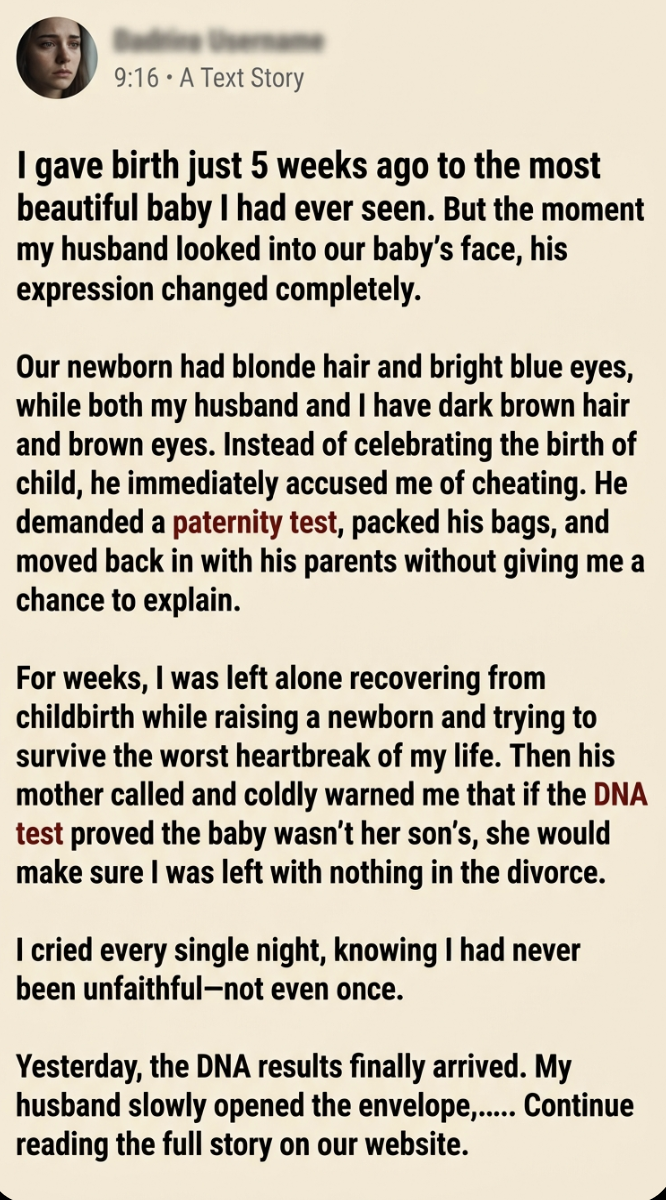
The day my son was born should have been the happiest day of our lives.
After fourteen hours of labor, I finally heard his first cry.
The nurse gently placed him in my arms, and in that moment, every ounce of pain disappeared.
He was perfect.
Tiny fingers.
Soft cheeks.
Bright blue eyes.
Golden blond hair.
I smiled through happy tears.
“He looks like an angel,” I whispered.
Then I looked at my husband.
Instead of smiling, his face slowly hardened.
He stared at our baby without saying a word.
Finally, he looked at me.
“Whose child is this?”
For a moment, I thought he was joking.
“I’m serious,” he said.
“We both have dark hair and brown eyes.”
“This isn’t possible.”
The joy inside the room vanished instantly.
I tried to explain that babies can inherit traits from earlier generations.
The doctor calmly agreed.
“Genetics can sometimes produce surprising combinations.”
But my husband refused to listen.
Two days later, he packed a suitcase.
“I’m getting a DNA test.”
“If that baby isn’t mine, we’re finished.”
Then he walked out.
Watching him leave hurt almost as much as childbirth itself.
The following weeks became the hardest of my life.
I barely slept.
I was recovering physically while caring for a newborn completely alone.
Some nights, I cried while rocking my son to sleep.
He had no idea why his mother kept crying.
He only reached out his tiny hand and wrapped his fingers around mine.
That little hand gave me strength to keep going.
Then one afternoon, my phone rang.
It was my mother-in-law.
Her voice was cold.
“If the DNA test proves that child isn’t my son’s,” she said,
“I’ll make sure you don’t receive a penny in the divorce.”
Before I could answer, she hung up.
I sat on the floor holding my baby.
I wasn’t afraid of the truth.
I was afraid that no one believed me.
Weeks later, the DNA results finally arrived.
We met at the lawyer’s office.
Neither of us spoke.
My husband slowly opened the envelope.
His eyes scanned the first page.
Then something unexpected happened.
The color drained from his face.
His hands began trembling.
He read the report again.
And again.
The lawyer quietly asked,
“Are you alright?”
He couldn’t answer.
Finally, he slid the papers across the table toward me.
The report clearly stated:
Probability of paternity: 99.9999%.
My husband was unquestionably the child’s biological father.
But there was another page attached.
It explained that further genetic testing had revealed our son carried a rare recessive combination of genes inherited from both sides of our families.
Several generations earlier, both of our family lines included relatives with naturally blond hair and blue eyes.
Those genes had remained hidden for decades.
Our son had simply inherited both recessive traits.
The doctor smiled gently.
“Rare doesn’t mean impossible.”
“It’s one of the many beautiful surprises genetics can bring.”
The room became completely silent.
My husband lowered his head.
“I destroyed everything,” he whispered.
He looked at me with tears filling his eyes.
“I doubted you.”
“I doubted our family.”
“I wasn’t there when you needed me most.”
For the first time since our son was born…
I saw genuine regret.
Days later, he returned home.
Not carrying excuses.
Carrying flowers.
Diapers.
Groceries.
And a handwritten letter.
Inside, he admitted every mistake.
He apologized for abandoning me during the most vulnerable weeks of my life.
He apologized for believing suspicion before trust.
Most of all, he apologized to the little boy who would never remember those first weeks—but whose father would.
Trust, however, does not heal overnight.
I forgave him.
But forgiveness was only the first step.
For months, we attended marriage counseling.
We learned to communicate honestly.
We learned that fear grows strongest when trust becomes weakest.
One afternoon, my father-in-law quietly visited our home.
He sat beside our sleeping baby and smiled.
“You know,” he said,
“My grandmother had bright blond hair.”
“No one in the family had seen those traits in over eighty years.”
He laughed softly.
“I guess little Noah brought them back.”
Even my mother-in-law eventually came to visit.
She stood quietly beside the crib.
With tears in her eyes, she whispered,
“I’m sorry.”
“I judged you before I knew the truth.”
I nodded.
“The hardest part wasn’t your words.”
“It was facing motherhood alone.”
She reached over and gently held my hand.
“I can’t change the past.”
“But I hope I can earn another chance.”
Slowly, our family began healing.
Years passed.
Our little blond-haired boy grew into a happy, curious child who loved asking questions about everything.
One evening, while looking through old family photo albums, he pointed at a faded picture.
“Dad,” he asked,
“Who is that little blond boy?”
My husband smiled.
“That’s your great-great-grandfather.”
Our son laughed.
“So I got his hair?”
“You sure did.”
That night, after our son had fallen asleep, my husband quietly said,
“I almost missed all of this because I chose doubt instead of trust.”
I squeezed his hand.
“And now?”
He looked toward our son’s room.
“Now I know that love isn’t proven by perfect circumstances.”
“It’s proven by believing in each other when fear tries to convince us otherwise.”
Looking back, I realized our greatest challenge had never been our son’s appearance.
It had been whether our marriage was strong enough to survive uncertainty.
Our little boy became more than a beautiful child.
He became a daily reminder that families are built on trust, patience, and grace—not on assumptions.
Because appearances can sometimes be surprising.
But the truth, when given the chance to be heard, has a way of bringing light back into even the darkest moments.