When my mother passed away, my father became a different man.
The cheerful, dependable father I had always known slowly disappeared behind loneliness.
For two years, he barely left the house.
He rarely answered the phone.
Every family gathering felt quieter than the last.
Then, one day, he introduced us to Liv.
She was thirty years old.
I was thirty-seven.
The age difference shocked everyone.
Still, I tried to be respectful.
If she truly made my father happy, I wanted to believe age didn’t matter.
They married six months later.
At first, Liv was polite.
She smiled often.
She called me “sweetheart.”
She brought flowers whenever she visited.
But little by little, something changed.
She began making decisions that weren’t hers to make.
She rearranged my mother’s furniture.
She replaced family photographs with expensive artwork.
She even suggested selling the old piano my mother had loved because it “didn’t match the modern style.”
Every time I disagreed, my father defended her.
“She’s only trying to help.”
I stayed quiet.
I didn’t want arguments.
Then came the family dinner that changed everything.
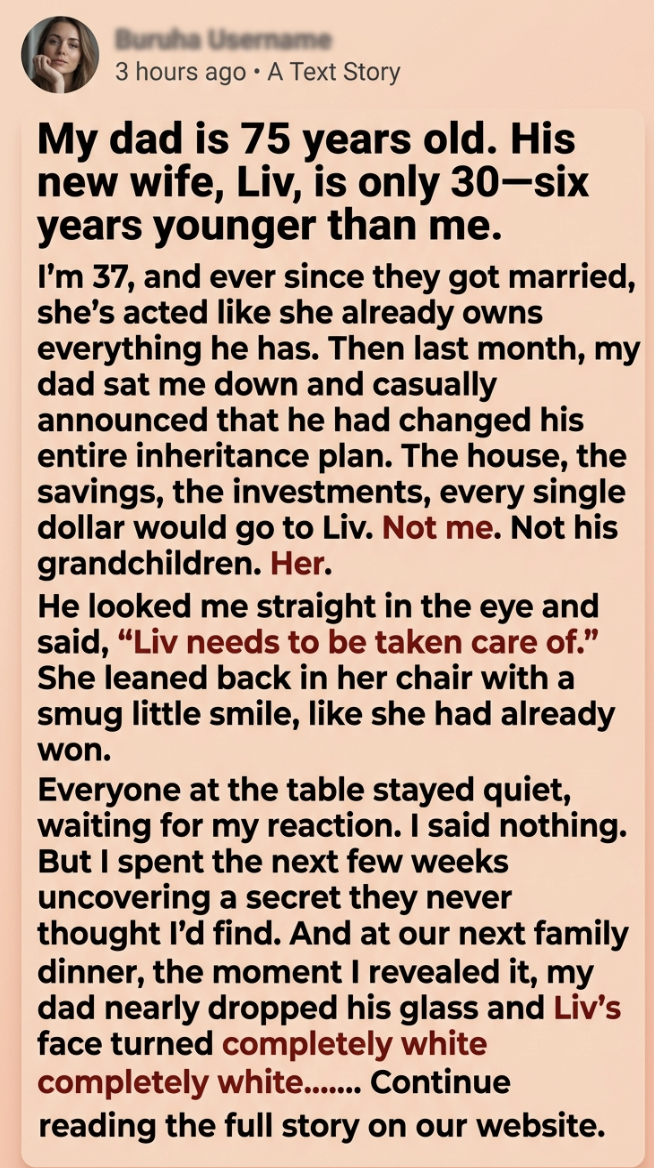
We had barely finished dessert when my father cleared his throat.
“I’ve updated my estate plan.”
Everyone looked at him.
He smiled calmly.
“When I’m gone, everything will go to Liv.”
“The house.”
“The investments.”
“The savings.”
“Everything.”
The room fell silent.
I glanced at my children.
Then at my brother.
No one spoke.
My father looked directly at me.
“Liv needs to be taken care of.”
Across the table, Liv leaned back with the smallest smile.
Not a grateful smile.
A victorious one.
As though the conversation had already ended.
I simply nodded.
“I understand.”
But inside…
Questions refused to leave me.
It wasn’t about money.
My father had every legal right to decide what happened to his estate.
What troubled me was how quickly everything had changed.
For years, he had spoken about leaving something for his grandchildren.
Suddenly, every promise had disappeared.
Over the next few weeks, I noticed little things.
Liv answered his phone more often than he did.
She insisted on attending every doctor’s appointment.
She discouraged old friends from visiting.
When I called, she often answered before my father could.
“Dad’s resting.”
“He doesn’t feel like talking.”
“I’ll let him know you called.”
Sometimes I wondered whether he had even received my messages.
Then one afternoon, while helping my father organize old paperwork in the garage, I noticed several unopened bank statements hidden inside a box.
He frowned.
“I’ve never seen these.”
Neither had I.
Together, we opened them.
Several unusually large transfers had been made from one investment account into another account neither of us recognized.
My father looked confused.
“I never approved this.”
My heart sank.
Something wasn’t right.
With his permission, we met with his longtime financial adviser.
After reviewing everything, the adviser quietly asked,
“Mr. Carter… have you personally signed these recent transfer forms?”
My father adjusted his glasses.
“No.”
The signatures looked similar.
But they weren’t his.
Further investigation revealed something even more troubling.
Liv had convinced him months earlier to sign several “routine financial documents” while he was recovering from minor surgery.
Hidden among those papers were documents granting her broad financial authority.
She had never technically stolen his money.
But she had quietly positioned herself to control almost everything.
My father sat in stunned silence.
“I trusted her.”
The adviser gently replied,
“Trust should never replace understanding.”
The following Sunday, our family gathered for dinner again.
Liv arrived wearing a confident smile.
She seemed certain nothing had changed.
Halfway through the meal, my father stood.
“I have something to say.”
Everyone became quiet.
He slowly placed a folder on the table.
Inside were copies of the financial records.
The power-of-attorney documents.
The forged signatures.
The legal investigation.
Liv’s face lost all color.
She looked at my father.
“I can explain.”
He raised a hand.
“No.”
“For months, I believed you loved me.”
“I now realize you loved the future you imagined with my money.”
She began crying.
Claiming she had only wanted security.
Claiming she had never intended harm.
But the evidence spoke louder than her words.
Within weeks, the financial authority was revoked.
The estate plan was rewritten.
Not in my favor.
Not in anyone’s favor.
Instead, my father surprised us all.
He created an education trust for every grandchild.
He donated part of his wealth to a local hospital where my mother had volunteered for years.
He kept enough to live comfortably and independently.
One evening, he invited me to sit with him on the old porch where we used to watch sunsets together.
“I’m sorry,” he said quietly.
“For what?”
“I confused loneliness with love.”
I looked at him.
He continued,
“When people grow older, they sometimes become afraid of being alone.”
“That fear can make them believe almost anything.”
I reached over and held his hand.
“You don’t have to buy someone’s love.”
“You already have a family.”
Tears filled his eyes.
“I almost forgot that.”
Months later, the divorce was finalized.
The house remained exactly as my mother had left it.
Her piano stayed in the living room.
The family photographs returned to the walls.
Every Sunday, the grandchildren filled the house with laughter again.
One afternoon, my youngest daughter climbed onto Grandpa’s lap and asked,
“Grandpa… what’s the most valuable thing you own?”
He smiled.
“It’s not the house.”
“It’s not the money.”
“It’s not the investments.”
She tilted her head.
“Then what is it?”
He looked around at all of us gathered together.
“You.”
“Family is the only inheritance that truly matters.”
As I watched my children laughing beside him, I realized something that no lawyer, will, or fortune could ever change.
Money can attract people.
Possessions can create arguments.
But genuine love never has to compete for an inheritance.
Because the greatest legacy a parent leaves behind isn’t measured in dollars.
It’s measured in trust, wisdom, forgiveness, and the family that chooses to stay together long after the paperwork is forgotten.