The smell of fresh varnish was intoxicating. I stood in the center of the living room, turning in a slow circle. The hardwood floors, which had been covered in grime and shag carpet when we bought the place, now gleamed like honey in the afternoon sun.
It was finished. Finally.
We bought a fixer-upper. It was a wreck, but Mark had sold me on the vision. He talked about growing old here. He talked about the swing set we would put in the back.
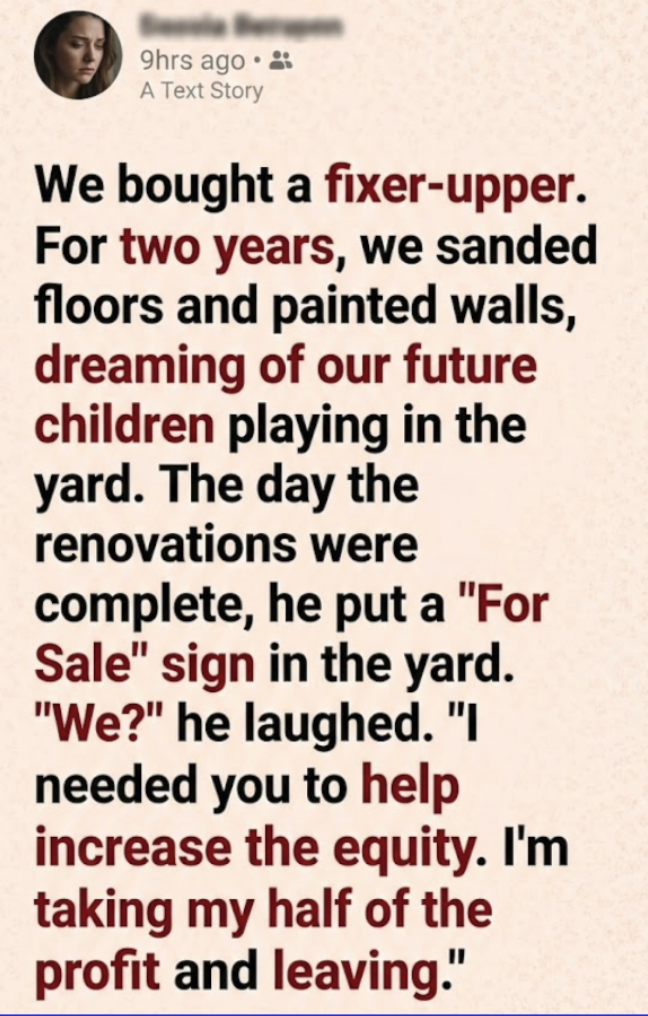
For two years, we sanded floors and painted walls. I spent my weekends covered in drywall dust. I learned to install tile. I ruined my manicure, my back, and my social life, all fueled by a singular, beautiful fantasy. We weren’t just fixing a house; we were building a nest. We were dreaming of our future children playing in the yard.
I walked to the window to admire the view of that yard, imagining where the sandbox would go.
That’s when I saw it.
A wooden post was being hammered into the lawn by a man in a blazer. A red sign hung from the crossbar.
My stomach dropped. I ran outside, the screen door slamming behind me. Mark was standing on the porch, watching the realtor with a satisfied nod.
“Mark!” I shouted. “What is that? Why is there a sign in our yard?”
He turned to me, not with guilt, but with the cool detachment of a businessman closing a deal.
The day the renovations were complete, he put a “For Sale” sign in the yard.
“We’re listing it on Friday,” he said calmly. “The market is peaking. We’re going to make a killing.”
“Listing it?” I stammered. “But… this is our home. We built this. We did this together.”
He chuckled—a dry, dismissive sound that made my blood run cold.
“‘We?’” he laughed.
He looked at my paint-splattered jeans and my tired eyes. He didn’t see a partner. He saw a subcontractor he hadn’t had to pay.
“‘I needed you to help increase the equity,’” he explained, as if it were obvious. “Contractors are expensive, Sarah. You saved us—well, me—thousands.”
I stood there, paralyzed. The nursery wasn’t a room for our baby; it was a “value-add bedroom.” The garden wasn’t for our future; it was “curb appeal.”
“‘I’m taking my half of the profit and leaving,’” he finished, checking his watch.
He walked past me back into the house—the house I had poured my sweat and soul into. I realized with sickening clarity that I hadn’t been building a life; I had been working an unpaid internship for his exit strategy. He had flipped the house, and he had flipped me right along with it.