The morning felt like a coronation. I ironed the little yellow dress with trembling hands. I braided Mia’s hair, listening to her hum a song she had learned in preschool.
“Today is the day, right Mommy?” she asked, her big brown eyes looking up at me.
“Yes, baby,” I smiled, fighting back happy tears. “Today you become ours forever.”
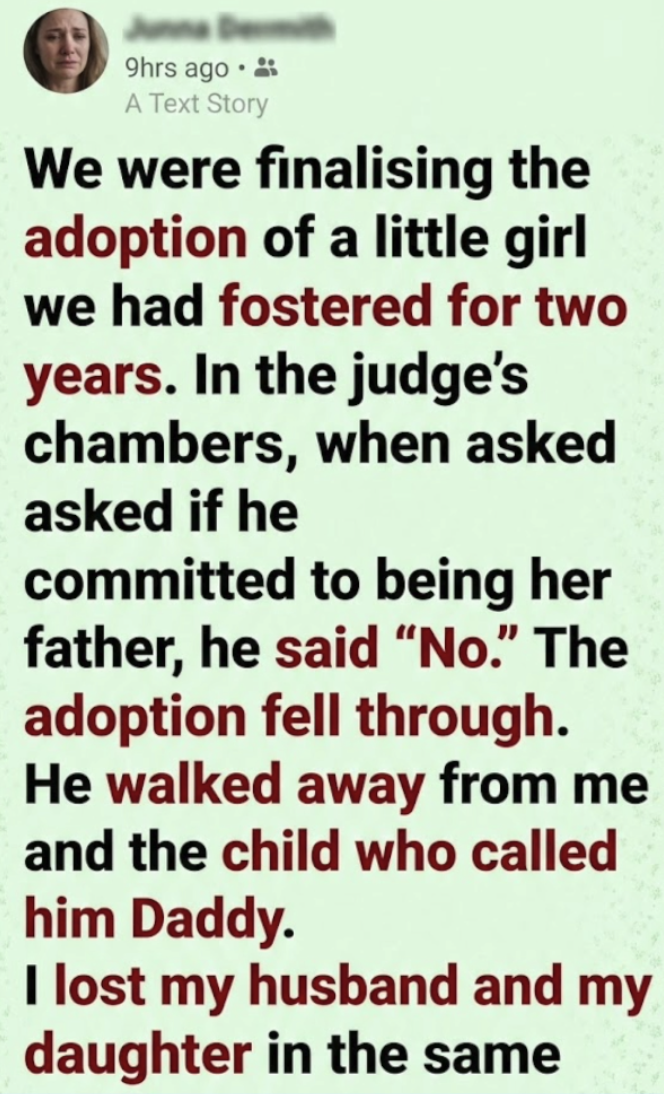
We had fostered Mia for two years. She was the light of our lives. My husband, Ryan, had taught her to ride a bike. He had read her bedtime stories every night. He was “Daddy.” We were finalizing the adoption of a little girl we had fostered for two years.
We walked into the courthouse hand in hand. The social worker was there, beaming. The courtroom felt warm, less like a place of judgment and more like a place of celebration. We had passed the home studies, the background checks, the interviews. This was just the ceremony.
We went into the judge’s chambers—a cozy, wood-paneled office meant to make the child feel comfortable. The judge, a kind woman with reading glasses perched on her nose, smiled at us.
She went through the standard questions. Do you promise to love her? Yes. Do you promise to provide for her? Yes.
Then, she turned to Ryan.
“And do you, Ryan, commit to being her father, to love and guide her for the rest of your life?”
The room went quiet, waiting for the inevitable “I do.”
Ryan stared at the judge. Then he looked at Mia, who was clutching a stuffed bear he had bought her.
“No,” he said.
The word hung in the air like a gunshot.
In the judge’s chambers, when asked if he committed to being her father, he said ‘No.’.
I froze. “Ryan? What are you saying? It’s just nerves, Your Honor, he—”
“It’s not nerves,” Ryan interrupted, his voice devoid of emotion. “I can’t do this. I don’t want to be a father. I want a divorce.”
He chose that moment—the literal finish line—to detonate our lives. Because the petition was filed jointly, because our home study was based on us being a couple, his refusal shattered the legal framework of the adoption instantly.
The adoption fell through.
The judge’s face hardened. The social worker gasped. But the worst sound was Mia’s small, confused voice asking, “Daddy?”
Ryan stood up. He didn’t look at me. He didn’t look at the child who had drawn him pictures and trusted him to keep her safe.
He walked away from me and the child who called him Daddy.
He walked out of the chambers and out of the courthouse, leaving us in the wreckage. The social worker had to take Mia. I wasn’t legally her mother yet. I was just a foster parent whose household had just dissolved. I watched them lead her away, sobbing, reaching for me.
I stood in the hallway, hollowed out. He hadn’t just ended a marriage. He had orphaned a child who finally thought she was safe. In one breath, I lost my husband and my daughter. He stole my family, not with a fight, but with a single, cowardly word.