The silence in the house was the first thing I noticed after Mark packed his bags. It wasn’t a peaceful silence; it was the heavy, suffocating quiet of a stage after the actors have left.
I decided to clean his study. I wanted to scrub away the traces of him, to turn his “man cave” into a sewing room, or a library, or anything that didn’t smell like his cologne and deceit.
I was clearing out the bottom shelf of the bookshelf, behind a row of dusty encyclopedias, when I felt it. A shoebox. It was taped shut, pushed all the way to the back.
I sat on the floor, the carpet scratching my legs. I cut the tape.
Inside were letters. Dozens of them. They weren’t tied with a ribbon; they were stacked chronologically, a meticulous archive of a secret life. I looked at the name on the first envelope. Jessica. The high school girlfriend he swore he had gotten over two decades ago.
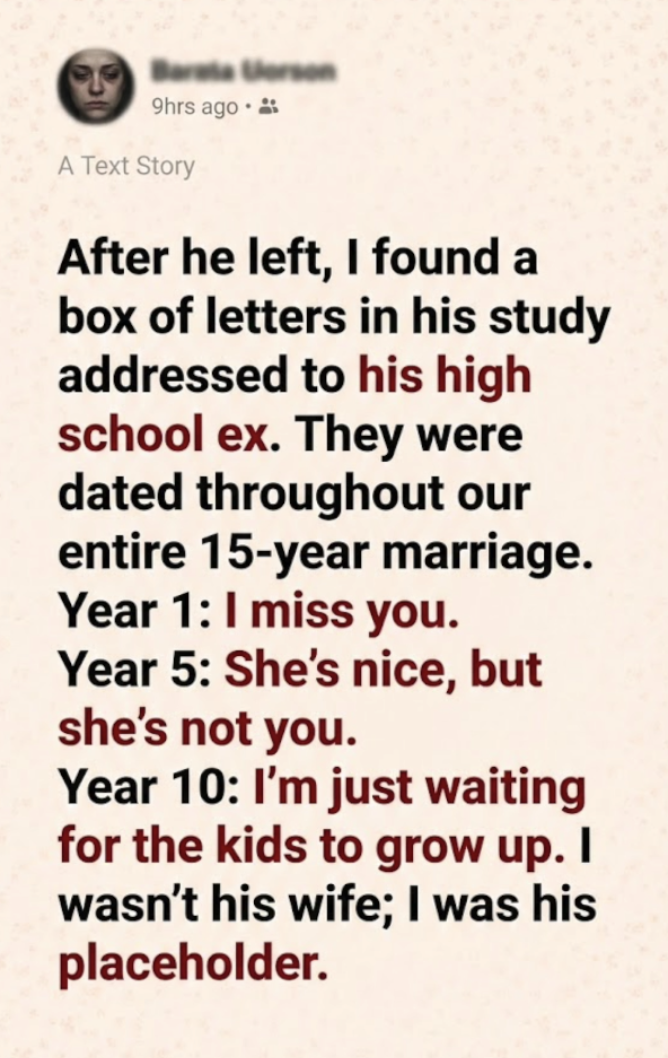
After he left, I found a box of letters in his study addressed to his high school ex.
My hands trembled as I opened the first one. It was dated October 2010—three months after our wedding.
“Year 1: I miss you,” he had written in his familiar, jagged scrawl. He wrote about how our wedding cake was too sweet, how my laugh was too loud, and how he wished it was her sitting across from him at breakfast.
I felt sick. I reached for another one from the middle of the stack. They were dated throughout our entire 15-year marriage.
I opened one from 2015. We had just bought this house. We were trying for a baby. I thought we were happy.
“Year 5: She’s nice, but she’s not you,” the letter read.
“Nice.” I was the woman washing his clothes, cooking his meals, carrying his children, and building his life. And to him, I was just “nice.” A comfortable piece of furniture that wasn’t quite his style, but served a purpose.
I flipped to the back of the stack. The handwriting was more rushed now, more desperate. This one was dated just before our youngest turned ten.
“Year 10: I’m just waiting for the kids to grow up,” he confessed to a woman who probably never even received these letters.
He wasn’t staying for me. He wasn’t staying for us. He was serving a sentence. He was biding his time, ticking off the days until he could be released for good behavior.
I put the letters back in the box. I looked around the room—the photos on the wall, the life we had built. It all looked like a set now. A prop house constructed to pass the time.
The tears finally came, hot and angry. I hadn’t lost a husband who loved me; I had lost a tenant who was just leasing space in my life.
I wasn’t his wife; I was his placeholder. I was the intermission between the prologue of his youth and the third act he had planned with her all along. And the tragedy wasn’t that he left; it was that he had never really arrived.