The memory of that Tuesday is etched into my brain like a scar. I was sitting on the nursery floor, rocking a screaming infant, while my two-year-old banged pots and pans in the kitchen.
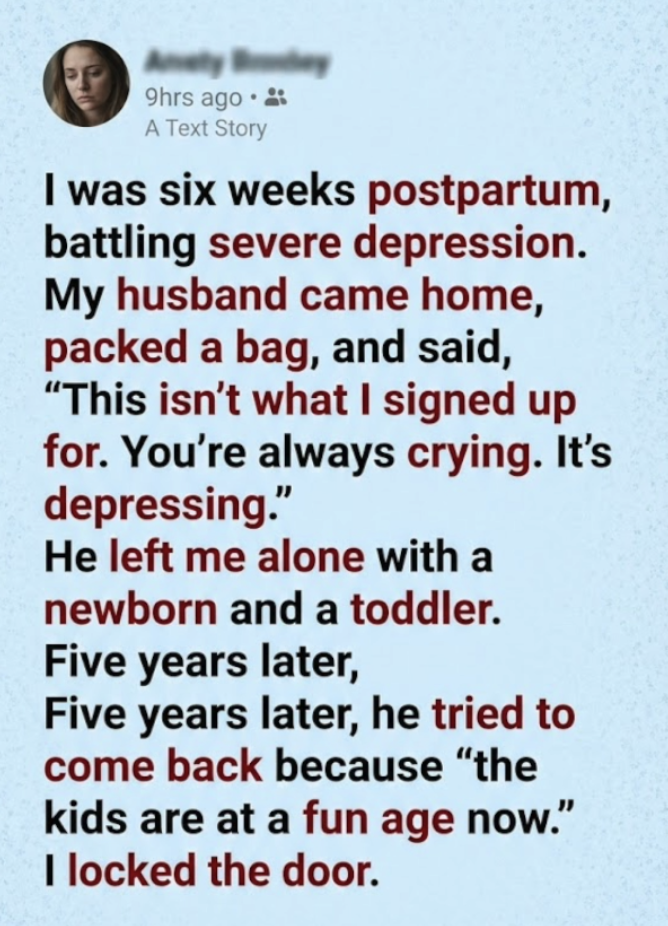
I hadn’t showered in three days. The house was a wreck. And inside my head, a dark, heavy fog had settled that made even breathing feel like a chore. I was six weeks postpartum, battling severe depression.
I heard the front door open. Relief washed over me. Mark is home. He can hold the baby. I can sleep for an hour.
But he didn’t come to the nursery to help. He came into the bedroom to get a suitcase.
I stood in the doorway, the baby still wailing in my arms. “Mark? What are you doing?”
He zipped the bag shut with a sharp, final sound. He looked at me, not with concern, but with disgust.
“I can’t do this anymore, Jen,” he said. “‘This isn’t what I signed up for.’“.
“Signed up for?” I whispered. “This is our family. I’m sick, Mark. I need help.”
“‘You’re always crying,’” he countered, walking past me as if I were a piece of furniture. “‘It’s depressing.’“.
He walked out the front door. He got in his car. And he left me alone with a newborn and a toddler.
The next five years were a blur of survival. I learned to change diapers with one hand and cook mac and cheese with the other. I found a therapist. I found a job. I built a village of friends who became the family Mark refused to be. I crawled out of the darkness inch by inch, dragging my children into the light with me.
We made it. We were happy.
Then came last Saturday.
I was in the driveway, washing the car with the kids. Leo was seven now, spraying his little sister, Mia, with the hose. Their laughter rang out, clear and bright.
A car pulled up to the curb. Mark stepped out.
He looked good. Rested. He smiled at the kids as if he were a favorite uncle returning from a long trip, not a deserter returning to the scene of the crime.
“Hey, guys!” he called out.
The kids stopped playing. They didn’t run to him. They looked at me, confused.
I walked to the edge of the driveway, crossing my arms. “What are you doing here, Mark?”
“I want to see them,” he said, gesturing to the children he hadn’t sent a birthday card to in three years. “Five years later, he tried to come back,” breezing in as if the past didn’t exist.
“Why now?” I asked. “You didn’t want them when they were crying. You didn’t want them when I was drowning.”
He shrugged, offering a grin that was supposed to be charming. “Well, you know,” he said. “‘The kids are at a fun age now.’“.
The rage that filled me was cold and precise. He wanted the highlight reel. He wanted the catch in the yard and the school plays. He wanted the reward without the work. He thought he could skip the trenches and show up for the parade.
“Get off my property,” I said.
“Jen, come on. I’m their father.”
“No,” I corrected him. “You’re a sperm donor who quit when the job got hard. You don’t get the fun years if you weren’t there for the hard years.”
I ushered the kids inside. He started walking up the path, thinking I was bluffing, thinking his charm would work like it used to.
I locked the door.
I turned the deadbolt with a satisfying click. I watched through the peephole as he stood there, stunned that his key to our lives had been revoked. I turned back to my children, who were waiting for me with the hose, ready to resume the joy that we had built without him.