The notification on my phone was the final nail in the coffin of my marriage. It was an overdraft alert.
I opened the banking app, my hands trembling. Yesterday, there had been three thousand dollars—our mortgage money, our grocery money, our safety net. Today, the balance stared back at me in mocking red numbers.
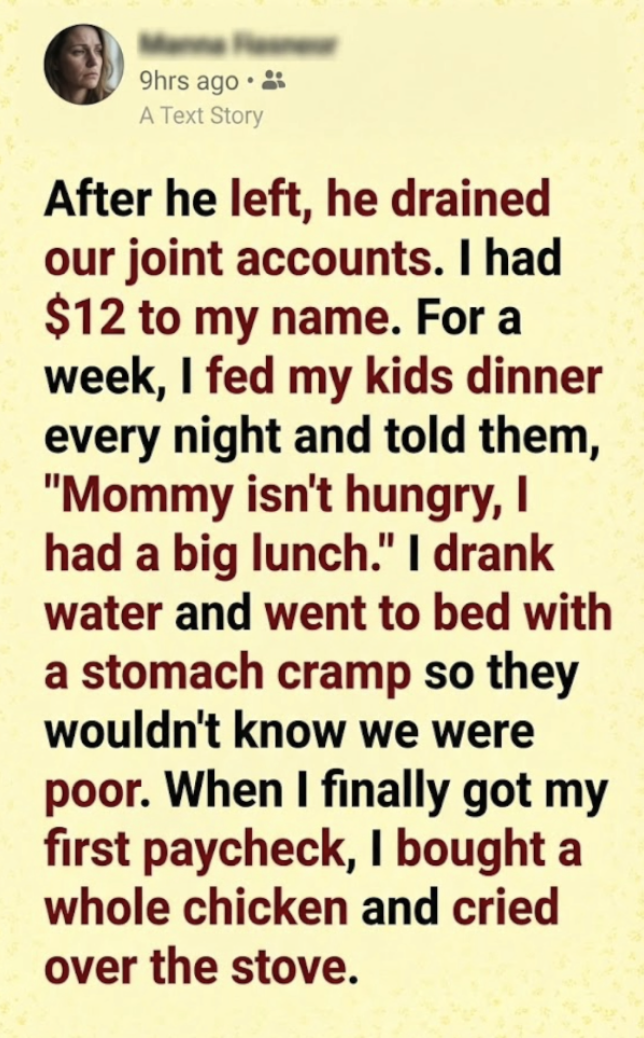
After he left, he drained our joint accounts.
He had taken everything. He didn’t care that he had left two children behind. He didn’t care that the rent was due. He had cashed out our life and walked away, leaving me with exactly $12 to my name.
I sat on the kitchen floor and hyperventilated. Twelve dollars. A loaf of bread, a gallon of milk, maybe a carton of eggs. That was supposed to last us until my new job’s payroll processed in seven days.
I made a decision then. My children would not know. They would not feel the panic that was clawing at my throat. They would not know that their father had tried to starve them out.
That week became a blur of creative poverty. I made pasta with butter. I made grilled cheese. I portioned out the food with the precision of a surgeon, ensuring their plates were full.
But there wasn’t enough for three.
For a week, I fed my kids dinner every night. I would set their bowls down, smiling as they dug in. When they asked where my plate was, I delivered the line I had rehearsed in the mirror.
“‘Mommy isn’t hungry, I had a big lunch,’” I lied.
I hadn’t had lunch. I hadn’t had breakfast. I was running on fumes and fear.
I sat at the table with them, sipping from a tall glass, watching them eat. I drank water and went to bed with a stomach cramp so they wouldn’t know we were poor. The hunger was a physical ache, a sharp, twisting pain that kept me awake, but it was bearable because I could hear their steady breathing in the next room. They were full. They were safe. That was the only fuel I needed.
On Friday morning, the direct deposit hit.
I stared at the screen, weeping at the sight of money. It wasn’t a fortune, but it was salvation.
I drove straight to the grocery store. I didn’t buy lobster. I didn’t buy steak. When I finally got my first paycheck, I bought a whole chicken.
I brought it home and roasted it with potatoes and carrots. As the smell of savory, rich food filled the tiny apartment—a smell that signaled safety and abundance—I broke down.
I stood there and cried over the stove. I cried for the hunger pangs. I cried for the fear. I cried for the husband who didn’t care if we starved.
But mostly, I cried because I had won. I had carried us across the desert of poverty on my back, and tonight, for the first time in a week, Mommy was going to have dinner too.