The Glass Fortress
The air in the dining room was thick with the scent of roasted turkey and the sound of my brother Kalin’s voice. He was standing at the head of the table, clicking through a PowerPoint titled “The Future of Digital Artistry”. Every slide was a chaotic mess of AI-generated landscapes rendered in Comic Sans.
“It’s about the democratization of the soul,” Kalin proclaimed. My parents nodded fervently, scribbling notes on their napkins as if he were delivering a sermon on world peace. To them, Kalin’s “art gallery” was a masterpiece, despite the fact that it was his fourth “business venture” funded by their retirement savings in three years.
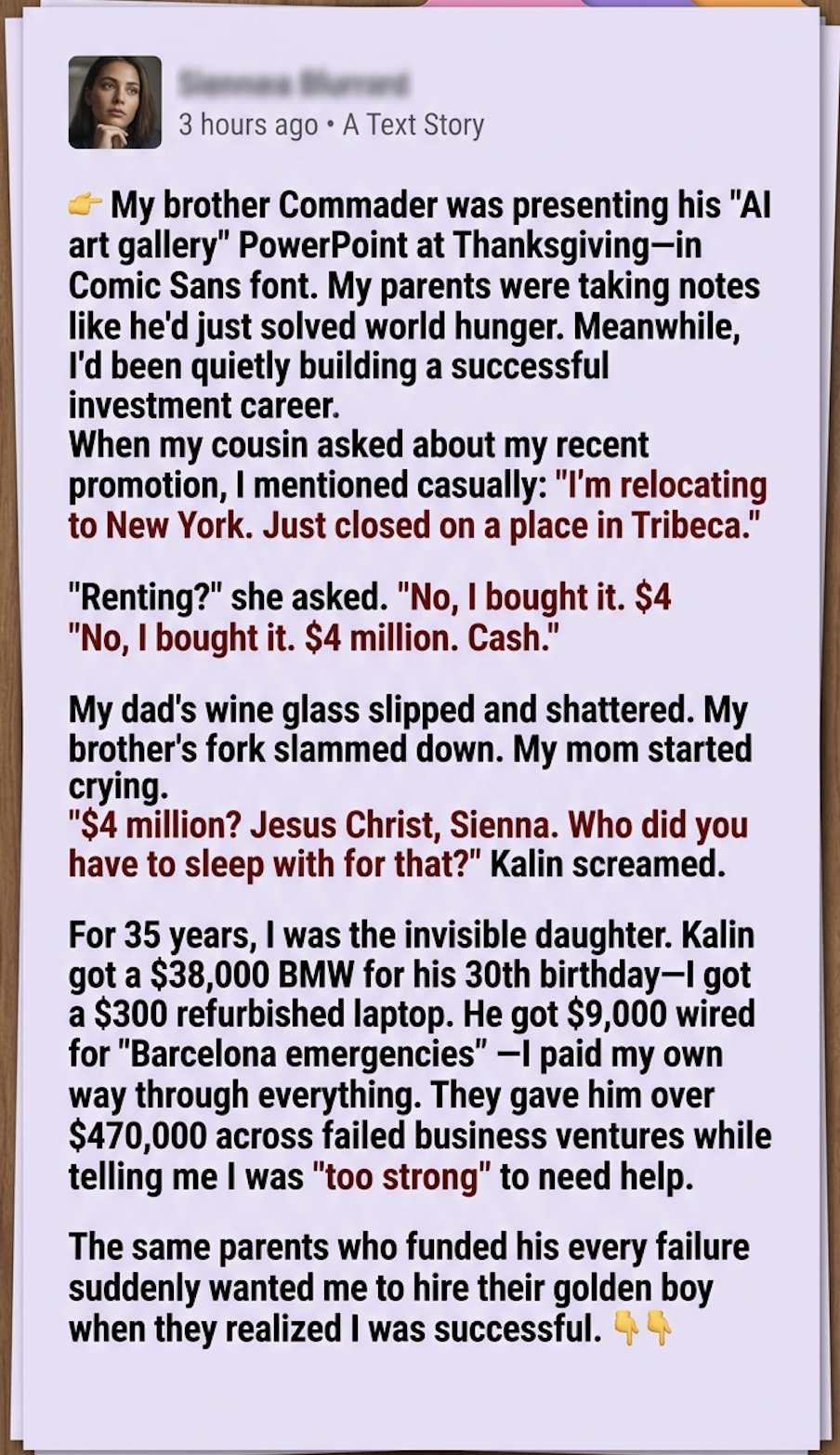
I sat at the corner of the table, nursing a glass of water. For thirty-five years, I had been the invisible daughter, the one who was “too strong” to need a helping hand. While my parents wired $9,000 for his “Barcelona emergencies” and bought him a $38,000 BMW for his 30th birthday, I had been working eighty-hour weeks building a career in investment. My only gift from them in a decade had been a $300 refurbished laptop that smelled like old cigarette smoke.
The silence was broken when my cousin turned to me. “So, Sienna, any updates from the office? Or are you still just… managing things?”
“Actually,” I said, setting my glass down. The room didn’t go quiet, but I continued anyway. “I’m relocating to New York. I just closed on a place in Tribeca”.
Kalin stopped mid-sentence. “Renting? Those lofts are a rip-off, Sienna. You should invest in my gallery instead.”
“No,” I replied, my voice steady. “I bought it. $4 million. Cash“.
The sound of my father’s wine glass shattering against the hardwood floor was the only response. My mother’s fork slammed onto her plate, her eyes wide as she began to cry—not out of pride, but out of a sudden, jarring realization that the daughter they ignored was now the most powerful person in the room.
“Four million dollars?” Kalin screamed, his face turning a mottled red. “Jesus Christ, Sienna. Who did you have to sleep with for that?”.
I looked at him—the “golden boy” who had burned through over $470,000 of our parents’ money on failed dreams. I looked at my parents, who were already exchanging glances. I knew that look. It was the look they gave right before they asked for a “small loan” to help Kalin get back on his feet.
“You’re successful now,” my mother whispered, reaching for my hand. “You could finally hire your brother. He needs a stable lead for his creative department”.
I stood up, smoothed my dress, and picked up my coat. “I built my career because I was ‘too strong’ to need help,” I said, echoing their own words back to them. “And Kalin? He’s far too creative for a corporate job. I wouldn’t want to stifle his genius.”
I walked out the door, leaving the shattered glass and the PowerPoint presentation behind. For the first time in thirty-five years, I wasn’t just invisible—I was gone.