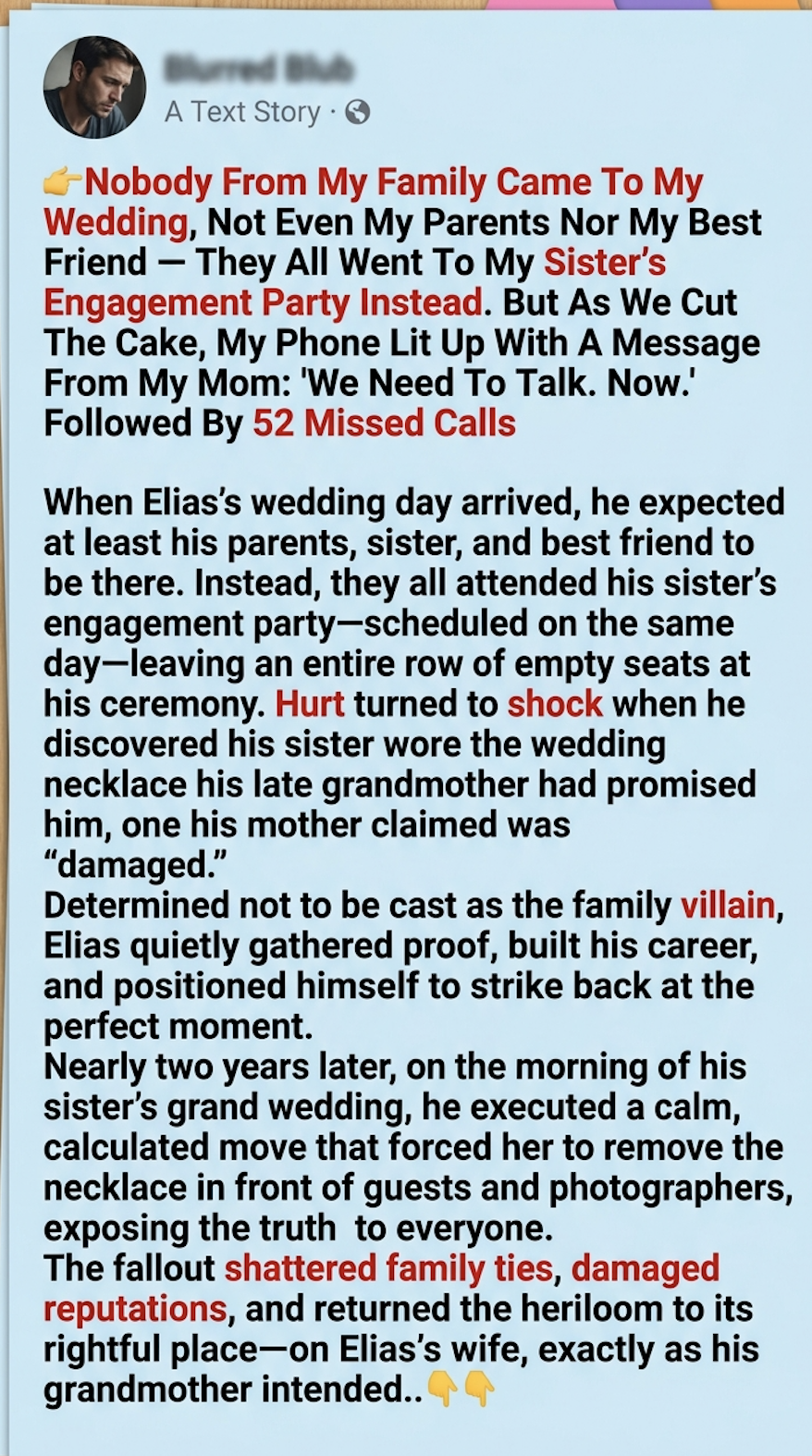
The silence in the chapel was louder than any music could have been. I stood at the altar, holding Sarah’s hands, looking past her at the front row. Twelve empty mahogany chairs stared back at us. My parents, my sister Maya, and even my best friend Leo—the man who was supposed to be my Best Man—were gone.
I tried to focus on Sarah’s vows, but my pocket kept vibrating. When we finally reached the reception, I excused myself for a moment. I opened my phone, expecting “Congratulations” or “Sorry we’re late.” Instead, my feed was flooded with photos from a “Surprise Engagement Party” for Maya. There she was, glowing, surrounded by our entire family and my best friend.
But it wasn’t just the betrayal that made the blood drain from my face. It was what was around Maya’s neck.
It was the “Aurelia Pearl”—a vintage teardrop necklace that belonged to our grandmother. She had promised it to me in her final days to give to my wife. When I asked my mother for it months ago, she wept and told me it had been “lost in a house fire” years ago. Yet there it was, sparkling on Maya’s throat, gifted to her by our parents for her engagement.
As we stood to cut our wedding cake, my phone lit up again.
Mom: “We need to talk. Now. Why did you send that email to the estate lawyer? You’re ruining your sister’s night!”
Then came the calls. 52 missed calls in thirty minutes. I didn’t answer a single one. I turned my phone off, kissed my wife, and spent the rest of my wedding night realizing I no longer had a family—I had a set of creditors.
For the next two years, I was a ghost. I didn’t argue. I didn’t post rants. I worked. I used the money I’d saved for a “family” to build a consulting firm that specialized in asset recovery. I also spent thousands on a private investigator and a forensic jeweler.
I found the truth: My parents hadn’t just “given” Maya the necklace. They had forged a secondary codicil to my grandmother’s will to claim the jewelry as their own so they could pass it to her.
The opportunity for “The Move” came on the morning of Maya’s “Grand Wedding.” It was a multi-million dollar affair at a historic estate. I was invited, mostly because my parents wanted to “reconcile” (read: they wanted me to fund Maya’s new house).
I walked into the bridal suite thirty minutes before she was set to walk down the aisle. She was already in her dress, the Aurelia Pearl pinned at her neck. My mother and father were there, beaming.
“Elias! You came!” my mother cried, reaching out.
“I did,” I said, my voice like ice. I wasn’t alone. Behind me stood a man in a dark suit and a woman holding a professional camera. “This is Mr. Vance. He’s a court-appointed officer.”
The color left Maya’s face. “Elias, what is this? It’s my wedding day!”
“Actually, it’s a repossession,” I said. I pulled out the original, notarized will and the forensic report proving the codicil they used was a forgery. “That necklace is stolen property. You have two choices: You remove it now, quietly, and hand it to the officer, or we let the police—who are currently waiting at the entrance of the ballroom—come in and do it in front of your 400 guests and your new in-laws.”
My father stepped forward, his face purple with rage. “You wouldn’t dare. You’ll destroy the family name!”
“You destroyed the family when you left twelve empty seats at my wedding for a lie,” I replied.
Maya was sobbing, her hands shaking as she unclipped the clasp. The photographer I hired captured every second of the “Golden Child” surrendering the loot.
As the officer placed the necklace in a velvet-lined box, I turned to the door.
“The reception looks lovely, by the way,” I said over my shoulder. “But don’t worry about the ‘family name.’ After the lawsuit I’m filing on Monday for the rest of the estate’s diverted funds, there won’t be much of a name left to protect.”
I walked out of that estate and drove straight to a quiet dinner with Sarah. I pulled the box from my pocket and placed the necklace on the table.
“Grandmother wanted you to have this,” I said. “And this time, there are no empty seats at our table.”