The bank notification on my phone screen was a punch in the gut: $12.43 Remaining Balance.
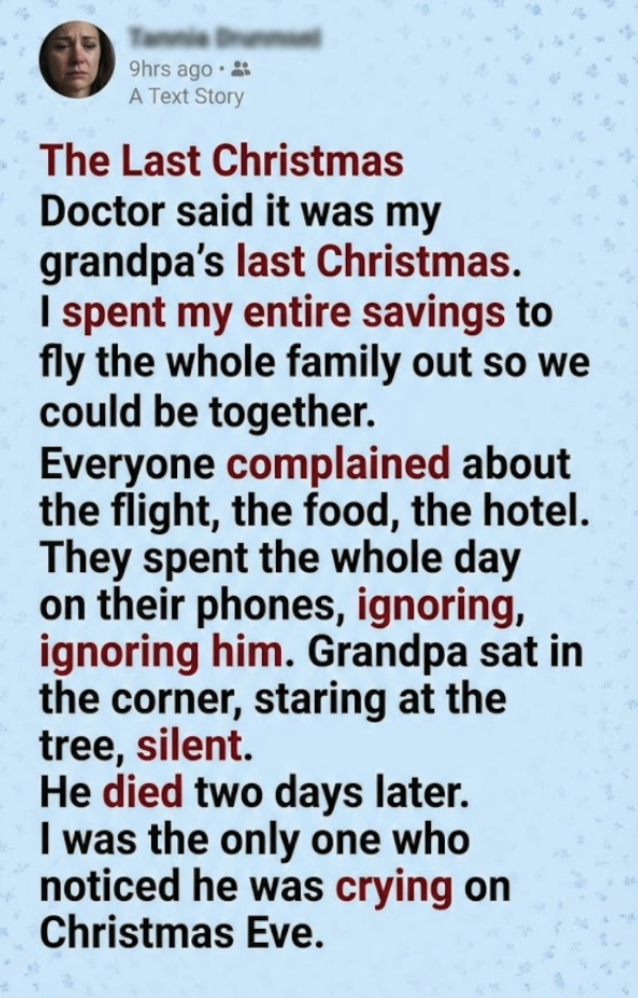
I didn’t care. It was worth it. The oncologist had been blunt: the cancer was aggressive, and this would be my grandpa’s last Christmas. He had been the architect of my childhood, the man who taught me to fish and to forgive. I couldn’t let him fade away in a quiet nursing home.
So, I did the math and I made the sacrifice. I spent my entire savings to fly the whole family out so we could be together. Cousins from the coast, aunts from the south—I rented a large lodge in the mountains, filled the fridge, and bought the tickets. I wanted to give him a grand finale, a room full of love and laughter.
The reality, however, arrived with baggage—and not just suitcases.
From the moment they walked through the door, the air was thick with dissatisfaction. My aunt complained that the drive from the airport was too winding. My cousin, staring at his screen, groaned that the lodge’s Wi-Fi was “garbage.” Everyone complained about the flight, the food, the hotel.
“I can’t believe we had to fly economy,” my uncle muttered, cracking a beer I had paid for. “My back is killing me.”
They didn’t look at the frail man sitting in the armchair by the fire. They didn’t see the way his hands trembled or the pallor of his skin. To them, this wasn’t a vigil; it was an inconvenient vacation.
Christmas Day was the worst. I had envisioned board games and storytelling. Instead, the living room was a sea of blue light. They spent the whole day on their phones. They were texting friends, scrolling TikTok, and checking work emails. They were ignoring, ignoring him.
Grandpa sat in the corner, dressed in his best flannel shirt. He had a small smile on his face at first, waiting for someone to ask him a question, to hand him a gift, to simply acknowledge that he was still there. But the questions never came.
He sat there, staring at the tree, silent. He was an observer at his own wake.
On Christmas Eve, the noise of the television and the tapping of screens filled the room. I was in the kitchen, washing dishes, when I looked over at the armchair. The room was loud, but Grandpa was entirely alone.
I walked over to bring him a cup of tea. That’s when I saw it. A single tear tracking through the deep lines of his cheek. I was the only one who noticed he was crying.
He wasn’t crying because he was in pain. He wasn’t crying because he was afraid of dying. He was crying because he realized that he had already become a ghost to the people he loved. He was right there, breathing and warm, but they had already buried him under their indifference.
I knelt beside him and took his hand. He squeezed it weakly, looking at me with eyes full of devastating clarity. “It’s okay, kiddo,” he whispered, wiping the tear away before anyone else could see—not that they were looking. “Save your money next time.”
He died two days later.
The funeral was well-attended. The same cousins who couldn’t be bothered to look up from Instagram stood at the podium and wept. They posted photos of him—photos I had taken—with captions about “Heartbreak” and “Family First.” They got hundreds of likes for mourning a man they hadn’t spoken to when he was sitting three feet away.
I didn’t speak at the funeral. I sat in the back, thinking about my empty bank account and that single tear. I realized I hadn’t bought a family reunion. I had bought a front-row seat to the truth: that sometimes, the loneliest place in the world is a room full of family.