The restaurant was expensive—the kind of place with white tablecloths and menus without prices. It was the place we had always promised we would go when the “bad times” were finally over.
And they were over.
Across the table, Elena looked radiant. Her skin was clear, her eyes were bright, and she was wearing a silk dress that she had bought with her own paycheck. She looked nothing like the woman I had found shivering on the bathroom floor four years ago. She looked nothing like the woman I had visited in county jail.
I raised my glass of sparkling water. “To you,” I said, smiling until my cheeks hurt. “To the VP of Marketing. You did it, El.”
She didn’t pick up her glass. She was looking at me with a strange, detached expression—like she was looking at an old photograph she was about to throw away.
“We need to talk, Mark,” she said.
My stomach dropped. I knew that tone. But usually, that tone was followed by a confession about a relapse or a debt collector.
“What is it?” I asked, reaching for her hand. “Is it work? Is it the stress?”
She pulled her hand away. “I want to separate.”
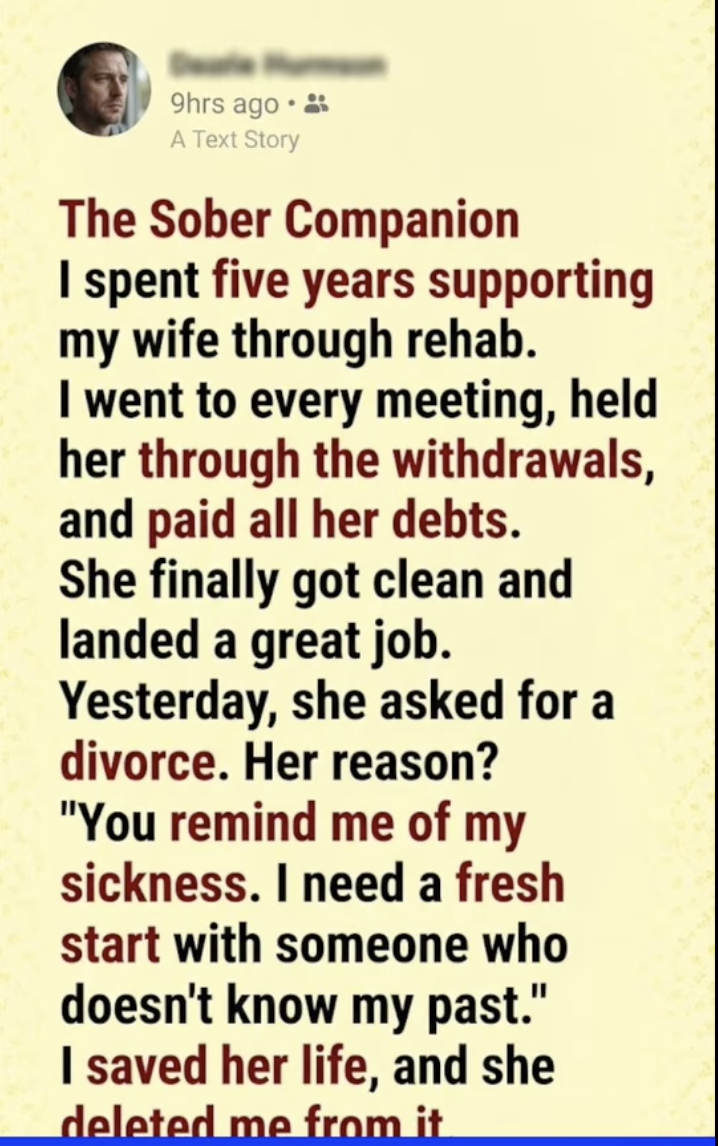
The noise of the restaurant seemed to vanish. I stared at her, trying to process the words. For half a decade, my entire existence had been a support structure for hers. I spent five years supporting my wife through rehab. I had been the designated driver, the nurse, the bank, and the punching bag.
“Separate?” I stammered. “Why? We just made it. We survived. I went to every meeting with you. I held her through the withdrawals when you were screaming in pain. I paid all her debts so you could have a credit score again. We are finally free.”
“That’s just it,” she said, her voice steady and cool. “She finally got clean and landed a great job“. “I am a different person now, Mark. I’m successful. I’m healthy. But when I look at you… I don’t see my husband.”
“Who do you see?” I whispered.
“I see the nights I soiled myself,” she said brutally. “I see the look of pity in your eyes when you picked me up from the precinct. I see the debt. ‘You remind me of my sickness’“.
The cruelty of it took my breath away. I wasn’t her partner; I was a mirror reflecting the version of herself she wanted to kill.
“Yesterday, she asked for a divorce,” and now she was explaining why. “I can’t be this new, shiny person while you’re around remembering the old me. ‘I need a fresh start with someone who doesn’t know my past’“.
“So I’m collateral damage?” I asked, my voice shaking. “I’m just the crutch you throw away once the bone heals?”
“I’m sorry, Mark. I really am grateful. But I need to move on.”
She placed her napkin on the table, stood up, and walked out of the restaurant, her heels clicking confidently on the floor—a confidence I had bought for her with my sweat and my savings.
I sat there alone, staring at the empty chair. I realized then that I hadn’t been fighting for us. I had been fighting for her. I was the medicine, and now that the patient was cured, the medicine was just a bitter taste she wanted to wash out of her mouth.
I saved her life, and she deleted me from it. I was the only one left carrying the weight of the war we had fought, while she walked away into a peace that I was forbidden to share.