It was 10:14 AM on a Tuesday. I know the time because I was looking at the digital clock on the dashboard, annoyed that I was running five minutes late for a dentist appointment. The sky was a painfully bright blue. The radio was playing a pop song I hated but was too lazy to change.
Then, the phone rang.
It was my brother. His voice was two octaves too high, tight with a panic that bypassed my brain and went straight to my gut. He didn’t say hello. He just said, “It’s Mom. You need to get to the hospital.”
I don’t remember the drive. I don’t remember parking. I remember the smell of the hospital corridor—antiseptic and floor wax—and the look on the doctor’s face before he even opened his mouth.
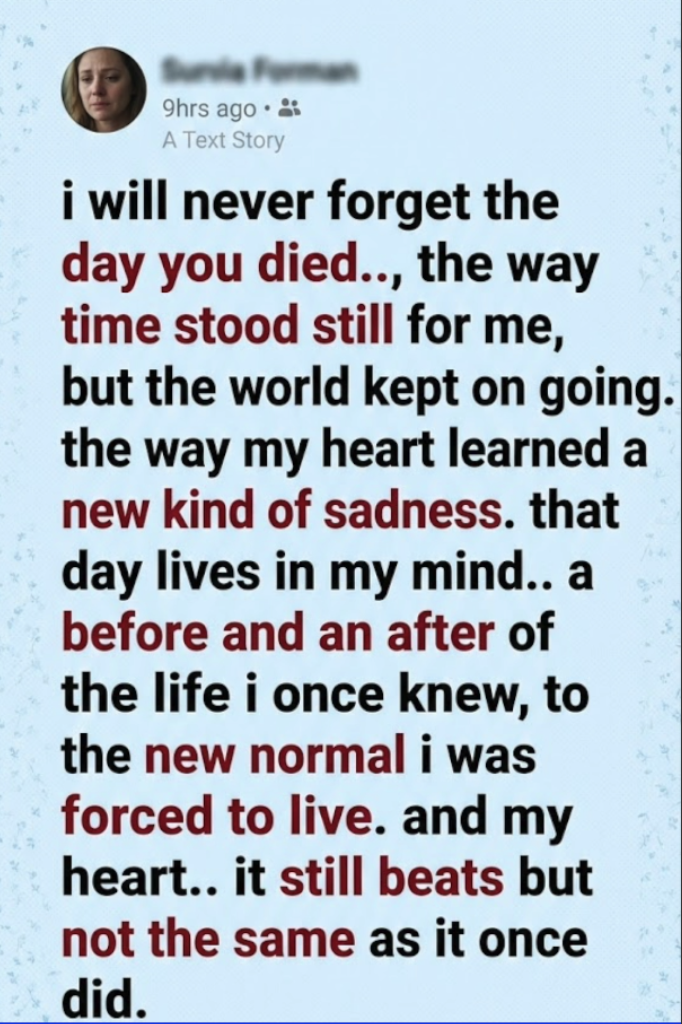
I will never forget the day you died.
It wasn’t a cinematic moment. There were no violins. There was just a sudden, deafening silence in my head. The doctor’s lips were moving, explaining aneurysms and “instantaneous events,” but the words sounded like they were coming from underwater.
In that sterile room, time stood still for me. It felt literal. I felt like the air had solidified, trapping me in amber. I looked at the dust motes floating in the shaft of sunlight coming through the window. They hung suspended, motionless.
But then, I looked out that window.
Down on the street, a bus was merging into traffic. A woman was walking a Golden Retriever. A man was eating a sandwich on a bench.
I wanted to scream at them. Stop! Don’t you know what just happened? The axis of the world has snapped!
But they didn’t stop. The world kept on going. The traffic lights changed. The clouds drifted. The indifference of the universe was almost more violent than the death itself. How could the sun still shine when my source of light had just gone out?
That moment created a fault line in my history. There was now a before and an after of the life I once knew. The “Before Me” was the guy worried about being late to the dentist. The “After Me” was a ghost wandering through a reality that looked familiar but felt alien.
In the weeks that followed, I returned to work. I bought groceries. I paid bills. I entered the new normal I was forced to live. But everything was muted. Colors were less vibrant. Food tasted like cardboard.
My heart learned a new kind of sadness. It wasn’t the sharp, screaming grief of the first day. It was a heavy, dull ache—a background radiation that permeated everything. It was the sadness of realizing that every good thing that happened from now on would be slightly tarnished because she wasn’t there to see it.
It has been three years now. People tell me I seem like myself again. I laugh at jokes. I go to parties. But sometimes, when the room is quiet, I press my hand to my chest.
My heart.. it still beats. It pumps blood. It keeps me alive. But the rhythm is different now. It’s heavier. It’s a survivor’s cadence. It beats, but not the same as it once did, because a piece of it is still back in that hospital room, frozen at 10:14 AM on a Tuesday.