For five years, Thanksgiving at Barbara’s house had been a minefield. It wasn’t just the passive-aggressive comments about my job or my cooking; it was the food itself.
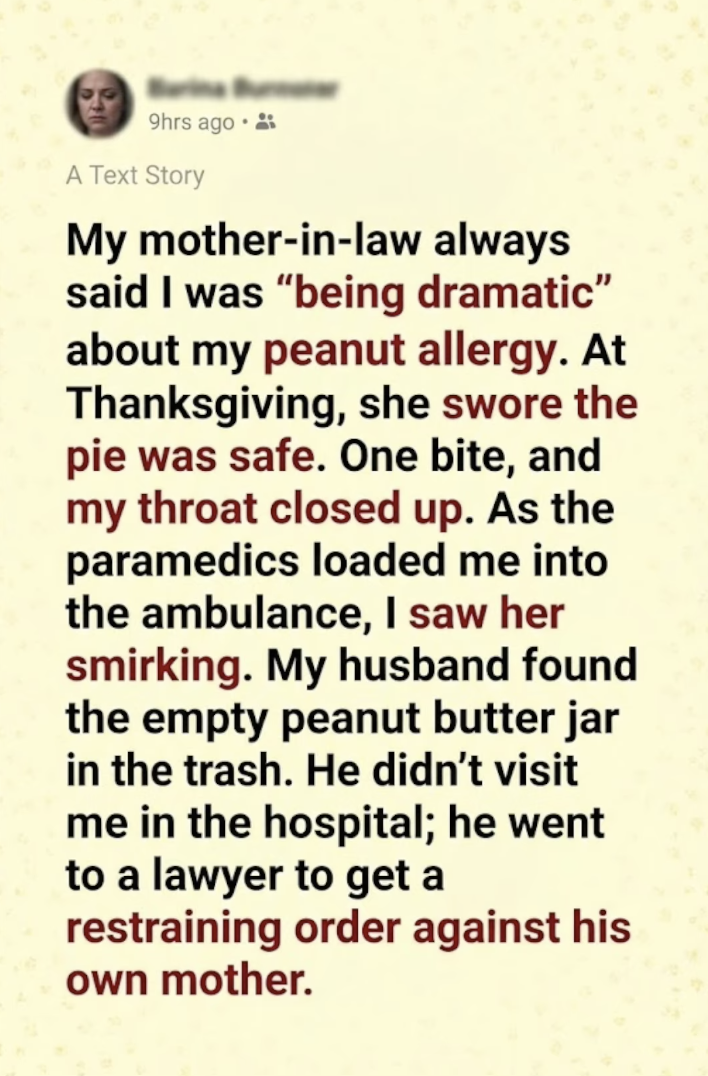
“Oh, loosen up, Jenna,” Barbara would say, waving a spoon covered in unknown sauce. “My mother-in-law always said I was ‘being dramatic’ about my peanut allergy“. She treated my EpiPen like a prop and my medical condition like a personality quirk designed to annoy her.
This year, however, she seemed different. She was sweeter. She insisted I sit down while she served dessert. She brought out a chocolate silk pie that looked impeccable.
“I made this one specifically for you, Jenna,” she said, her voice dripping with sugary concern. “I used sunflower butter instead of peanut butter. I know how ‘sensitive’ you are.”
I looked at my husband, Mark. He squeezed my hand under the table. “Mom worked hard on it, babe,” he whispered. “It’s safe.”
I wanted to believe her. I wanted a normal holiday. At Thanksgiving, she swore the pie was safe.
I took a forkful. The texture was smooth, rich, and… familiar. Too familiar.
The reaction was instantaneous. It wasn’t a slow build; it was a violent seizure of my respiratory system. One bite, and my throat closed up.
My fork clattered to the plate. I grabbed my throat, my eyes bulging. Mark jumped up, shouting, “Jenna! The EpiPen! Where is it?”
Chaos erupted. Chairs were overturned. Someone called 911. The world narrowed down to a terrifying tunnel where air existed but couldn’t reach my lungs. I was fading, the room spinning into darkness.
The last thing I saw was the flashing red lights of the ambulance reflecting off the front window. As the paramedics loaded me into the ambulance, I saw her smirking.
She wasn’t panicked. She wasn’t crying. She was standing on the porch with her arms crossed, a look of triumphant satisfaction on her face, as if she had finally proven that a little peanut butter wouldn’t kill me. Except it almost had.
I woke up in the ICU hours later, a tube in my nose and an IV in my arm. The room was quiet. I waited for Mark to walk through the door, distraught and apologetic.
But Mark wasn’t there.
My phone buzzed on the bedside table. It was a text from him: I love you. I’m handling it. I’ll be there soon.
“Handling it?” I thought, hurt that he wasn’t holding my hand.
He arrived two hours later. He looked wrecked—pale, shaking, but with a cold fury in his eyes I had never seen before. He didn’t just sit down; he paced.
“She tried to kill you,” he said, his voice flat.
“Mark, maybe it was an accident…” I croaked, my throat raw.
“No,” he cut me off. “My husband found the empty peanut butter jar in the trash“. “She hid it at the bottom of the bin, wrapped in a paper towel. It wasn’t a mistake, Jenna. It was a test. And she failed.”
He stopped pacing and looked at me. “I didn’t come straight here because I had to make a stop.”
I realized then what he had done. He didn’t visit me in the hospital; he went to a lawyer to get a restraining order against his own mother.
“She is never coming near you again,” Mark vowed, gripping the bed rail until his knuckles turned white. “She doesn’t get to be a grandmother. She doesn’t get to be a mother. She lost that privilege the moment she decided her pride was more important than your life.”
I looked at him—this gentle man who usually avoided conflict at all costs—and saw a fortress. He had chosen his wife over his blood. The pie had been meant to expose my “drama,” but instead, it had exposed her malice, and in doing so, it had cost her the only son she had.