The lasagna stopped coming after three weeks. The sympathy cards stopped arriving after two months. By the six-month mark, people stopped lowering their voices when they mentioned his name.
Now, it had been two years.
Elara sat across from her sister, Claire, in a bustling cafe. The world outside was bright and loud. Claire was talking about her kitchen renovation—debating the merits of subway tiles versus hexagon patterns.
“I just want it to feel finished, you know?” Claire said, sipping her latte. “So I can stop thinking about it.” Then she paused, looking at Elara with a tilted head, her expression shifting to one of pitying assessment. “Speaking of finished… I saw David from the office asked about you. Maybe it’s time? You seem… back to normal. It’s been a long time.”
Elara smiled. It was a practiced smile, the one she wore like armor to make other people comfortable with her tragedy.
“I’m okay,” Elara said gently.
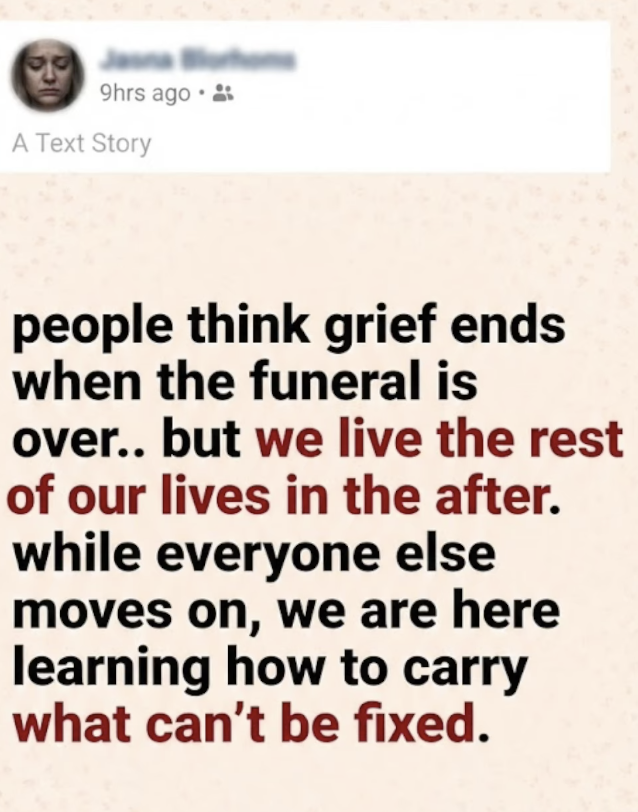
But inside, the disconnect was deafening. She wanted to grab Claire’s hand and explain that people think grief ends when the funeral is over. They think grief is an event, a flu you get over, or a season that passes.
They didn’t understand that the funeral was just the orientation day. The real work began when the black dress was dry-cleaned and hung back in the closet. The truth was, we live the rest of our lives in the after.
“The After” was a strange, foreign country. In the “Before,” Elara had a husband who made terrible puns and excellent coffee. In the “After,” she had a silence in the hallway that was so thick she sometimes had to push her way through it.
“I’m not trying to push,” Claire continued, mistaking Elara’s silence for agreement. “It’s just… everyone else is happy again. You should be too.”
Elara looked out the window. She saw pedestrians rushing to work, cars honking, the world spinning on its axis with indifferent momentum. While everyone else moves on, Elara felt like she was standing on a different frequency. They were living in linear time; she was living in a loop of absence.
“I haven’t stopped moving, Claire,” Elara said softly. “I’m just moving with a limp you can’t see.”
“But you can fix it, right? With time? Therapy? Maybe a vacation?”
Elara shook her head. That was the biggest lie of all—that grief was a broken bone that would eventually set and heal. It wasn’t. It was an amputation. You don’t “fix” a missing limb; you learn to walk differently. You learn to balance on a center of gravity that has permanently shifted.
We are here learning how to carry what can’t be fixed.
“I’m not broken, Claire,” Elara said, picking up her cup. “And I’m not fixed. I’m just carrying him. It’s heavy, and it’s awkward, and sometimes it knocks the wind out of me. But I’m carrying it.”
She took a sip of coffee. It tasted bitter. But she drank it anyway. Because that’s what you do in the After. You drink the coffee, you smile at your sister, and you adjust the invisible weight on your shoulders so you can take one more step.