The catalogue of granite headstones was spread across the dining room table like a menu of despair. For three months, Elias had been obsessing over the details. Serpentine edge? Polished or matte? Onyx or Grey Cloud?
He wanted it to be perfect. It was the last thing he could give to his brother, Marcus, who had died at twenty-six with a half-finished novel on his desk and a passport full of stamps he never got to use. Elias felt that if the stone was heavy enough, expensive enough, beautiful enough, it might somehow anchor the drifting void that Marcus had left behind.
“Elias,” his mother said gently, placing a hand on his shoulder. “You haven’t left the house in weeks. Marcus wouldn’t want you staring at rocks.”
“It has to be right,” Elias muttered, tracing the font options. “It’s his legacy. It’s how people will remember him.”
But deep down, Elias knew it was a lie. The stone was cold. It was static. Marcus was none of those things. Marcus was loud music, spicy food, and impulse road trips. Marcus was movement.
That afternoon, Elias drove to the cemetery to meet the mason. The air was crisp, the kind of autumn day Marcus loved. Elias stood by the empty patch of dirt, shivering in his coat, feeling utterly hollow.
He looked around at the sea of grey stones. Thousands of names etched in rock. And he realized, with a sudden, terrifying clarity, that none of this was for the dead. The dead weren’t here. This was a garden of guilt for the living.
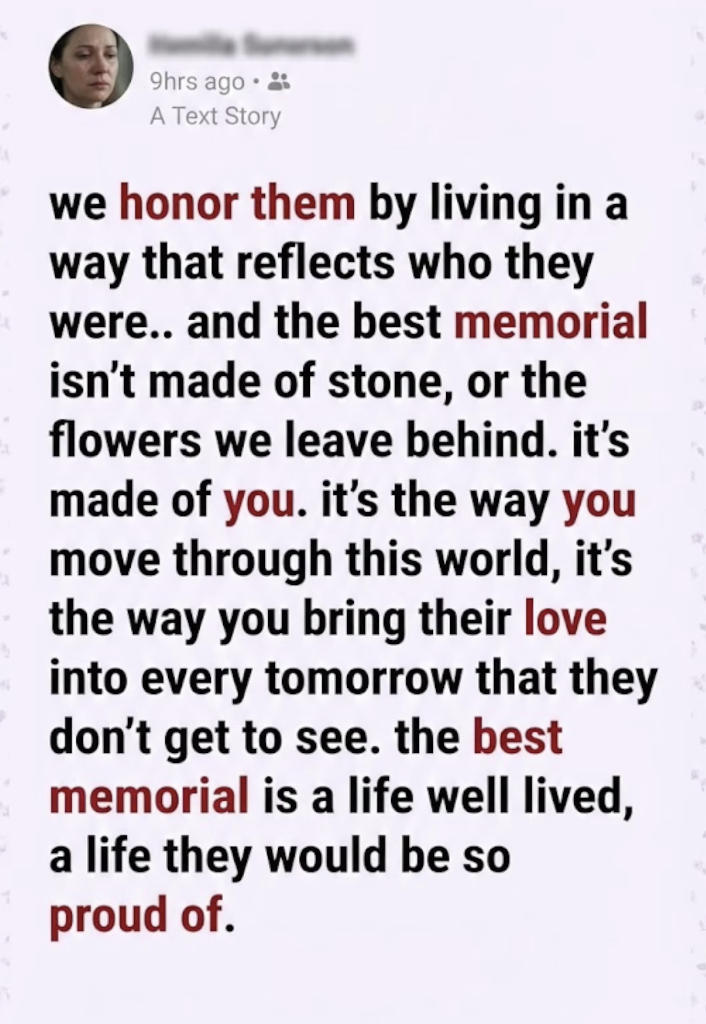
He thought about the quote he had read earlier that morning, something Marcus had actually pinned to his wall years ago: The best memorial isn’t made of stone, or the flowers we leave behind. It’s made of you.
Elias looked at his own hands. They were pale from months of staying indoors. He thought about the trip to Patagonia he and Marcus had planned. He thought about the guitar gathering dust in the corner of his room—the one Marcus had taught him to play.
By building a shrine to death, Elias was letting Marcus’s spirit die twice.
“Mr. Thorne?” the mason asked, holding a clipboard. “Are we ready to finalize the order?”
Elias looked at the catalogue one last time. Then he looked at the blue sky.
“No,” Elias said. “Put a simple marker. Just his name and dates. That’s enough.”
“Are you sure? Most families want a tribute.”
“The stone isn’t the tribute,” Elias said, his voice steady for the first time in months. “We honor them by living in a way that reflects who they were.“
Elias left the cemetery. He didn’t go home. He drove to a music shop and bought a new set of strings. Then he went to a travel agent.
He realized that it’s the way you move through this world that matters. Every time he laughed, it was Marcus’s joy echoing. Every time he took a risk, it was Marcus’s courage living on.
He wasn’t leaving his brother behind; he was carrying him. He would bring their love into every tomorrow that they don’t get to see.
Elias booked the flight to Patagonia. He would climb the mountain they had talked about. And when he reached the summit, breathless and alive, he knew that would be the true monument—not a slab of granite in a quiet field, but a heart beating wildly for two. Because the best memorial is a life well lived, a life they would be so proud of.