The kit was supposed to be a responsible, modern pre-requisite. A “check-the-box” activity before the cake tasting and the seating charts.
“Let’s just make sure we aren’t carriers for anything weird,” Mark had joked, swabbing his cheek in the kitchen of the apartment they had just bought together. “Imagine if we’re both allergic to cilantro or something.”
I laughed. It was easy to laugh then. We were invincible. We were three months away from the altar.
The email came on a Tuesday. I opened it while Mark was in the shower. I expected a boring chart of percentages—maybe a predisposition to high cholesterol or some surprising Scandinavian ancestry.
Instead, there was a bright red notification at the top of the screen: High Genetic Match Detected.
I frowned, scrolling down. I assumed it was a glitch. Or maybe we were distant cousins? That would be a funny story for the reception toast.
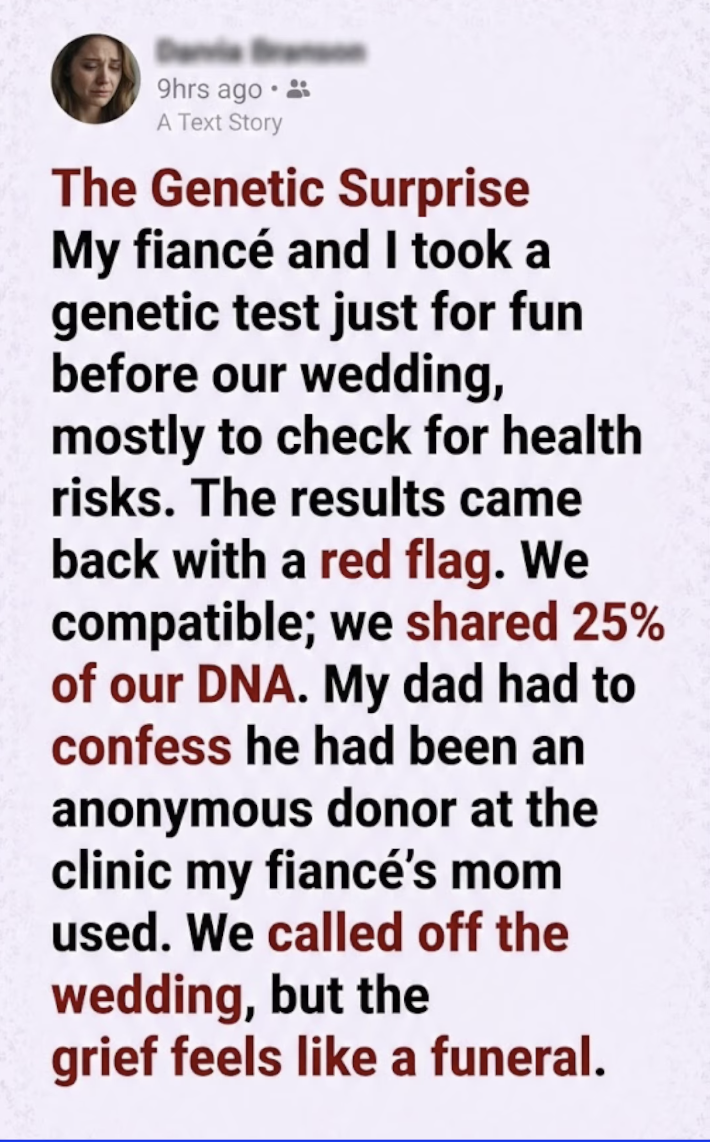
Then I saw the number. We shared 25% of our DNA.
I sat frozen on the edge of the bed. I knew enough biology to know what 25% meant. It meant grandparent. It meant aunt. Or, in our case, since we were the same age… it meant half-sibling.
When Mark came out of the bathroom, towel drying his hair, he saw my face and dropped the towel. “What? Is it bad? Do I have a disease?”
“We have the same father,” I whispered.
The next hour was a blur of denial and frantic phone calls. We drove to my parents’ house in silence. My father was sitting in his recliner, reading the paper. When we showed him the results, he didn’t look confused. He looked pale.
My dad had to confess he had been an anonymous donor at the clinic my fiancé’s mom used.
He started explaining—about being young, needing money for med school, about the closed records, about how the odds were one in a billion. He kept saying, “I didn’t know. I didn’t know.”
But the math didn’t care about his intentions. The math only cared that the man I loved, the man I slept beside, was my brother.
We walked out of that house and into a nightmare. There was no fighting for us. There was no “working through it.” The law, biology, and morality had built a wall between us that no amount of love could scale.
We called off the wedding.
We had to return the gifts. We had to cancel the venue. We had to tell our friends a vague lie about “growing apart” because the truth was too taboo to speak aloud.
I spent the day that was supposed to be my wedding day sitting alone in an empty apartment, staring at a dress I would never wear. Mark was gone—not because he didn’t love me, but because he couldn’t love me.
I realized then that this pain was sharper than widowhood. When someone dies, you mourn the loss of their life. But Mark was still alive. He was just a few miles away, grieving the same loss. The grief feels like a funeral, but there is no body to bury. There is only the ghost of a future that was genetically impossible from the start.