The login screen for the university bursar blinked innocently on the laptop screen. Tuition Due: $42,000.
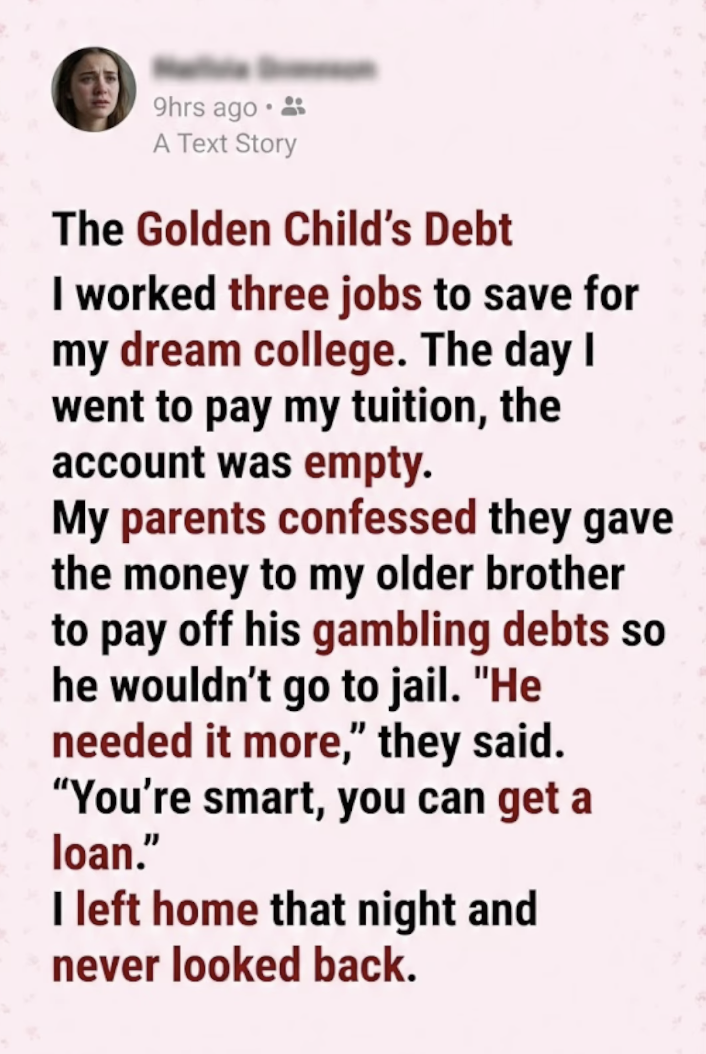
Lucas cracked his knuckles. He had the money. He had spent the last four years smelling like fryer grease and floor cleaner to ensure he had the money. He had worked three jobs to save for my dream college. He had skipped proms, football games, and summer trips. He had lived like a monk so he could leave like a king.
He opened a second tab for the joint savings account he shared with his mother. He typed in the password.
Available Balance: $12.00.
Lucas stared. He refreshed the page. He closed the browser and reopened it. $12.00.
The world tilted on its axis. The air left the room.
He walked downstairs. His parents were in the living room watching a sitcom. His older brother, Greg, was there too, nursing a beer, looking unusually relaxed for someone who had been dodging phone calls for months.
“Where is it?” Lucas asked. His voice was terrifyingly calm.
His mother muted the TV. She didn’t ask what. She flinched.
“Lucas, sit down,” his father said, his tone heavy with a rehearsed speech. “We had an emergency.”
“What kind of emergency costs exactly forty-two thousand dollars?” Lucas asked, his eyes drifting to Greg. Greg looked at the floor.
“It was bad, Luke,” Greg muttered. “I owed some bad people. They were going to hurt me. My parents confessed they gave the money to my older brother to pay off his gambling debts so he wouldn’t go to jail“.
Lucas felt a laugh bubbling up in his throat—a jagged, hysterical thing. “So you took my future to pay for his mistake?”
“He needed it more,” his mother pleaded, reaching out a hand he refused to take. “It was life or death, Lucas. You have to understand.”
“I understand,” Lucas said. “I understand that you stole from the son who works to save the son who gambles.”
“Don’t say ‘stole’,” his father snapped. “We are a family. We help each other. Besides, you’re smart, you can get a loan“.
There it was. The curse of competence. Because Lucas was the capability in the room, he was the sacrifice. His intelligence wasn’t a gift to be nurtured; it was an excuse to neglect him. They assumed he would figure it out because he always did. They assumed he was unbreakable.
Lucas looked at them. He looked at the beer in Greg’s hand—bought, presumably, with the interest from Lucas’s stolen sweat.
He realized then that if he stayed, this would be his life. He would be the eternal safety net. He would build castles, and they would strip the stones to build Greg a bunker.
“You’re right,” Lucas said. “I am smart.”
He turned around and walked to the front door.
“Where are you going?” his mother cried, standing up. “We’re not done discussing this!”
“I’m going to get a loan,” Lucas said, grabbing his car keys. “And I’m going to college.”
“Come back here! You can’t just leave!”
“I can,” Lucas said. “Because clearly, you can’t afford me anymore.”
I left home that night and never looked back.
He took out the loans. He worked double shifts in the library. He graduated at the top of his class. And ten years later, when Greg’s next “emergency” happened and his parents called asking for help, Lucas didn’t answer. He had already paid his dues. The empty account was the severance package that set him free.