The acceptance letter to Stanford had been taped to the refrigerator for four months. It was the only thing in the house that was mine.
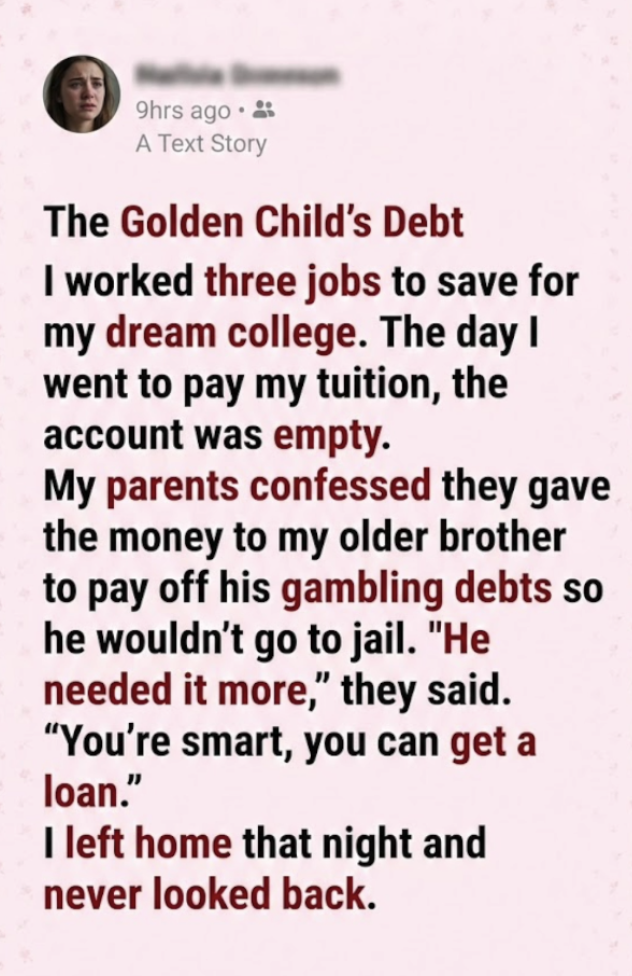
For three years, my life had been a blur of grease, textbooks, and caffeine. I worked the opening shift at a coffee shop from 5 AM to 1 PM, went to classes, and then stocked shelves at the grocery store until midnight. On weekends, I tutored rich kids for cash. I had worked three jobs to save for my dream college. Every dollar I earned went into the joint savings account my mother had opened for me “for safekeeping.”
Today was the deadline. I sat at the kitchen table, my laptop open, ready to transfer the tuition. I felt a rare sense of pride. I had done it. I had paved my own way.
I logged in. I blinked. I refreshed the page.
The balance read: $14.50.
My stomach dropped so hard I felt nauseous. Twenty-five thousand dollars. Gone.
“Mom?” I called out, my voice sounding thin and strangled. “Dad?”
They walked into the kitchen together. They didn’t look shocked. They looked resigned. My father wouldn’t meet my eyes.
“Where is it?” I asked, standing up. “Where is my tuition?”
My mother smoothed her apron, a nervous tic I knew well. “Sit down, honey. We need to explain.”
“I don’t want to sit. I want to know why the account was empty“.
“It’s your brother,” my father muttered.
Of course. It was always Jason. Jason, who couldn’t hold a job. Jason, who always had a “business opportunity” that required capital. Jason, the golden boy who could do no wrong, even when he did everything wrong.
“He was in trouble, deep trouble,” my mother said, her voice trembling. “My parents confessed they gave the money to my older brother to pay off his gambling debts“. “There were men looking for him. If we didn’t pay, he wouldn’t go to jail—he would have been hurt.”
“So you gave him my money?” I screamed. “My sweat? My sleep? My future?”
“He needed it more,” my mother said, tears finally falling. “He was desperate.”
“And what about me?” I asked, feeling the tears hot on my face. “What about my desperation?”
My father finally looked at me. He shrugged, helpless. “You’re smart, you can get a loan“.
The room went silent.
There it was. The penalty for competence. Because I was capable, because I was “smart,” I was expected to survive the fall. Because Jason was a mess, he was entitled to the parachute I had sewn for myself. My hard work wasn’t my future; it was his emergency fund.
I looked at them—these people who claimed to love me. They didn’t see a daughter. They seen a resource. As long as I stayed, I would always be the bank, the fixer, the safety net.
I didn’t argue. I didn’t cry anymore. I walked past them, up the stairs to my room.
“Where are you going?” my mother called out. “We can figure this out! We can co-sign a loan!”
I packed a duffel bag. Laptop, clothes, the acceptance letter from the fridge. I had $14.50 in the bank and a maxed-out credit card. I was terrified.
But as I walked back down the stairs, I felt lighter than I had in years.
“I’m resigning,” I said to them as I reached the front door.
“Resigning from what?” my dad asked.
“From being the solution to problems I didn’t create.”
I left home that night and never looked back. It took me ten years to pay off the loans I eventually took out. But every cent of that debt was worth it, because it was the price I paid for my freedom.