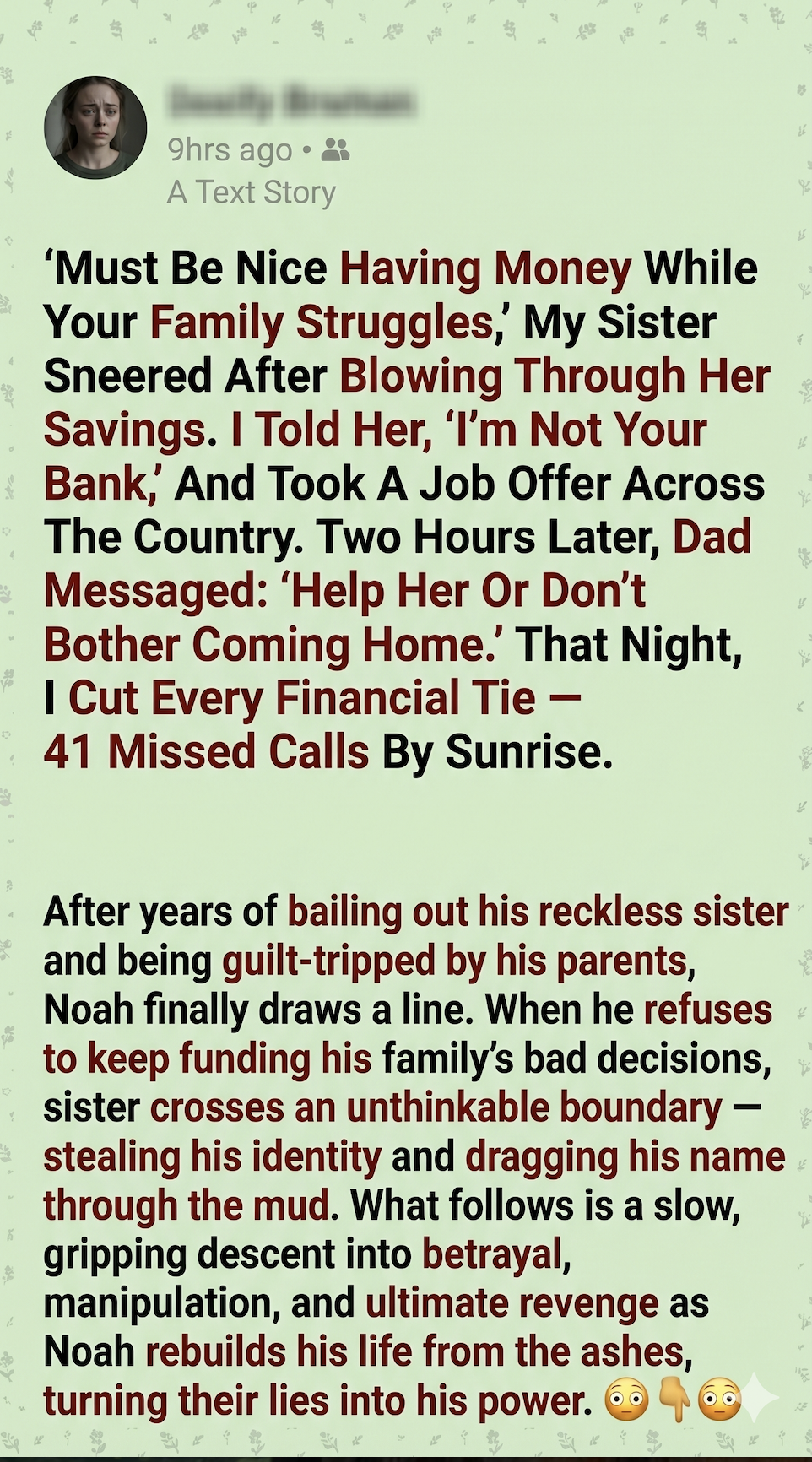
This story dives into the toxic cycle of being the family “provider” and the explosive moment when the bank finally closes its doors.
The 41st Call
For years, I was the family’s emergency fund. My sister, Tiffany, lived a life of “manifesting” and luxury travel on a retail salary, and whenever her credit cards maxed out, my phone would ring. My parents always sang the same tune: “She’s your sister, Noah. Family helps family.”
The Breaking Point
The final straw came when Tiffany “accidentally” spent her rent money on a designer handbag and a weekend in Vegas. She stood in my kitchen, sneering at my modest apartment and the second job I worked on weekends.
“Must be nice having money while your family struggles,” she spat, as if my savings were a gift from the universe rather than the result of 80-hour work weeks.
I looked at her, then at the $3,000 bag on her arm. “I’m not your bank, Tiff. Not today, not ever again.”
The Ultimatum
Two hours after she stormed out, my dad’s name flashed on my screen. I didn’t even have to say hello.
“Help her pay that debt, Noah, or don’t bother coming home for the holidays. We don’t raise selfish children in this house.”
The coldness in his voice was the final key turning in the lock. I didn’t argue. I didn’t beg. I simply hung up and spent the next six hours doing what I should have done years ago.
The Blackout
I took the job offer I’d been sitting on—a position 2,000 miles away that came with a relocation bonus. I called my cell provider and changed my number. I logged into the family streaming accounts, the shared cloud storage, and the emergency credit card I’d let my mom keep “just in case.” I cut every single tie.
I moved out that night. As I drove across the state line, I checked my old phone one last time before factory resetting it.
41 missed calls. 18 from Dad. 23 from Tiffany.
She had tried to use the emergency card at a club. It declined. Dad had tried to call me to demand why the Netflix was logged out. Silence.
The Twist
Six months later, I was settled in my new city, thriving in a role where I was respected. A former mutual friend messaged me a screenshot. Tiffany had tried to open a new line of credit using my social security number, thinking I was still the “quiet brother” who wouldn’t notice.
She didn’t realize I’d set up a fraud alert the night I left. When the police showed up at her door for identity theft, she tried to call me again. But that number didn’t exist anymore.
I wasn’t just a bank that closed; I was a ghost they could no longer haunt.