The bouquet of hydrangeas on the kitchen island was wilting, dropping pale blue petals onto the granite. They had been a gift from Sarah, who had visited yesterday, cooing over little Leo in his bassinet.
“Look at you, Jenna,” Sarah had said, squeezing Jenna’s arm. “You’re a natural. You’re positively glowing.”
Jenna had smiled—a tight, practiced contortion of facial muscles that didn’t reach her eyes. She nodded because that’s what new mothers were supposed to do. They were supposed to be exhausted but blissful, running on adrenaline and oxytocin.
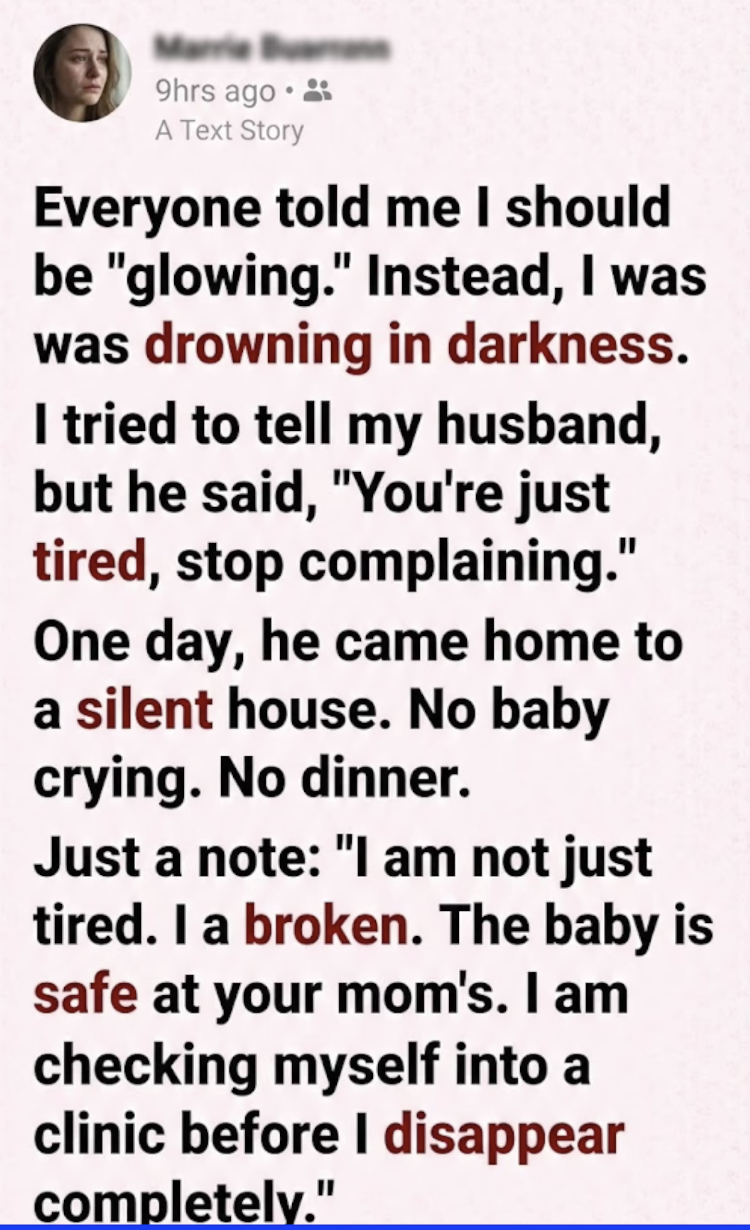
But when the door closed behind Sarah, the “glow” evaporated, leaving Jenna alone in the suffocating quiet of the house. The truth was, the advice she received was a lie; everyone said she should be glowing, but instead, she was drowning in darkness.
It wasn’t just sadness. Sadness was a feeling you could name. This was an abyss. It was a terrifying numbness where love for her child should have been. When Leo cried, she didn’t feel a maternal tug; she felt a spike of paralyzing anxiety, a physical revulsion to the sound of her own failure. She felt like she was watching her life through the wrong end of a telescope—distant, muted, and utterly terrifying.
That evening, when her husband, David, came home, she tried again. He was heating up leftovers, tired from a long day at the firm.
“David,” she said, her voice trembling. “Something is wrong. I don’t feel right. I feel like I’m underwater.”
He didn’t look up from the microwave. “Babe, you’re feeding him every three hours. Of course you don’t feel right.”
“No, it’s not that,” she pressed, tears stinging her eyes. “I’m having scary thoughts. I don’t feel connected to him. I think I need help.”
David finally turned, his expression one of impatient exhaustion. “Jenna, look at Instagram. Every new mom feels overwhelmed. You’re just tired, stop complaining“.
His words hit her like a physical blow. It was the final confirmation of her isolation. If the person closest to her couldn’t see the water rising above her head, then she truly was alone.
The next morning, David left for work before sunrise. Jenna stood over Leo’s crib. He was sleeping peacefully, a perfect, innocent little life that depended entirely on her. And looking at him, Jenna realized with terrifying clarity that she was currently the most dangerous thing in his world because she was hollowed out.
She couldn’t do another day of pretending to “glow.” She couldn’t do another hour of drowning while everyone told her she was fine.
She moved with robotic efficiency. She packed the diaper bag full—enough formula and clothes for three days. She strapped Leo into his car seat, her hands shaking so badly it took three tries to buckle the chest clip.
She drove to her mother-in-law’s house. It was a fifteen-minute drive that felt like an eternity. She rang the doorbell, handed the heavy car seat to a confused-looking Barbara, and muttered something about a sudden doctor’s appointment and needing emergency help. She left before Barbara could ask questions.
Jenna drove back to her empty house. The silence was profound. No baby crying. No hum of the bottle warmer.
She sat at the kitchen island, next to the wilted hydrangeas, and pulled a piece of paper from a notepad. She couldn’t explain it face-to-face. She knew if David argued with her, if he told her she was “just tired” again, she might actually shatter into pieces right in front of him.
She wrote quickly, the pen digging into the paper.
David,
I can’t do this anymore. You wouldn’t listen when I said I was drowning. I am not just tired. I a broken. Leo deserves a whole mother, not this shell.
Don’t worry about him. The baby is safe at your mom’s.
I am driving to Saint Mary’s. I am checking myself into a clinic before I disappear completely.
Please don’t be angry. I’m trying to survive.
-Jenna
She left the note in the center of the island. She grabbed her keys and walked out the door, leaving behind the life everyone thought was perfect, hoping that by walking away now, she might eventually be well enough to walk back into it.
That evening, David came home to a silent house. There was no baby crying. There was no dinner cooking.
There was just the note, finally forcing him to see the darkness he had refused to acknowledge.