The worst part of the breakup wasn’t the empty side of the bed or the awkward division of mutual friends. The worst part was reaching for the phone to tell the one person who would understand, only to remember she wasn’t there to answer.
Maya sat on her kitchen floor, a half-eaten tub of ice cream in her lap and mascara running down her cheeks. In the past, this would have been a “Code Red.” Her mother would have been over in twenty minutes with a bottle of wine and the specific brand of spicy chips Maya loved. They would have sat on this exact floor, and her mother would have listened—really listened—without offering empty platitudes.
Maya wiped her eyes and looked at the framed photo on the fridge. It was a candid shot of the two of them laughing at a failed attempt to bake a birthday cake. They looked less like mother and daughter and more like partners in crime.
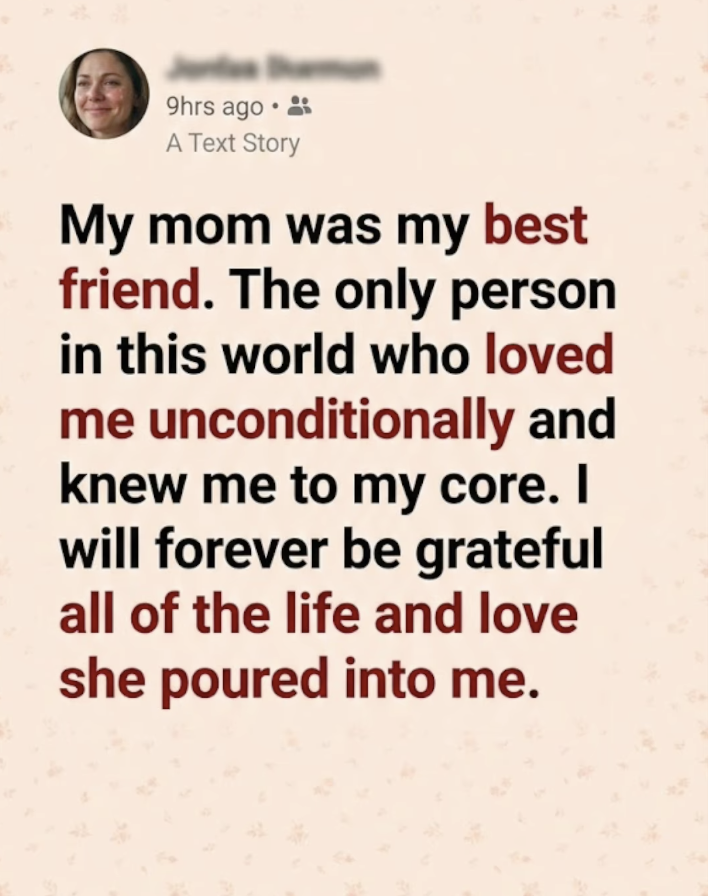
The text she had saved on her phone felt heavy in her pocket: My mom was my best friend. It was a title often tossed around lightly, but for Maya, it was the literal truth. Her mother hadn’t just raised her; she had witnessed her.
Maya closed her eyes, trying to conjure the feeling of her mother’s hand on her hair. The world was full of people who liked Maya, people who loved her with conditions—conditions like be successful, be funny, be strong. But her mother was the only person in this world who loved me unconditionally.
When Maya had failed her bar exam the first time, everyone else had looked at her with pity or disappointment. Her mother had simply said, “Okay, so we study harder. You’re brilliant, Maya. This is just a plot twist, not the ending.”
She knew me to my core. She knew when Maya’s smile was fake. She knew that Maya’s anger was usually just fear in a trench coat. Without that translator, Maya felt like she was speaking a foreign language that no one else could interpret.
“I don’t know who I am without you,” Maya whispered to the empty kitchen. “I feel empty.”
But as the words hung in the silence, a memory surfaced. Her mother, weeks before she passed, holding Maya’s hands in the hospital room.
“You think you’re going to be empty when I go,” her mother had said, her voice weak but steady. “But you’re wrong, baby girl. I’ve spent thirty years filling you up. You are brimming with everything I gave you.”
Maya took a deep, shuddering breath. She looked down at her hands—her mother’s hands. She thought about her resilience, her humor, her ability to find the absurdity in a tragedy. Those weren’t just traits she developed; they were gifts.
She realized then that the emptiness she felt was an illusion. She was a vessel. I will forever be grateful all of the life and love she poured into me. It was all still there. The advice, the laughter, the unconditional validation—it was baked into her bones.
Maya stood up. She washed her face. She looked in the mirror and saw her mother’s eyes staring back, determined and kind.
“Okay,” she said to her reflection, channeling the voice she missed so desperately. “This is just a plot twist. Not the ending.”
She wasn’t alone. She was walking forward, carried by the momentum of a love that was too vast to ever truly run out.