The room smelled of antiseptic and stale coffee. It was a smell I used to associate with healing, with broken bones set right and fevers broken. Now, it smelled like the end of the world.
Dr. Aris sat across from us. He was a kind man with kind eyes, the sort of doctor who held your hand when he delivered bad news. I watched his mouth move, but the words seemed to be coming from underwater. I was gripping Mark’s hand so hard my knuckles were white, waiting for the “but.” Waiting for the “however.” Waiting for the miracle.
Then came the sentence that severed my life into two distinct halves: Before and After.
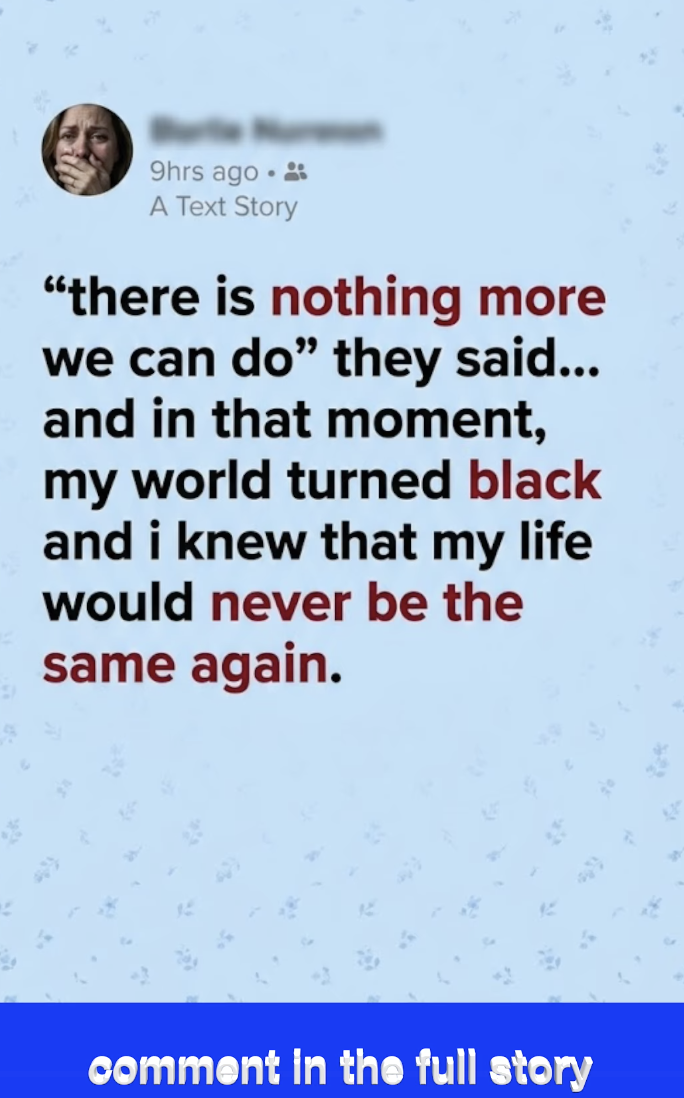
“I’m so sorry,” Dr. Aris said softly, his voice heavy with defeat. “There is nothing more we can do“.
The silence that followed was louder than a scream. It wasn’t just a medical opinion; it was a verdict. It was the closing of a door I had spent months trying to keep propped open with hope, prayers, and experimental treatments.
In that split second, the fluorescent lights overhead didn’t just dim; they vanished. In that moment, my world turned black.
It wasn’t a fainting spell. It was a spiritual eclipse. The future we had planned—the trip to Italy next summer, the house by the lake we were saving for, the simple prospect of growing old and gray on the same porch swing—it all incinerated. The timeline I thought I was living in dissolved, replaced by a terrifying, dark unknown.
I looked at Mark. He wasn’t looking at the doctor. He was looking at me. His eyes were dry, resigned, as if he had known this was coming long before I was willing to admit it. He squeezed my hand, a weak, trembling pressure that was meant to comfort me, even though he was the one leaving.
I tried to speak, to ask a question, to demand a different answer, but the air had left the room. The devastation was absolute. It wasn’t just sadness; it was a complete restructuring of reality. The person I was five minutes ago—the wife fighting for her husband’s recovery—was gone. I was now a wife preparing for a funeral.
We walked out of the office into the hallway. Nurses were chatting at the station. A janitor was mopping the floor. The world was audaciously, offensively normal. How could the elevators still ding? How could people still be checking their watches? Didn’t they know the sky had just fallen?
I looked down at our joined hands. I knew we still had days, maybe weeks. But the transition had already happened. The hope was gone, replaced by a clock ticking down to zero.
I took a breath that felt like inhaling broken glass. I knew that my life would never be the same again. The colors were duller. The sounds were muted. I was walking, breathing, and moving, but the light had gone out, and I had no idea how I was supposed to navigate the darkness that lay ahead.