The Full Story
The silver key felt heavy and cool in my palm—a physical weight representing twelve years of double shifts, missed vacations, and meticulous saving. I had bought the house of my dreams, a quiet craftsman on the edge of town, entirely on my own.
When I invited my parents over, I expected a “well done.” I expected them to finally see me.
Instead, my mother didn’t even take her coat off. She walked through the open-concept kitchen, running a finger along the granite countertops with a look of pure resentment. “It’s a bit much for one person, isn’t it?” she asked.
“I worked for it, Mom,” I said, trying to keep the pride in my voice.
“While your brother is still sleeping on a couch?” my father snapped, gesturing vaguely toward the city where my brother, Kyle, had just flunked out of his third “business venture” funded by their retirement savings. “You’ve been hoarding your money while he struggled. It’s selfish. This house… this belongs to the family. It belongs to Kyle’s future.”
I laughed, thinking it was a joke. It wasn’t.
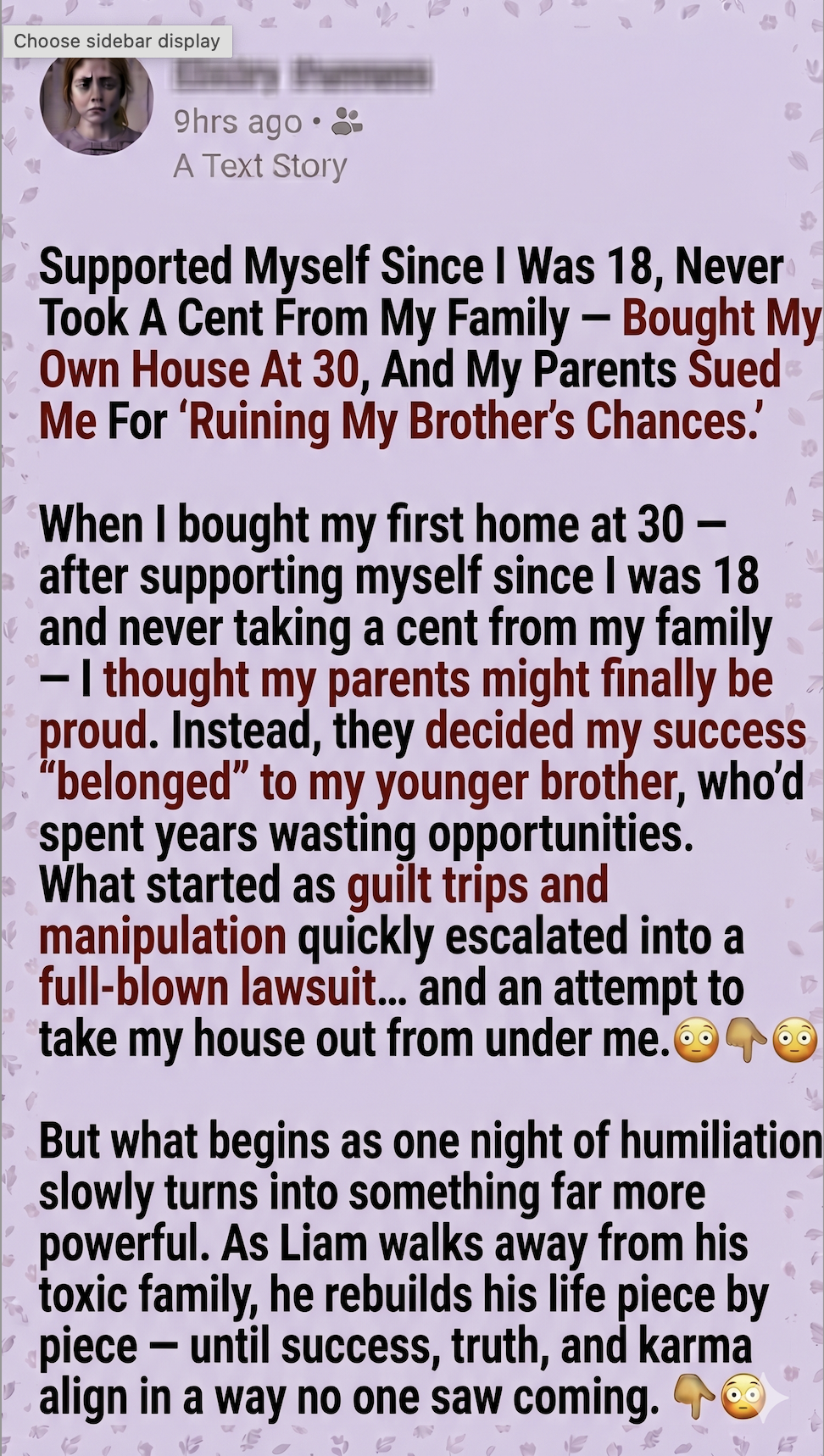
Two weeks later, I wasn’t receiving housewarming gifts. I was receiving a process server. My parents were suing me for “Unjust Enrichment.” Their logic was twisted: because they had “provided the foundation of my life” (public school and a roof until I was 18), they claimed a 50% stake in all my assets to “level the playing field” for my brother.
The day of the hearing, my parents sat across from me in the hallway, Kyle smirked beside them, wearing a suit I had probably paid for indirectly through their drained savings.
“Just give him the guest suite and put his name on the deed,” my mother whispered as we entered the courtroom. “Don’t make this ugly.”
“It’s already ugly,” I said.
In front of the judge, their lawyer painted a picture of a “prodigal child” who had abandoned their struggling family. But I had come prepared. I produced twelve years of tax returns, bank statements showing zero transfers from my parents since my eighteenth birthday, and a grueling paper trail of every loan and bill I’d paid myself.
The judge looked at my parents, then at the “ruined” brother, and finally at the mountains of evidence of my independence.
“Mr. and Mrs. Miller,” the judge said, her voice dripping with ice. “To claim a right to the fruits of a labor you did not support is not a legal argument. It is a confession of greed. Not only is this case dismissed with prejudice, but you will be responsible for the defendant’s legal fees.”
As we walked out, my father grabbed my arm. “You’ve ruined him! He was counting on that equity to start his new company!”
I pulled my arm away and looked at the three of them—the people who had tried to steal my home to reward a person who had never built anything.
“I didn’t ruin Kyle’s chances,” I said, the silver key glinting in the light. “You did. You taught him that he could take what he didn’t earn. But the locks on my house have already been changed, and today, I’m changing the locks on my life. Don’t call again.”
I walked to my car, leaving them in the shadow of the courthouse, finally free of a debt I never actually owed.