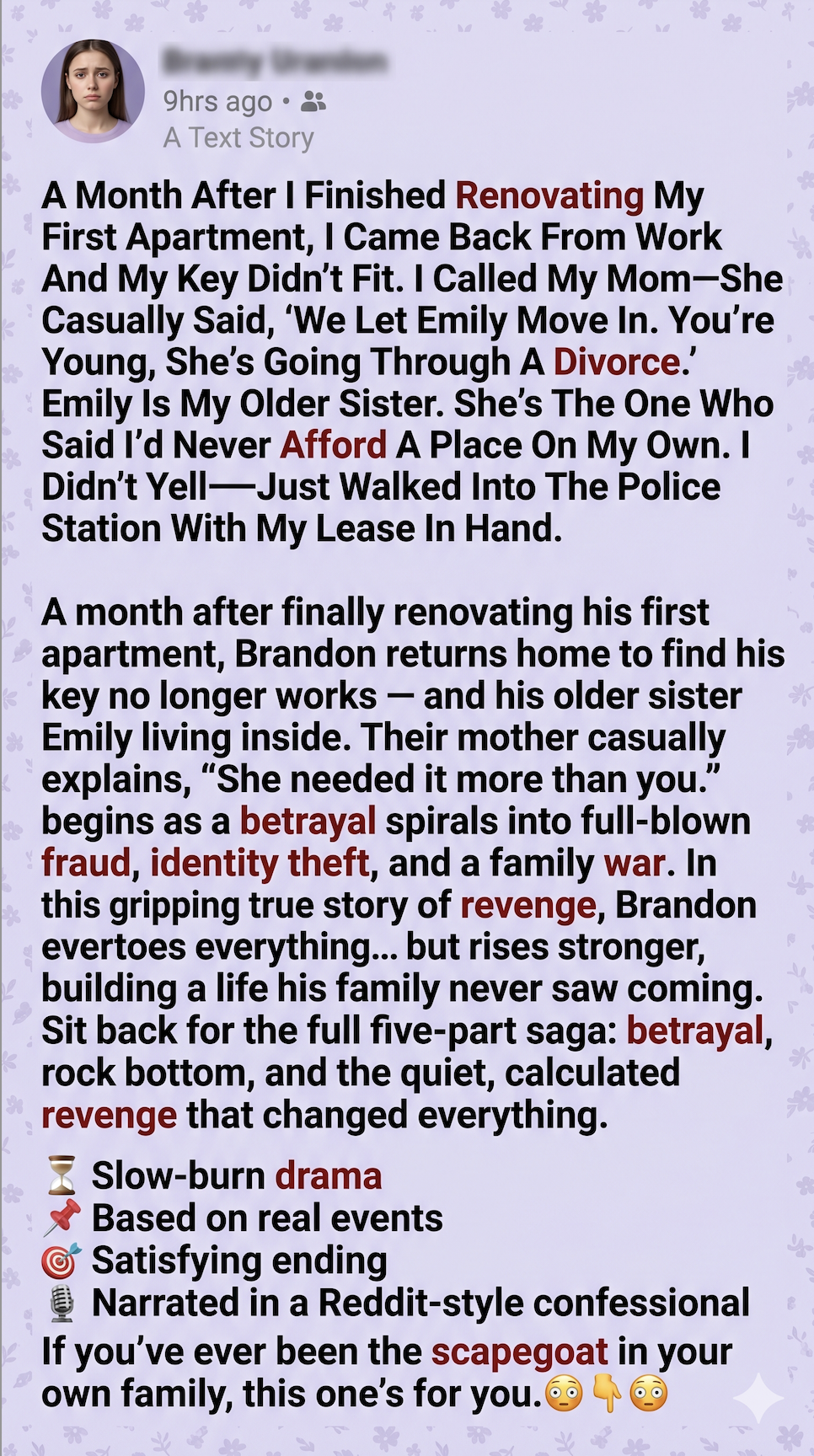
This is a five-part saga of tactical revenge. We’ll lean into the “Reddit-style” confessional tone, focusing on the cold, methodical way Brandon dismantles the situation after his mother and sister decided his hard work was communal property.
Part 1: The Lockout
I didn’t even drop my groceries. I just stood there, staring at a brass deadbolt that refused to turn. I’d spent six months and every cent of my savings stripping the wallpaper, fixing the plumbing, and installing those floors in my first apartment.
When my mom picked up the phone, her voice was airy. “Oh, Brandon! I meant to tell you. Emily’s situation with the divorce got… messy. She needed a safe space, and you’re so young, you can just crash on our couch for a bit. It’s family, honey.”
The betrayal wasn’t just the lock; it was the fact that Emily—the sister who told me I’d be a “renter for life” while she married into money—was currently sitting on my sofa, drinking my wine, in a place she didn’t pay a dime for. I didn’t argue. I didn’t scream. I went to the precinct.
Part 2: The Paperwork War
The police officer looked at my lease, then at my ID. “You’re the sole tenant?” “Yes,” I said. “And the locks were changed four hours ago without my consent.”
Because Emily had moved her “designer” luggage in, the police called it a civil matter—at first. But then I showed them the “Identity Theft” alert on my phone. While I was at the station, I realized my filing cabinet, which held my birth certificate and social security card, was still in that apartment. I checked my credit app. A new credit card application had just been flagged in my name.
Emily wasn’t just taking my home; she was trying to steal my future to fund her “post-divorce glow-up.”
Part 3: The Eviction Trap
I played the “quiet son” for three days while staying at my parents’ house. My mom kept telling me to “be the bigger person.” Meanwhile, I was working with a locksmith and a private process server.
Since I was the legal leaseholder and the owner of the furniture, I waited until Emily and my Mom went out for a “healing brunch.” I arrived with a moving crew. In two hours, the apartment was empty. I didn’t just take my stuff; I took the light fixtures I’d bought, the smart thermostat, and even the custom closet organizers I’d built.
When they returned, the apartment wasn’t just empty—it was a shell. And sitting on the counter was a formal “Notice to Quit” and a copy of the police report for the fraudulent credit card application.
Part 4: The Family Fallout
The “Family War” began at 3:00 PM. My phone vibrated so hard it nearly fell off the table. My mom was hysterical, calling me “heartless.” Emily was screaming in the background that she had “nowhere to go.”
I sent one group text:
“The credit card company is tracing the IP address of the application. The police have the footage from the apartment’s hallway camera showing who entered with the locksmith. You have 24 hours to return my filing cabinet, or I press charges for felony identity theft. Family doesn’t steal. Family doesn’t lock family out of their own homes. Pick a side.”
My father, who had been silent the whole time, finally called me. “She did what with your Social Security number?” The tide was turning.
Part 5: The Satisfying End
It took six months to fully settle. Emily had to move into a tiny studio, funded by a job she hated, because Dad refused to bail her out once he saw the evidence of the fraud. My mother’s “golden child” had been exposed as a thief.
I didn’t move back into that apartment. The vibe was ruined. I used the “renovation” equity to break my lease and bought a small fixer-upper house three towns over. My new door uses a biometric lock. No keys. No “family” favors.
Sometimes, the only way to deal with a family that treats you like a scapegoat is to build a fence so high they can’t even see the life you’ve built without them.
Moral of the story: Never let someone who called you a “failure” sit at the table you built with your own hands.