The Ghost in the Ledger
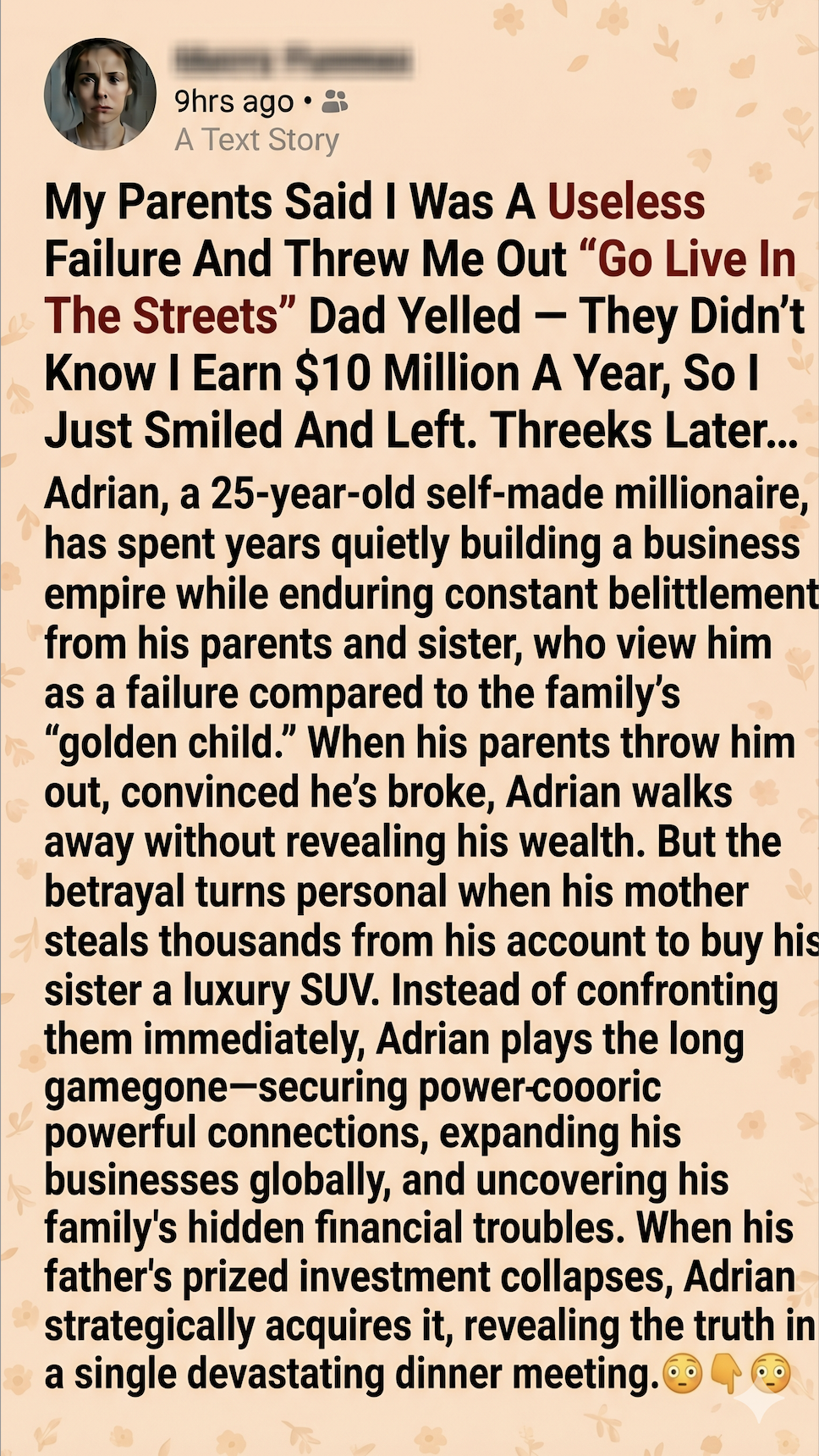
The suitcase hit the pavement with a hollow thud. It was a cheap thing, scuffed and worn—perfectly matching the “useless failure” persona I had curated for the last five years.
“Don’t come back until you’ve found a real job!” my father bellowed from the porch, his face a shade of purple that matched his wine. “Go live in the streets for all I care. Maybe a cold night will finally teach you the value of a dollar!”
My mother stood behind him, stroking my sister’s hair. My sister, the “Golden Child,” just smirked, twirling the keys to a house I knew they couldn’t actually afford.
“I understand, Dad,” I said, picking up the bag. I didn’t tell them that the “bag” contained a high-end encrypted laptop that managed a software conglomerate valued at nine figures. I didn’t tell them my personal income for the year had just crossed $10 million. I just smiled, walked to the bus stop, and disappeared into the city.
Three weeks later, the game changed.
I was sitting in my penthouse office when my phone buzzed. A notification from an old, dormant joint account I’d forgotten to close—one my mother still had access to. $50,000 withdrawn. Then another $20,000.
I pulled up the bank’s digital footprint. The money had been spent at a luxury dealership. My mother had stolen my “emergency savings”—the only money she thought I had—to buy my sister a brand-new SUV as a graduation present.
I leaned back in my leather chair. I could have called the police. I could have frozen the account. But why stop at a few thousand dollars when I could take everything they valued?
I spent the next month quietly buying up debt. It turned out my father’s “prized investments” were nothing more than a house of cards built on predatory loans. He was drowning, using my mother’s dwindling inheritance to keep the lights on while they played the role of local royalty.
Then, the final piece fell into place. My father’s flagship commercial property—the building his pride was anchored to—went into foreclosure. I didn’t just buy the debt; I bought the entire holding company through a shell corporation.
I invited them to a “business dinner” to meet their new landlord.
They walked into the private room of the city’s most exclusive steakhouse, looking nervous but dressed in their finest (likely unpaid-for) clothes. When they saw me sitting at the head of the table, my father’s jaw literally dropped.
“Adrian? What the hell is this?” he hissed. “Are you waiting tables here? Get out before you embarrass us!”
“Actually, Dad, I’m the one who paid for those shoes you’re wearing,” I said, sliding a folder across the table. “And the SUV Mom bought for Sis with my stolen money? I’ve already sent the repo man. It should be leaving your driveway about… now.”
My mother turned pale. “Adrian, how dare you—”
“I’m the ‘useless failure’ who owns your mortgage, your office, and your debt,” I interrupted, my voice as cold as the ice in my glass. “You told me to go live in the streets. But looking at these foreclosure papers, it seems like you’re the ones who need to start looking for a sidewalk.”
The silence was absolute. The “Golden Child” started to cry. My father looked like he was having a heart attack.
“I’m not going to make you homeless,” I said, standing up and buttoning my tailored blazer. “I’ve bought a small, one-bedroom apartment in the worst part of town. You can live there, rent-free, until you find ‘real jobs.’ Consider it a gift from the son who didn’t count.”
I walked out of the restaurant without looking back. They wanted me to learn the value of a dollar; I decided to teach them the cost of a betrayal.