Part 1: The Invisible Provider
For three years, I was a ghost. Every month, like clockwork, $2,400 left my account and entered a private bridge account I’d set up for my parents. They thought it was a “government relief grant” or an “anonymous donor” from their church. I let them believe it because I knew their pride wouldn’t handle a handout from me—the son they considered “unambitious” because I worked from home in tech while my brother, Caleb, wore a suit to a mid-level marketing job.
While Caleb was out buying rounds of drinks for friends and taking flashy vacations, I was eating ramen and working twelve-hour shifts to ensure my parents didn’t lose the roof over their heads.
Part 2: The Dinner Table Execution
The truth came out during my mother’s 60th birthday dinner. Caleb had just presented her with a designer handbag—likely bought on credit—and the room was thick with praise for his “generosity.”
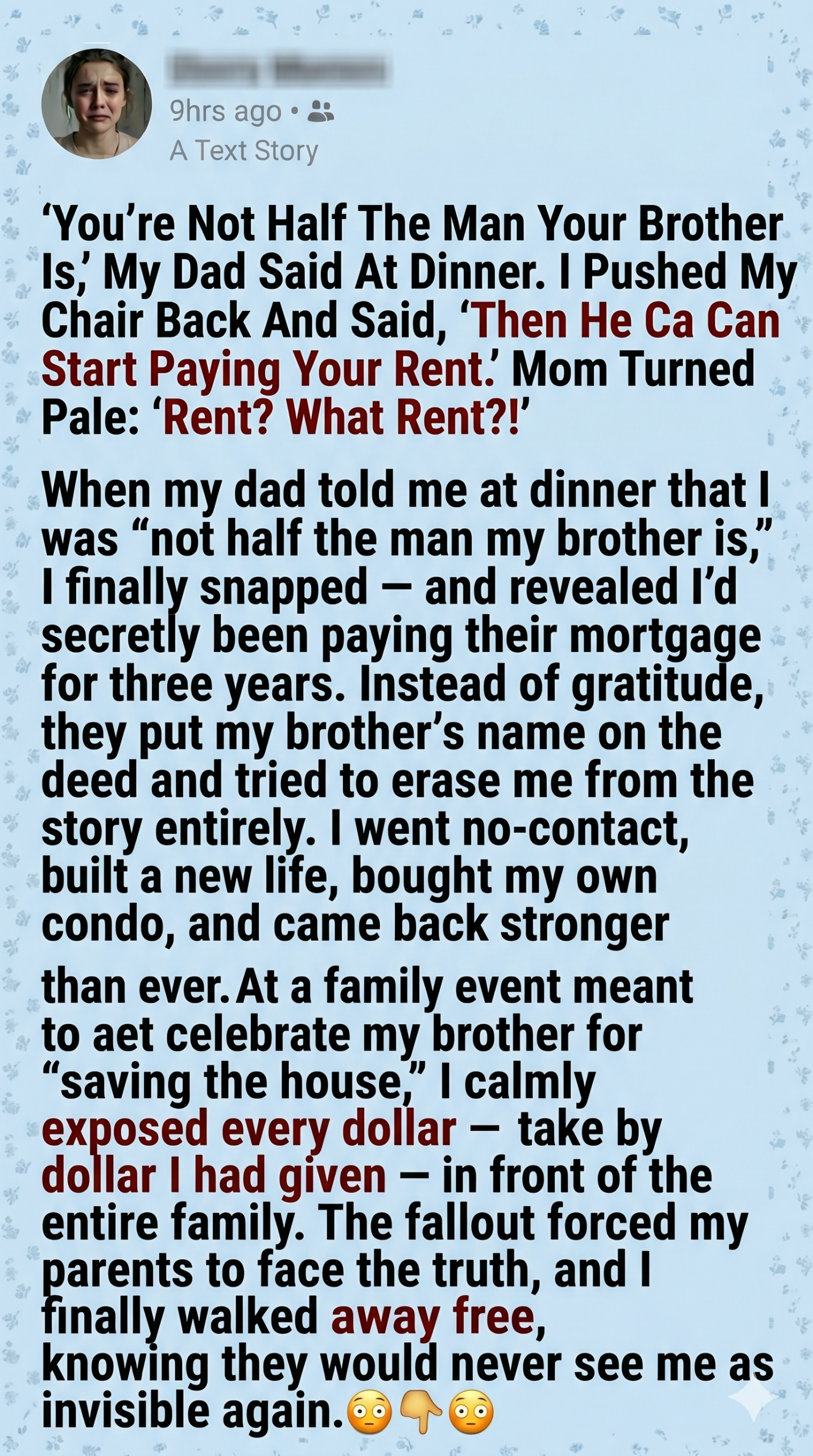
My father turned to me, his eyes cold. “You know, seeing Caleb take care of us like this… it makes me realize you’re not half the man your brother is, Leo. You just sit in that room and hoard your little pennies while he actually contributes.”
I felt a snap in my chest. The three years of silence, the missed vacations, the constant belittling—it all surfaced at once. I pushed my chair back, the screech of wood on tile silencing the room.
“If that’s how you feel,” I said, my voice eerily calm, “Then Caleb can start paying your rent.“
The table went dead silent. My mother turned pale. “Rent? What rent? The bank handles the house, Leo. Don’t be dramatic.”
“The bank hasn’t seen a dime of your money in thirty-six months,” I replied. “I’ve been the one holding the deed up. But since I’m ‘not half a man,’ I guess I’ll just stop. Good luck with the next payment on the first.”
Part 3: The Ultimate Betrayal
I expected a phone call, an apology, or even a shocked confrontation. What I got instead was a legal notice.
In a move of pure, calculated spite, my father had used his remaining legal authority to put Caleb’s name on the deed of the house. They used the “breathing room” my money had provided to restructure their assets, effectively handing my brother the equity I had built for them. They tried to erase my three years of sacrifice as if it were a clerical error.
I didn’t argue. I didn’t beg. I went no-contact. I blocked their numbers, moved to a different city, and focused every ounce of that “unambitious” energy into my own firm.
Part 4: The Celebration of Lies
Two years later, an invitation arrived via a cousin. It was for a “Family Victory Party.” Caleb was being celebrated for “saving the family home” from a recent financial dip. The narrative they’d spun was perfect: Caleb was the hero, and I was the bitter son who had abandoned them.
I showed up. But I didn’t bring a gift. I brought a black leather folder.
I waited until the toasts started. Caleb was standing there, basking in the glory of being the “provider,” while my parents looked at him with tears of pride.
“I have a toast too,” I said, stepping into the center of the room.
The air left the room. My father tried to bark me down, but I was already opening the folder. I didn’t shout. I simply started reading—bank statements, transfer receipts, and the original emails from the bridge account.
“January 2023: $2,400. February: $2,400. March…”
I went through all thirty-six months. I showed the family the dates that coincided with my parents’ “miracle” payments. Then, I showed the date they added Caleb to the deed—exactly two weeks after I told them the truth.
Part 5: The Fallout
The silence was deafening. The extended family looked at my parents with newfound disgust. Caleb couldn’t even look me in the eye. He knew, and they knew, that the “hero” was a fraud and the “disappointment” had been their savior.
“You can keep the house,” I told my father, tossing the folder onto the table. “And Caleb can keep the debt that’s coming with it. Because I’m officially done being invisible.”
I walked out of that house for the last time. I have my own condo now, a thriving business, and a life where my worth isn’t measured by how much I can be exploited. They aren’t just my past anymore—they’re a closed account.
I finally walked away free.