This story follows a similar arc of extreme familial entitlement, but adds a public “smear campaign” element that makes the revenge even more satisfying.
Plot Summary
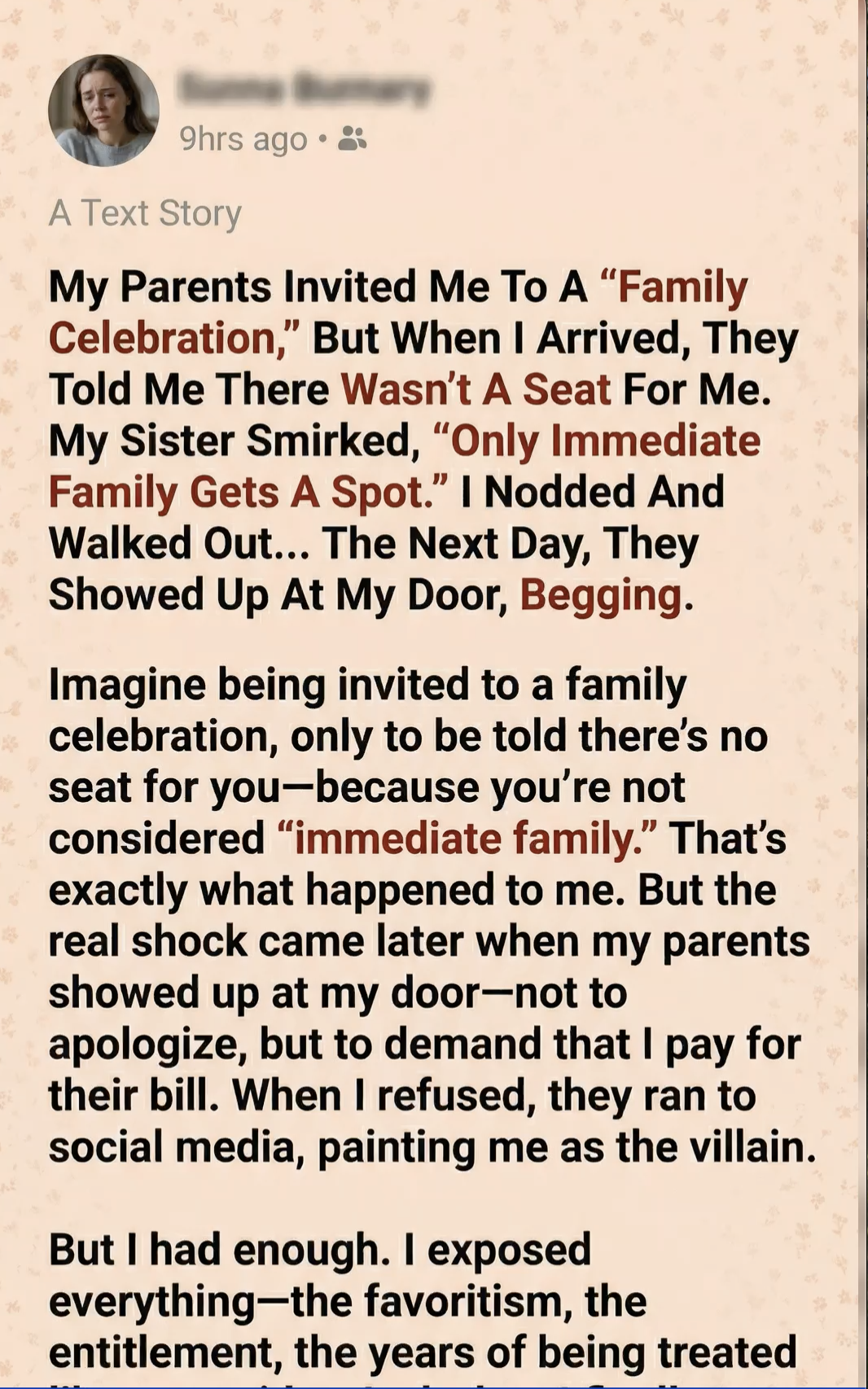
The narrator is invited to a “family celebration” by their parents, only to arrive and be told by their sister that there isn’t a seat for them because “only immediate family gets a spot.” This implies the narrator has been “demoted” from the inner circle.
The twist: The “celebration” was an expensive dinner the parents assumed the narrator would pay for. When the bill arrived and the narrator wasn’t there to swipe their card, the parents and sister showed up at the narrator’s home—not to apologize, but to demand payment. When met with a “no,” the family took to social media to play the victim, prompting the narrator to drop a “truth bomb” exposing years of toxic favoritism.
The Expanded Story
The restaurant was Le Sel, the kind of place where the menus don’t have prices and the napkins are thicker than my bath towels. My parents had texted me three days ago: “Big family celebration Friday at 7. Don’t be late!”
I wore my best suit. I even brought a vintage bottle of champagne to share. But when I walked to the long, candle-lit table, I saw my parents, my sister Elena, her husband, and even her husband’s cousins. Every chair was filled.
“Oh, you’re here,” my mother said, not looking up from her lobster bisque.
“Where do I sit?” I asked.
Elena smirked, adjusting her silk scarf. “Actually, we realized at the last minute that the reservation was capped. We decided to keep it to immediate family only. Since you live across town and have your own thing going on… well, there just isn’t a spot.”
The table went silent. My father didn’t look at me. He just sipped his scotch.
“I’m your son,” I said quietly.
“Don’t make a scene,” Elena whispered. “It’s a vibe thing. Just go grab some takeout.”
I didn’t argue. I didn’t cry. I just nodded, handed the $200 bottle of champagne to a random couple at the next table, and walked out.
The Midnight Knock
I was halfway through a peaceful movie at home when my doorbell began to scream. It wasn’t a ring; it was a rhythmic, angry pounding.
I opened it to find my mother, red-faced, and my father, looking disheveled.
“How could you do that?” my mother shrieked. “We were stuck there for two hours! They wouldn’t let us leave!”
“Do what?” I asked.
“The bill!” my father barked. “It was $1,400! We told the waiter you were coming to handle it, like you always do for ‘family celebrations.’ When you never showed up to the table, they made us stay until we called someone to wire the money. Elena had to use her vacation savings!”
“But Elena said I wasn’t immediate family,” I replied calmly. “Why would a non-family member pay for your dinner?”
The Social Media War
By the next morning, my Facebook feed was a nightmare. Elena had posted a photo of my parents looking “distraught,” captioned:
“So sad when ‘successful’ children forget where they came from. Left our elderly parents stranded at a restaurant because of a ‘petty seating misunderstanding.’ Money really does change people. 💔 #Heartbroken #FamilyFirst”
The comments were brutal. Aunts, uncles, and family friends were calling me “ungrateful” and “cold-blooded.”
The Receipt Drop
I didn’t reply to the post. I made my own.
I uploaded a gallery.
-
Slide 1: The screenshot of the “Immediate Family Only” text Elena sent me afterward, laughing about the seating.
-
Slide 2: A spreadsheet of the last three years of “family celebrations”—totaling $18,000—all paid by me.
-
Slide 3: The bank statement showing I’d been paying my parents’ car insurance and Elena’s Netflix/Phone bill for two years.
My caption:
“If I’m not ‘family’ enough to sit at the table, I’m certainly not ‘family’ enough to pay for the meal. Since I’m officially ‘non-immediate,’ I’ve canceled the insurance policies and the shared accounts. Hope the ‘vibe’ was worth $1,400. You have the life you pay for now.”
The silence on Elena’s post was instantaneous. The “un-invitation” had just become permanent.