The irony of “gratitude” is that it’s usually demanded by those who deserve it the least.
For three years, I was the ghost in the machine of the Miller household. While my peers were posting about prom and college dorm setups, I was hunched over two monitors in a basement room that smelled like stale coffee and ambition. I was a freelance software architect. By eighteen, I was pulling in six figures; by nineteen, I was the reason the lights stayed on.
I never asked for a “Thank You” plaque. I just paid the mortgage through a joint account I’d set up with my mom when I was sixteen, and I covered the utilities because I liked having high-speed internet. My parents, Dad especially, treated my “computer hobby” with a mix of condescension and convenience. To them, I was just the quiet kid who didn’t cost them anything.
Then came Maya’s 21st birthday.
The Party
The living room was decked out in gold streamers. Maya, the golden child whose greatest life achievement was “finding her vibe” at a community college she eventually dropped out of, stood center stage.
“Open it!” Mom squealed, sliding a thick envelope across the table.
Maya tore it open. Two first-class tickets to Paris, a boutique hotel reservation for three weeks, and a five-figure “spending stipend.”
“You deserve the world, baby girl,” Dad said, pulling her into a bear hug. “We wanted to make sure your milestone was unforgettable.”
I sat at the end of the table, calculating the cost in my head. That trip cost exactly what I’d deposited into the “House Fund” over the last four months.
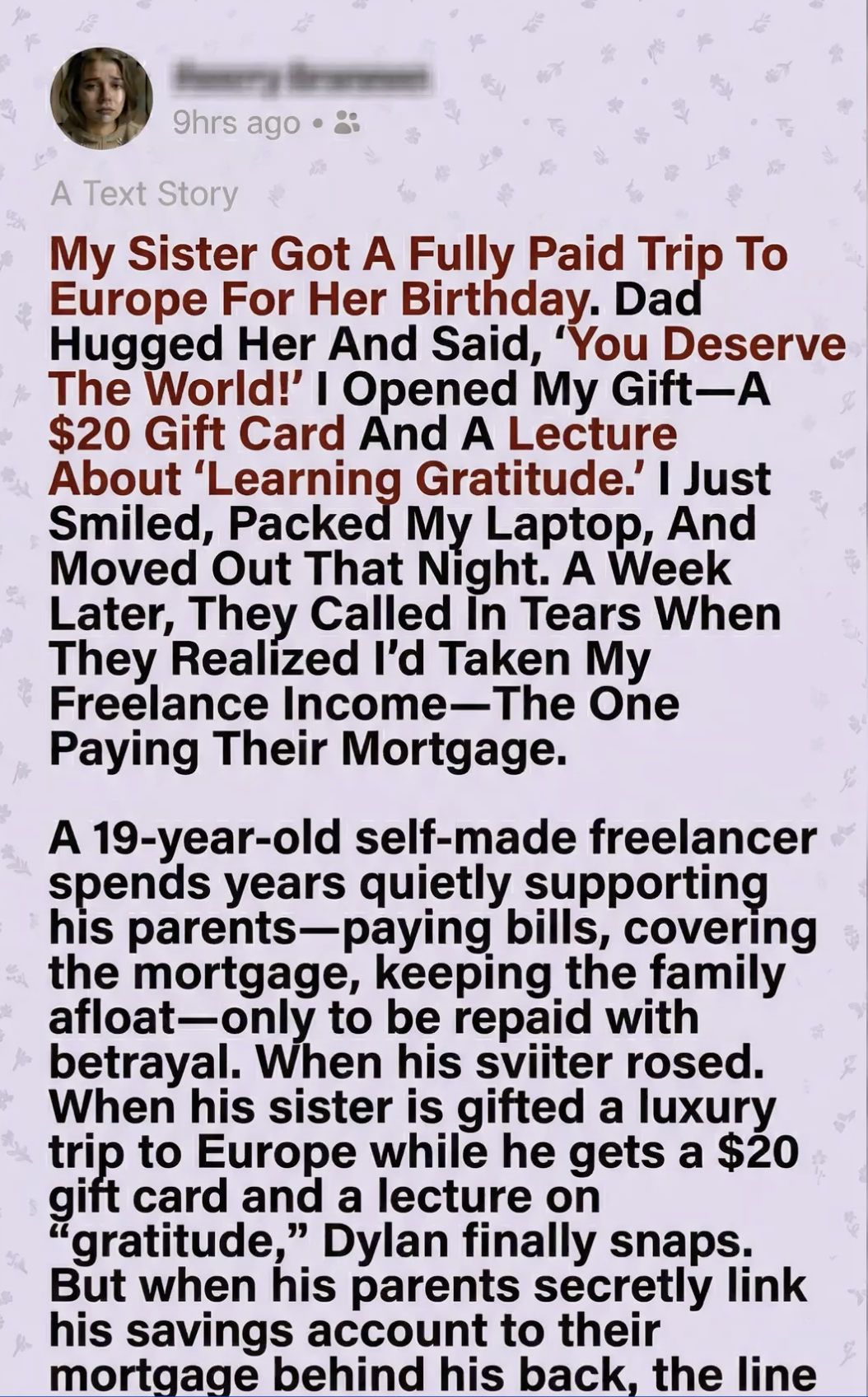
“And for Dylan,” Dad said, his voice dropping an octave into his ‘parenting’ tone. He slid a small, plastic card across the mahogany. It was a $20 Starbucks card. “We know you spend all day in that basement, so we thought you could use some fresh air. And Dylan? We noticed you’ve been a bit sullen lately. Use the walk to the coffee shop to practice some gratitude. You have a roof over your head, don’t you?”
Maya giggled, waving her Paris tickets like a fan. “Thanks, Dyl. For, you know, being the stable one so I can go explore.”
I didn’t argue. I didn’t yell. I just looked at the $20 card, smiled the most genuine smile I’d had in years, and said, “You’re right, Dad. I really do need to appreciate what I have.”
The Departure
That night, the house was silent, filled with the heavy sleep of people who felt secure.
I didn’t need much. I packed my two laptops, my server tower, and three suitcases of clothes. The beauty of being a “self-made freelancer” is that my office is wherever I plug in.
Before I walked out, I sat at my desk one last time. I logged into my bank portal. I saw the “Joint Mortgage Account”—the one my parents thought was magically replenishing itself via Dad’s “smart budgeting.” I saw a pending transfer: they had tried to link my private high-yield savings account to the mortgage as a “back-up” just two days ago, likely to fund Maya’s shopping spree in Europe.
I hit ‘Unlink.’ I hit ‘Close Account.’ I moved every cent of my freelance income into a private, encrypted business trust they couldn’t touch.
I left the $20 Starbucks card on the kitchen island with a sticky note: “Found my gratitude. It’s at a loft downtown. Good luck with the June payment.”
The Collapse
Six days later, the “Grateful Son” era ended.
My phone blew up at 10:00 AM. Seventeen missed calls from Dad. Three from Mom. A string of increasingly frantic texts from Maya.
I finally picked up.
“Dylan! Where the hell are you?” Dad’s voice was shaking, the bravado gone. “The bank called. The mortgage payment bounced. And when I went to check the joint account, it’s… it’s gone. Everything is gone!”
“Not everything, Dad,” I said, leaning back in my new ergonomically designed chair, looking out at the city skyline. “You still have the roof over your head. For about thirty more days, anyway.”
“Don’t you get smart with me! Move the money back! We already paid for Maya’s flight—we can’t be short on the house now!”
“That sounds like a ‘learning opportunity,’ Dad,” I replied calmly. “You told me to be grateful for what I have. I realized I have a highly marketable skill and a lot of capital. I decided to be grateful for my own hard work instead of being grateful for the privilege of subsidizing a sister who treats me like a furniture piece.”
“You’re making your sister cry! She’s supposed to leave tomorrow!” Mom wailed in the background.
“Then she can sell the tickets,” I said. “That should cover at least two months of the mortgage. Or she can practice some of that gratitude you mentioned. I hear it’s very fulfilling.”
I hung up. I didn’t block them—I wanted to see the notifications. I wanted to see the moment the “Golden Child” realized that her gold was actually just my sweat and code.
For the first time in nineteen years, the basement was empty, and I was finally breathing fresh air.